Martial Arts Near Me: What Should I Look For?
Typing martial arts near me into Google can produce a long list of schools within minutes. The difficult part isn't finding martial arts nearby. It's determining which school deserves your time and trust.
Kids Martial Arts Fremont: Choosing a Program
Parents searching for kids martial arts in Fremont have plenty of choices. Karate, Taekwondo, Brazilian Jiu-Jitsu, Kung Fu, Aikido, and other martial arts programs are available throughout the area.
Traditional Martial Arts Fremont: Why It Matters
People searching for traditional martial arts in Fremont may encounter schools using the word "traditional" in very different ways. Sometimes it refers to uniforms, Japanese terminology, bowing, or simply practicing a martial art that originated many years ago.
Aikido for Senior Beginners: A Safe Start
A fall, an uneven curb, or the sudden pull of an arm can feel more consequential as we get older. This is one reason why Aikido for senior beginners attracts people who want to move with greater confidence, not train for a fight. A good Aikido class offers measured physical practice, calm attention and practical skills that can support everyday balance, coordination and awareness.
Japanese Dojo Etiquette for Beginners Explained
The first few minutes at an Aikido class can feel more unfamiliar than the techniques. You may see students bow at the entrance, line up quietly, remove their shoes in a particular place and listen closely when the instructor speaks. Japanese dojo etiquette for beginners is not a test of whether they already know the rules. It is a practical way of creating a calm, safe training space where everyone can learn.
How to Fall Safely in Aikido for Beginners
A first Aikido class can make one concern very clear: throws only feel safe when both partners understand how to receive them. People often wonder how to fall safely in Aikido before they begin, and that instinct is sound. Safe falling is not an optional extra or a dramatic stunt. It is a foundational skill, taught patiently so that children and adults can train with confidence, respect their training partners and protect themselves.
Best Martial Arts Over 40 for Lasting Training
Starting martial arts after 40 is not about proving that you can train like you did at 20. It is about finding instruction that helps you move with more confidence, learn useful skills and continue training year after year. The best martial arts over 40 are usually the ones that match your current fitness, injury history, goals and willingness to practice patiently.
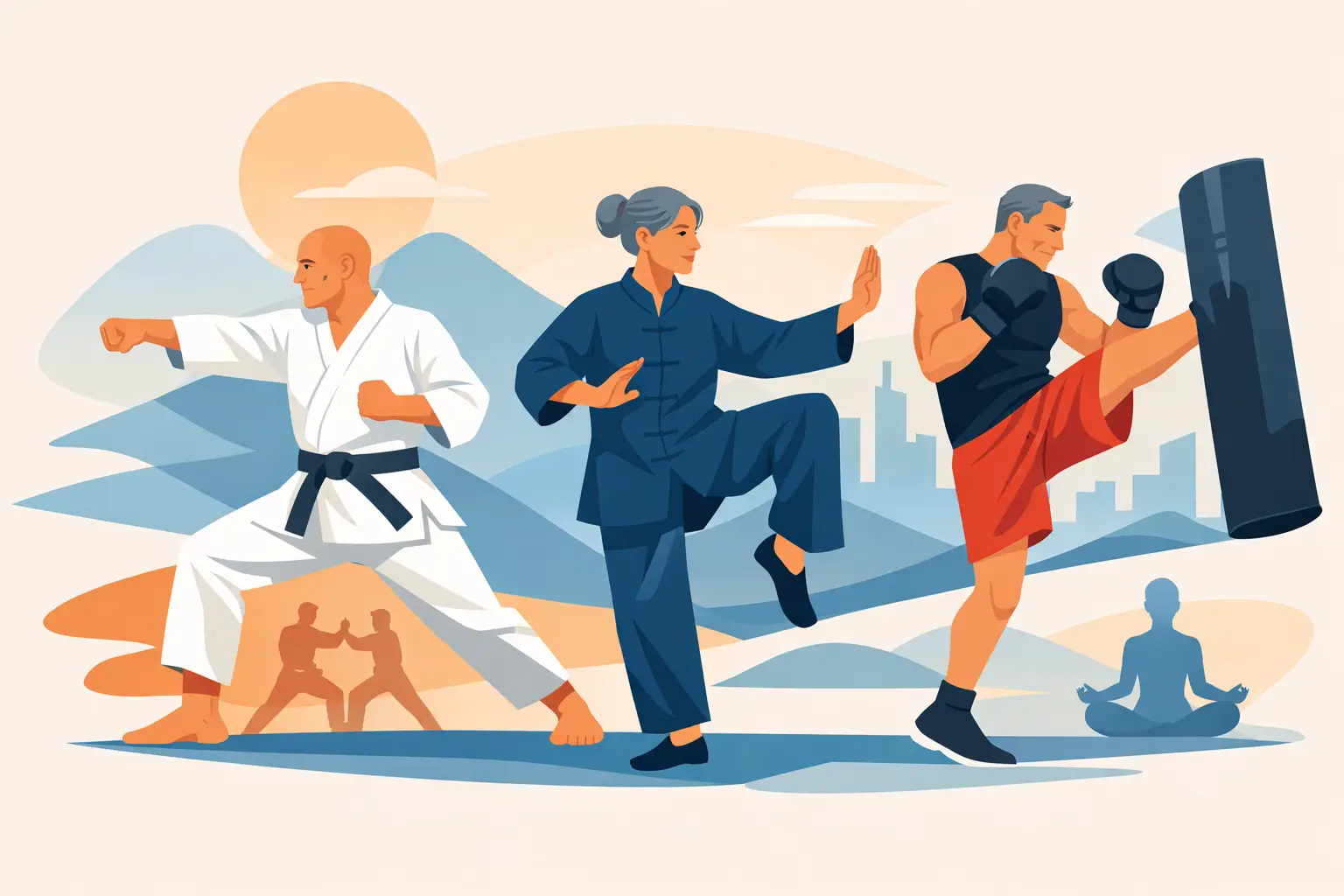
A good class should challenge you without treating discomfort as a badge of honor. It should teach sound body mechanics, give you time to understand each movement and provide training partners who value control and mutual respect. The style matters, but the quality and culture of the dojo matter just as much.
What makes a martial art suitable after 40?
Age alone does not decide what you can train. Many people begin in their forties, fifties or later and make excellent progress. However, mature beginners often have different priorities from younger students. They may want practical self-defense awareness, improved balance, a structured way to exercise or a discipline that helps them stay calm under pressure.
The right training environment recognizes those priorities. Warm-ups should prepare the body rather than simply exhaust it. Techniques should be taught progressively, with clear attention to posture, distance, timing and safe practice. A student should be able to ask questions, work at an appropriate pace and gradually build confidence with falls, rolls, partner exercises and more demanding movements.
It is also sensible to be honest about previous injuries. A history of knee, shoulder, neck or back problems does not automatically rule out martial arts, but it should affect how you begin. Seek appropriate professional medical guidance when necessary, then speak openly with the instructor. A responsible teacher can offer sensible modifications while still helping you train with purpose.
Best martial arts over 40: the main options
There is no single best answer for every adult. The most suitable art depends on whether you are drawn to striking, close-range grappling, traditional forms, self-defense skills or a combination of these.
Aikido for balance, awareness and controlled partner work
Aikido is often a strong choice for adults who want traditional martial arts training without a competition-focused culture. It develops balance, coordination, awareness, body alignment and the ability to respond to force with control rather than aggression. Students learn how to receive an attack safely, redirect force, apply joint controls, perform throws and use immobilizations with care.
Aikido also places real value on ukemi, the practice of falling and rolling safely. Learning to protect yourself when losing balance can be valuable beyond the dojo, although it must be introduced gradually. A well-run class does not expect a new student to take hard falls immediately. It teaches the foundations in stages, allowing the body and confidence to develop together.
The trade-off is that Aikido is not designed around competitive sparring or fighting matches. Those seeking regular full-contact testing may prefer another discipline or may choose to complement Aikido with striking or grappling training. For adults who value technical refinement, composure and long-term practice, its approach can be particularly rewarding.
Brazilian Jiu-Jitsu for close-range grappling
Brazilian Jiu-Jitsu, often called BJJ, teaches positional control, escapes, holds and submissions on the ground. It can suit adults who want practical experience dealing with close physical contact and who enjoy problem-solving under resistance. Because technique can reduce reliance on strength, it has appeal for students of many body types.
The caution is that live grappling can place sustained pressure on fingers, shoulders, knees and the neck. A thoughtful academy will pair newcomers carefully and encourage controlled rounds, but intensity varies widely between schools. Adults over 40 should look for a class where tapping early, training intelligently and protecting training partners are part of the culture rather than signs of weakness.
Judo for throws and physical conditioning
Judo develops grip fighting, throws, pins and strong movement under pressure. It offers excellent conditioning and a direct understanding of balance and off-balancing. Students who enjoy athletic partner training may find it highly engaging.
Judo can also be physically demanding, particularly because repeated throwing and falling are central to practice. Beginners need thorough instruction in breakfalls, and anyone with significant joint concerns should consider the pace carefully. The best Judo clubs adapt training for their members, but it may be a more physically demanding option than some adults want when first returning to martial arts.
Karate for striking and disciplined movement
Karate can be an excellent choice for adults seeking striking fundamentals, fitness, coordination and a clear traditional structure. Many schools teach stances, blocks, punches, kicks, forms and controlled partner drills in a way that allows students to progress steadily. It can be especially suitable for those who prefer remaining on their feet and appreciate focused individual practice.
The experience depends greatly on the school. Some Karate programs emphasize hard-contact sparring and fast, high kicks. Others place more weight on precise technique, controlled applications and sustainable training. A mature beginner does not need to chase flexibility or force beyond their present range of motion. Good instruction builds mobility over time.
Tai Chi and internal arts for movement quality
Tai Chi is sometimes chosen by adults who want improved posture, balance, breathing and calm concentration. Its slow forms can be accessible, and its emphasis on relaxed, connected movement can support other activities. For some people, it is the right first step back into regular physical practice.
However, not every Tai Chi class includes partner training or practical self-defense applications. If personal protection is an important goal, ask how the school teaches distance, timing, escapes and responses to physical contact. The name of a martial art tells you less than the actual curriculum and quality of instruction.
Choose the school, not only the style
A martial art can look ideal on paper and still be the wrong choice if the teaching culture is careless. Before enrolling, watch how the instructor corrects students. Are corrections calm and specific? Do experienced members take care of beginners? Is there an expectation of control during partner work? Are people allowed to progress at a sensible pace?
You should also ask practical questions. Find out whether the class includes beginners of a similar age, how instructors handle injuries and limitations, whether there is pressure to spar or compete and what a typical first few months looks like. A clear answer is reassuring. Vague promises about rapid belt advancement or guaranteed self-defense ability are not.
Traditional etiquette can be especially helpful for adult beginners when it is taught with warmth. Bowing, attentive listening, orderly practice and respect for partners create a focused atmosphere. They are not barriers to entry. They are habits that make training safer and more purposeful.
A sensible way to begin
Begin at a pace you can maintain and do not judge the experience by the first session alone. The early weeks may feel unfamiliar: the footwork is new, the body has to learn how to relax under instruction and even simple movements require attention. Consistency is more valuable than occasional all-out effort.
Give yourself permission to train within your limits. Tell your partner if a grip is uncomfortable. Rest when you need to. Practice the basics carefully rather than rushing toward advanced techniques. Martial arts progress is built through repetition, not through one impressive class.
For adults in Fremont and nearby Bay Area communities, Tri City Aikido offers a free introductory class so prospective students can experience the pace, etiquette and instruction before making a commitment. That first visit is a useful opportunity to see whether the dojo feels like a place where you can train steadily and be treated with respect.
The best choice is the art that you will return to next week, next season and next year. Choose a school where safety is active rather than assumed, where technique is valued over ego and where beginning after 40 is treated not as a limitation, but as the start of meaningful practice.
Best Martial Arts for Preschoolers: Parent Guide
A preschooler does not need to learn how to win a fight. They need a class where listening, moving safely, taking turns and trying again are part of every lesson. When parents ask about the best martial arts for preschoolers, the most helpful answer is not simply the name of a style. It is whether the instruction is genuinely designed for a four- or five-year-old child.