
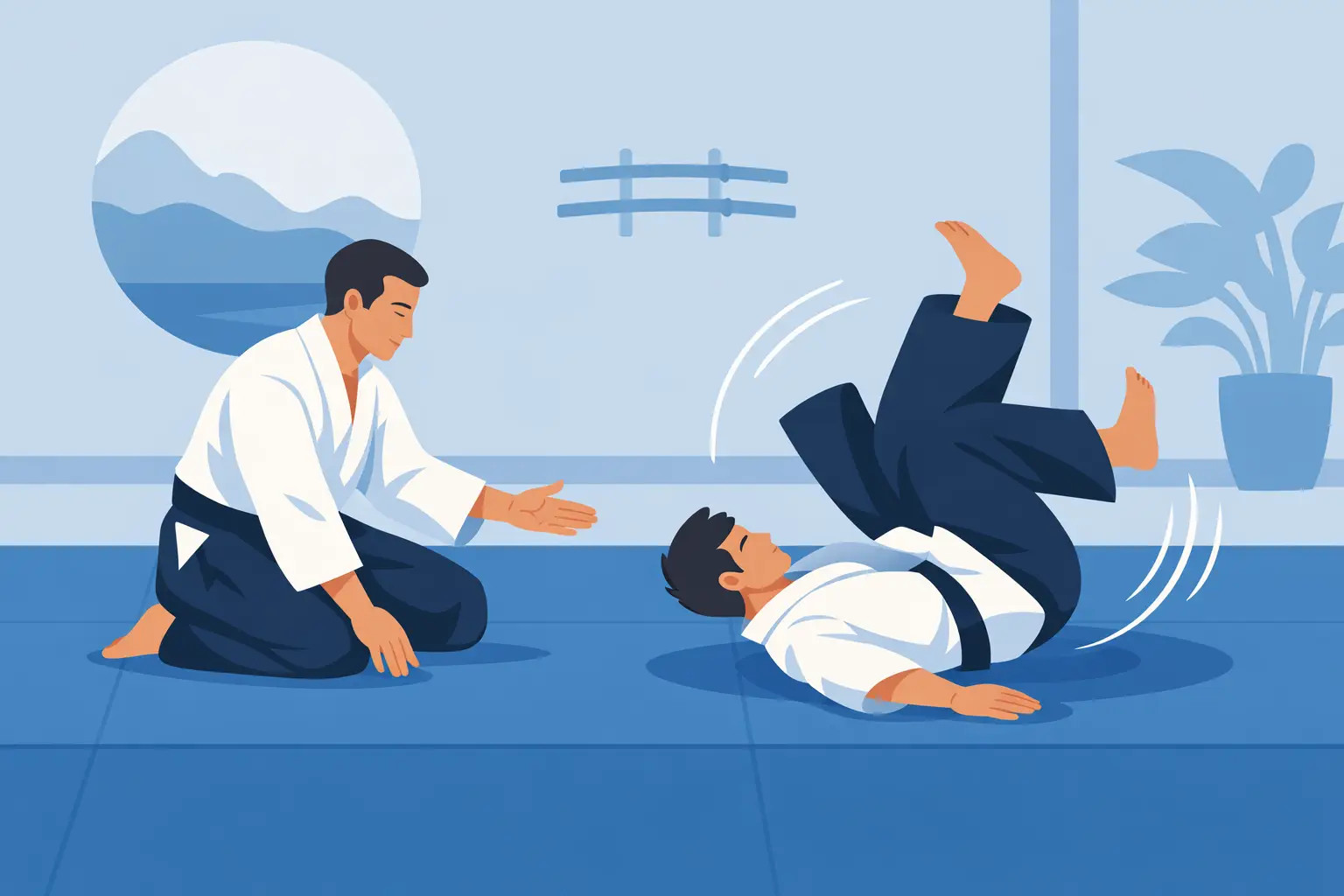
In Aikido, the art of receiving a technique is called ukemi. It includes falling, rolling, recovering your balance and responding intelligently to the movement of a throw or control. Good ukemi does not mean becoming passive. It means staying present, relaxed enough to move and disciplined enough to avoid panic.
How to fall safely in Aikido starts before the fall
The safest fall begins with posture and awareness, not with the moment your body reaches the mat. When the body stiffens, the impact of a fall can concentrate in vulnerable places such as the wrist, elbow, shoulder, hip or head. Aikido training teaches students to move with the direction of a technique rather than resisting until the last second, while learning how to receive contact with the mat safely.
That does not mean every fall should be large or fast. In fact, beginners should begin close to the ground under the supervision of an instructor. Controlled movements from kneeling or sitting allow students to learn proper body position without the added concern of height or speed. Only as those movements become comfortable and consistent should the training progress.
Several principles are emphasized during beginner ukemi. Students learn to protect the head, avoid unnecessary stiffness, maintain a rounded body position where appropriate and avoid trying to stop a fall with a locked arm. Just as importantly, they learn to breathe and remain aware throughout the movement. Holding the breath often makes the entire body tense at the exact moment it needs to move.
Begin with ground-level breakfalls
A breakfall is a method of receiving contact with the mat while reducing unnecessary impact on vulnerable parts of the body. Before attempting more advanced falls or rolls, beginners typically work close to the ground where movements can be practiced slowly and with control.
The backward breakfall
Backward falling practice is introduced progressively. Students learn how to keep the head protected, maintain an appropriate body position and allow the back and arms to contact the mat without trying to catch themselves with an outstretched hand.
The purpose is not to make a loud slap. A sharp sound can sometimes occur as a result of correct timing, but forcefully hitting the mat is not the goal. An instructor can help each student develop appropriate positioning based on body type, mobility and experience.
As confidence grows, the same principles can gradually be practiced from higher positions and eventually incorporated into partner training. There is no advantage in adding height or speed before the fundamental movement is comfortable.
The side breakfall
Side falling is also introduced close to the mat. Students learn how to receive the movement without trapping a leg underneath the body or attempting to stop themselves with a straight, locked arm. Proper positioning of the hips, shoulders, head and arms is developed through supervised repetition.
Side breakfalls are useful because many Aikido techniques direct the body diagonally rather than simply backward. Learning to move the hips and shoulders together helps students receive these movements with greater control.
Learn to roll along a curved path
Forward rolling ukemi is often what people picture when they think of Aikido. A smooth roll can carry momentum safely across the mat, but it should not be rushed. It is not a dive onto the shoulder, neck or head.
Beginners normally learn the shape of a roll close to the ground. The movement follows a curved path across the body rather than placing direct pressure on the head or neck. An instructor can guide the student through the correct position and make adjustments based on flexibility, confidence and body structure.
A useful early goal is simply to complete the movement with balance and control. Later, students learn to recover smoothly to their feet. This ability to recover matters as much as the roll itself. Ukemi is not merely about reaching the mat safely; it is about remaining aware and prepared to continue moving.
Each person's roll will look slightly different. A child with natural flexibility may round easily but still need reminders about control. An adult who has spent years at a desk may need more time to develop shoulder mobility and confidence. Neither situation is a problem. The appropriate pace is the one that allows sound technique without unnecessary pain or fear.
Work with a partner only when the basics are reliable
Once a student develops basic falling and rolling skills independently, partner practice can introduce direction, timing and gradually increasing movement. This stage requires clear communication. The person applying the technique, often called nage, has a responsibility to maintain control. The person receiving it, uke, must respond appropriately and protect themselves through proper ukemi.
At first, the person applying the technique may guide only the beginning of a movement while the receiving partner learns how and when to move safely. This lets both people understand the direction of the technique without forcing an outcome. As skill improves, ukemi becomes a more natural response to properly applied throws and off-balancing movements.
Do not try to prove toughness by taking a throw you are not ready to receive. If the speed, angle or pressure feels unsafe, communicate with your partner and reset. Good dojo training is cooperative in this essential sense: both students are responsible for helping each other learn safely.
Common mistakes that make falls riskier
One of the most common problems is trying to stop a fall with an outstretched hand. This is a natural reaction, especially outside the dojo, but it can place excessive force through the wrist, elbow and shoulder. In training, students gradually learn safer responses rather than relying on rigid bracing.
Another mistake is allowing the head to move into a vulnerable position during a backward fall. Protecting the head is one of the first priorities taught in beginner ukemi, and students should develop this habit at low speed before progressing.
Trying to copy advanced ukemi seen in demonstrations is equally unhelpful. High, fast falls can be impressive when performed by experienced practitioners, but they are the result of years of careful basics. Beginners build lasting confidence through low, controlled and repeatable movements.
Pain is also useful information. Mild effort as the body learns a new movement can be normal, but sharp pain, dizziness, numbness or ongoing joint discomfort should never be ignored. Tell the instructor immediately. Students returning after injury, surgery or a long break may need modified practice and should seek professional medical guidance when appropriate.
Safe falling for children and adult beginners
Children often learn ukemi through carefully structured movements, low-level rolls and clear routines. The aim is not to make a child fearless. It is to help them recognize instructions, manage their body in space and practice calm recovery when they lose balance. Those lessons support coordination, self-control and respect for others.
Adults sometimes bring a different concern: embarrassment. A beginner may worry about being less flexible, less athletic or slower than other students. A traditional dojo should give adults room to progress without that pressure. Safe falling is learned through repetition, not natural talent, and experienced students continue to practice ukemi throughout their training.
At Tri City Aikido, instruction is approached as a long-term discipline rather than a race to perform difficult throws. With patient supervision, students learn to make sensible decisions about distance, speed and readiness while training in the respectful spirit of Aikido.
Let ukemi build calm, not fear
Falling safely is a skill that grows one small movement at a time. Beginners start close to the mat, learn how to protect vulnerable areas of the body and progress only as their movement becomes comfortable and controlled. Over time, ukemi changes the feeling of training: a throw becomes less of a surprise and more of a coordinated interaction between two attentive partners.
The most useful next step is simple. Attend a class, tell the instructor that falling is new to you and allow yourself to learn slowly. Careful practice today creates the confidence to move more freely tomorrow.