
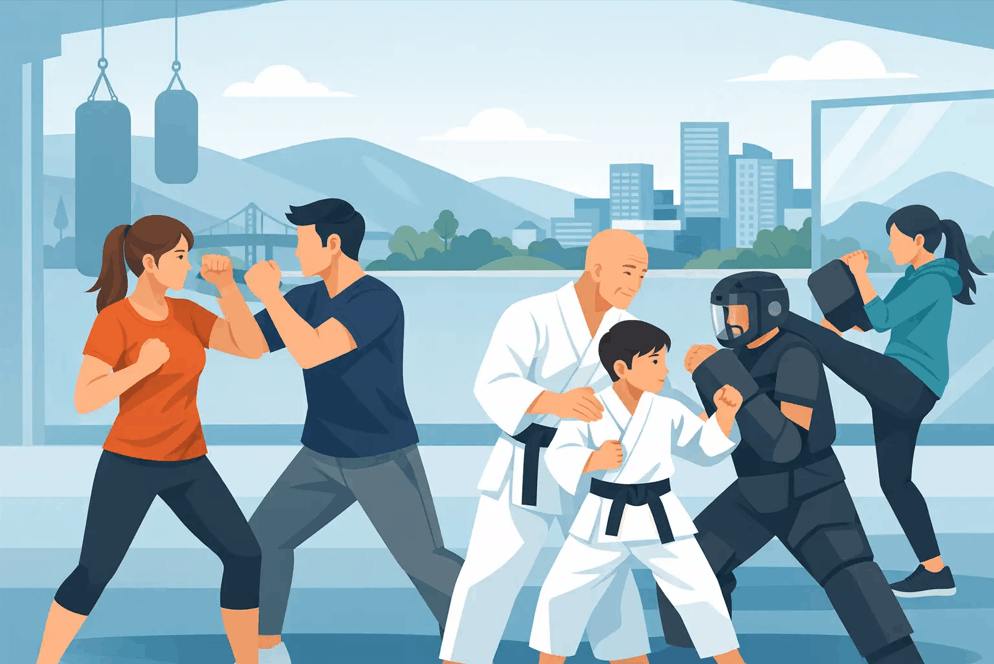
That's completely understandable. A traditional Japanese martial arts class can look unfamiliar from the outside. Students bow, use Japanese terminology, practice falling, work with different partners, and perform movements that a beginner may have never seen before.
The good news is that you aren't expected to know any of this before you begin. That's what classes are for.
You Don't Need Previous Martial Arts Experience
One of the most common concerns beginners have is that everyone else in class will already know what they're doing.
Experienced students will—but they were beginners once too.
You don't need previous experience in Aikido, Karate, Judo, Brazilian Jiu-Jitsu, or any other martial art before starting. In fact, many students walk into their first Aikido class having never practiced a martial art before.
A beginner should be taught from the beginning. Fundamental posture, movement, attacks, falling skills, etiquette, and techniques are developed progressively rather than assumed.
You Don't Need to Get in Shape First
Another common concern is physical conditioning.
People sometimes postpone beginning martial arts because they want to lose weight, become more flexible, or improve their endurance before attending their first class.
That reverses the process.
You don't get in shape so that you can start training. Training itself helps develop physical conditioning.
Aikido involves movement, getting up and down from the mat, balance, coordination, flexibility, and repeated practice. Your body gradually adapts as your experience increases.
Everyone begins from a different starting point, and improvement should be measured from there.
Your First Class Will Introduce Basic Movement
Aikido techniques can become sophisticated, but beginners don't start with the most difficult material.
Early training generally introduces fundamental ways of standing and moving, maintaining balance, changing position, interacting with a training partner, and receiving techniques safely.
These basics may initially seem simple, but they form the foundation for everything that follows.
As students become more experienced, they discover that many advanced techniques depend upon the same fundamental movements they learned as beginners.
Learning How to Fall Is Part of Aikido
If you watch an Aikido class, you'll probably notice students rolling and falling frequently.
This practice is called ukemi.
Ukemi teaches students how to safely receive techniques. Rather than simply being thrown to the ground, students progressively learn how to protect themselves, maintain awareness, and move with the forces created during training.
Beginners aren't expected to perform dramatic falls immediately. Falling skills should be introduced gradually so confidence and coordination develop together.
Over time, ukemi becomes an important skill in its own right.
You Will Train With Other People
Aikido is primarily partner training.
One person attacks while the other practices the technique. The roles then reverse so both students have an opportunity to learn each side of the interaction.
You'll also work with different people throughout your training.
This is important because everyone moves differently. People vary in height, weight, strength, flexibility, speed, experience, and the way they attack.
A technique that works comfortably with one training partner may expose weaknesses when practiced with someone else. Working with many partners teaches students to adapt rather than becoming accustomed to one person's movements.
Cooperative Training Doesn't Mean Fake Training
Aikido students cooperate because both people need to practice safely. That cooperation is sometimes misunderstood.
The attacker's job isn't to make the other person's technique work.
A proper attack gives the student performing the technique something meaningful to work with. As experience increases, attacks can become stronger, faster, and more difficult while still maintaining enough control for both people to continue learning.
The objective is not to defeat your training partner. It is to develop technique that increasingly depends upon correct timing, positioning, movement, and balance rather than your partner's willingness to fall.
Japanese Words Will Become Familiar Naturally
Traditional Aikido uses Japanese terminology for techniques, attacks, training roles, weapons, and dojo customs.
You don't need to memorize a Japanese vocabulary list before attending class.
Words become familiar through repetition. You hear a term while watching a technique, practice the movement, hear the term again the following week, and eventually associate the word with what you're doing.
The same process has introduced generations of students around the world to Aikido terminology.
Dojo Etiquette Is Learned Too
Bowing and other traditional customs can initially make a dojo seem formal to someone unfamiliar with Japanese martial arts.
Beginners aren't expected to arrive knowing every rule.
Dojo etiquette is taught just like technique. Watch the instructor and experienced students, ask when you're uncertain, and gradually the customs become familiar.
The purpose isn't to create unnecessary ceremony. Etiquette establishes respect, order, attention, and responsibility in an environment where people are practicing martial techniques together.
You Will Make Mistakes
This may be the most important thing for a beginner to understand.
You are supposed to make mistakes.
Your feet will occasionally end up in the wrong place. You may move in the wrong direction, forget the name of a technique, lose your balance, or watch an instructor demonstrate something and then immediately forget what you just saw.
That's normal.
Aikido is learned through repetition. Mistakes give the instructor something to correct, and those corrections gradually become part of your movement.
No legitimate instructor expects a first-day student to perform like an experienced practitioner.
What Should You Wear?
For a first lesson, comfortable clothing that allows unrestricted movement is generally sufficient unless the dojo tells you otherwise.
Once students begin regular training, they typically wear a martial arts uniform called a gi.
Aikido is normally practiced barefoot on the training mat, so special athletic shoes aren't required.
Before visiting any school, check its individual requirements so you know what that dojo expects from first-time students.
What Should You Look for During Your Visit?
If you've found several results while searching for Aikido classes near me, use your first visit to evaluate more than the techniques.
Pay attention to how the instructor treats beginners. Watch how experienced students interact with less experienced students. Notice whether people train seriously while still appearing comfortable with one another.
Ask yourself whether the instruction makes sense and whether you feel comfortable asking questions.
Aikido can become a long-term pursuit. The people and environment surrounding your training therefore matter considerably.
Try an Aikido Class in Fremont
Tri City Aikido has taught Traditional Japanese Aikido in the Fremont area for more than 30 years. We offer training for children and adults with an emphasis on fundamentals, practical application, disciplined practice, partner safety, and continued development.
If your search for Aikido classes near me brought you here, the next step doesn't require making a long-term commitment.
Come experience a free guest lesson.
Meet the instructor, step onto the mat, work with some of our students, and experience Aikido for yourself. You'll understand far more after participating in one class than you could learn from simply reading about it.