Those things can certainly be part of tradition, but they don't completely explain what makes a martial art traditional.
At Tri City Aikido, tradition means maintaining a connection to the principles, training methods, lineage, etiquette, and martial understanding that shaped the art while continuing to develop our ability to apply those principles today.
Traditional Doesn't Mean Refusing to Change
One misunderstanding about traditional martial arts is that students simply repeat old movements because that's the way they have always been performed.
That isn't the purpose of tradition.
A martial tradition preserves knowledge. Techniques, training methods, etiquette, weapons, and relationships between teachers and students provide a framework through which that knowledge is passed from one generation to another.
Students are still expected to question their own movement, correct weaknesses, improve their understanding, and make their technique increasingly effective.
Tradition gives us a foundation. Training determines what we are able to build upon it.
Lineage Connects Students to the Art
Traditional Japanese martial arts place importance on lineage because martial knowledge has historically been transmitted from teacher to student.
Aikido was developed by Morihei Ueshiba, commonly called O-Sensei. His students carried the art into different regions of Japan and eventually throughout the world.
Those students did not all practice identically. Different teachers emphasized different aspects of what they had learned, which is one reason Aikido today can look different from one organization or dojo to another.
Understanding a school's lineage helps explain where its approach to Aikido came from.
Tri City Aikido maintains ties to the Kumano and Shingu tradition through Kumano Jyuku. That connection is important because it provides continuity between the Aikido we practice today and the teachers who developed and preserved this approach before us.
The Dojo Is More Than a Training Room
A traditional dojo isn't simply a room with mats where martial arts happen to be practiced.
The word carries a deeper meaning associated with a place of study and development.
Students learn that entering the dojo brings responsibilities. The training area is treated with respect. Training partners are treated with respect. The instructor is treated with respect. Students are expected to contribute to the environment rather than behave as though they are simply purchasing access to a service.
These expectations help create a culture in which serious training can take place.
Why Do Students Bow?
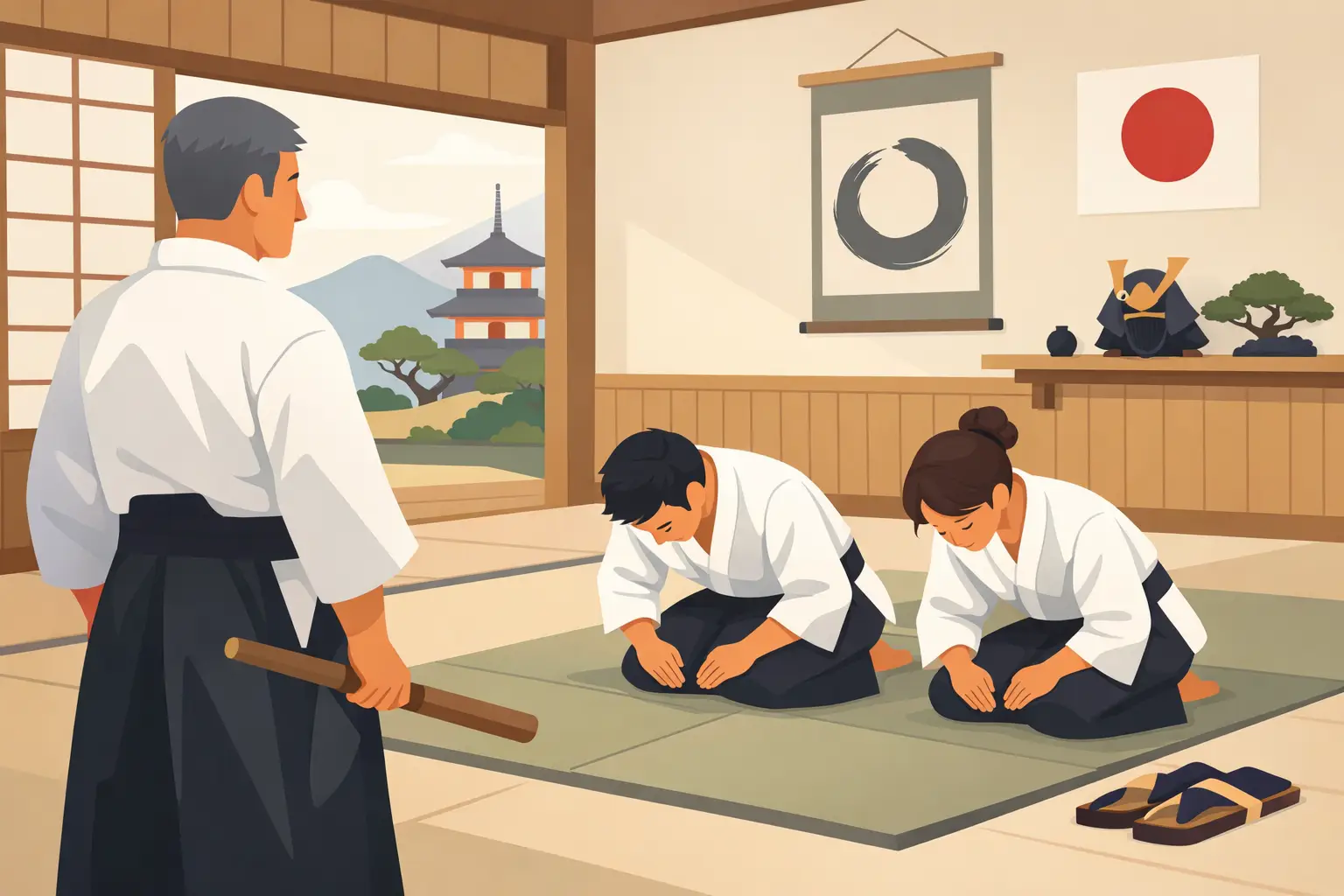
Bowing is one of the most visible customs in Japanese martial arts and one of the easiest for newcomers to misunderstand.
A bow is fundamentally an expression of respect and acknowledgement.
Students may bow when entering the dojo, stepping onto the mat, beginning class, training with a partner, and finishing practice.
These customs aren't intended to make one person feel inferior to another. They establish a shared standard of courtesy and remind students that both people have responsibilities during training.
When practicing techniques capable of causing injury, that mutual respect has practical value.
Etiquette and Martial Training Belong Together
Traditional etiquette can sometimes appear unrelated to self-defense or martial ability.
In reality, many dojo customs develop habits that directly support training.
Students learn to pay attention when instruction begins. They become aware of where other people are moving. They learn to control their behavior around training partners and take responsibility for another person's safety.
They also learn that experience carries responsibility. Senior students aren't simply people who know more techniques. They are expected to help maintain the standards of the dojo and assist less experienced students.
Etiquette therefore becomes part of how the training environment functions.
Traditional Training Requires Repetition
Martial arts techniques are not learned simply by understanding them intellectually.
The body has to learn them.
Students therefore practice fundamental movements and techniques repeatedly. A technique performed hundreds or thousands of times gradually reveals details that weren't apparent during the first few attempts.
Balance changes. Timing improves. Unnecessary muscular effort begins to disappear. Footwork becomes more precise. Students start recognizing opportunities that previously went unnoticed.
Repetition isn't intended to produce mindless imitation. Proper repetition creates the experience necessary to understand what the technique is actually teaching.
Weapons Help Preserve Aikido's Martial Origins
Weapons training is another important part of our approach to Traditional Aikido.
The bokken, a wooden practice sword, and the jo, a wooden staff, help students understand distance, timing, posture, direction, awareness, and whole-body movement.
Weapons can also clarify the origins of movements that appear in empty-hand techniques.
A movement that seems unusual when practiced empty-handed can make considerably more sense when the student recognizes its relationship to a sword or staff.
This relationship helps preserve the martial logic behind the movement rather than allowing technique to become an empty physical pattern.
Tradition Does Not Mean Choreography
Cooperative training is necessary in Aikido because students need partners in order to practice techniques safely.
But cooperation shouldn't mean that the attacker simply performs whatever movements are necessary to make a technique succeed.
A proper attack creates the reason for the technique.
As students develop, they should become increasingly capable of working with attacks that have genuine direction and intent. The person performing the technique must learn to recognize the opening created by the attack and respond through appropriate movement, timing, and positioning.
If a technique only works because the training partner has agreed to make it work, an important part of the martial lesson has been lost.
There Is No Competition at Tri City Aikido
Traditional Aikido at Tri City Aikido does not include tournaments or competitive matches.
That doesn't mean students aren't challenged.
The challenge is different.
Students work to improve their technique against increasingly demanding attacks while maintaining control and protecting their training partners. Progress is measured through technical development rather than victories over classmates.
This allows students of different ages, sizes, and experience levels to train together while pursuing the same underlying principles.
The Teacher-Student Relationship Matters
Traditional martial arts have always depended upon people, not simply information.
A book can describe a technique. A video can demonstrate one. Neither can feel what you're doing and tell you why your balance is wrong.
An experienced instructor can recognize problems that the student doesn't yet have enough experience to see.
Over years of training, that relationship changes. Students become more capable of recognizing their own errors, asking more sophisticated questions, and accepting greater responsibility for their development.
Eventually, some become responsible for passing what they have learned to another generation.
Tradition Must Remain Alive
A traditional martial art cannot survive simply by preserving terminology, uniforms, photographs, and ceremonies.
The art has to live in the people practicing it.
Every generation receives something from the teachers before them. Their responsibility is to study it seriously, understand it as deeply as possible, preserve what is valuable, and eventually pass that knowledge forward.
That process is what keeps tradition alive rather than turning it into history.
Traditional Martial Arts in Fremont
Tri City Aikido has practiced and taught Traditional Japanese Aikido in the Fremont area for more than 30 years.
Our training emphasizes martial principles, disciplined practice, proper attacks, partner safety, weapons training, etiquette, technical development, and respect for the lineage through which our Aikido was transmitted.
But the word "traditional" isn't something we expect prospective students to accept simply because we use it.
Come see what it means.
Visit the dojo, watch a class, meet the instructor, ask questions, and experience a free guest lesson. Traditional martial arts are ultimately understood through practice, and the best way to determine whether our approach is right for you is to step onto the mat and experience it yourself.