
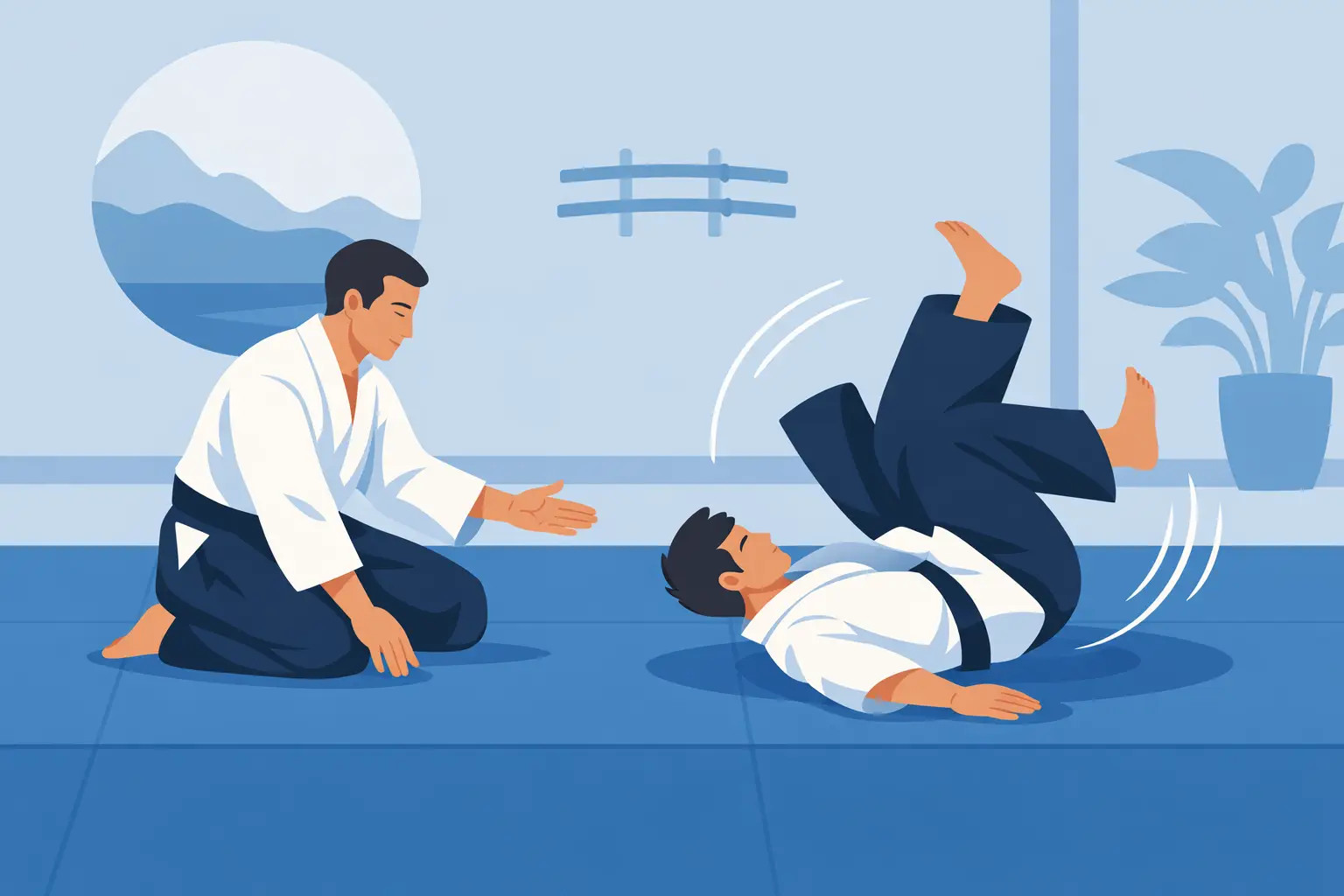
The word Aikido is often translated as “the way of harmonizing energy.” Although that description reflects part of the art’s philosophy, Aikido is still a martial art. Its techniques developed from older Japanese fighting systems and were designed to address grabs, strikes, and other forms of physical aggression.
What Is the Purpose of Aikido?
The purpose of Aikido is not simply to collect techniques. Training develops a person’s ability to recognize movement, maintain proper distance, protect their balance, and respond without hesitation.
Instead of colliding directly with an attack, students learn to move away from its strongest line and enter from a more favorable position. This can make it possible to control a larger or stronger person without attempting to overpower them muscle against muscle.
Aikido also teaches restraint. The goal is not to create unnecessary damage or prove who is tougher. A student should learn how to control a dangerous situation while remaining aware of the surrounding environment and the amount of force being used.
How Is Aikido Practiced?
Aikido is normally practiced with a partner. One student takes the role of the attacker, known as uke, while the other practices the technique as nage. The students then change roles so both can learn the attack, the response, and the safe way to receive the technique.
Training commonly includes:
- Footwork and body movement
- Throws and controlling techniques
- Joint locks and pins
- Escapes from grabs
- Responses to strikes
- Balance, posture, and distance
- Safe falling and rolling
- Wooden sword and staff practice
Students begin with structured exercises so they can learn safely and understand the mechanics of each movement. As their ability improves, the attacks can become more committed and the training more demanding.
Is Aikido a Sport?
Traditional Aikido is generally practiced without tournaments, competitive matches, or trophies. Students do not train to defeat one another for points. They work together so both partners can improve.
That cooperative structure does not mean the training lacks seriousness. A proper attack must have direction and intent. Without a sincere attack, the person practicing the technique cannot learn correct timing, positioning, or control.
The absence of competition also allows students of different ages, sizes, and experience levels to train together. Progress is measured by personal development, technical improvement, and the ability to perform under increasing pressure.
Does Aikido Require Strength or Previous Experience?
Aikido does not require previous martial arts experience. Most students begin without knowing how to fall, move, attack, or perform a technique. These skills are introduced gradually.
Physical strength can be useful, but it should not replace proper movement. A student who depends only on strength may struggle against someone larger or may lose balance while trying to force a technique. Aikido training teaches students to use posture, leverage, timing, and body position more efficiently.
This makes Aikido approachable for many adults and children, including people who do not consider themselves especially athletic. Each student develops at an individual pace through consistent practice.
What Can Aikido Training Develop?
People begin Aikido for many different reasons. Some are interested in self-defense. Others want exercise, greater confidence, improved coordination, stress relief, or a traditional martial arts experience.
Regular training can help develop:
- Balance and coordination
- Physical awareness
- Flexibility and mobility
- Concentration
- Confidence
- Discipline and patience
- Calm decision-making under pressure
These qualities do not appear after one or two classes. Aikido is a long-term practice in which improvement comes through repetition, observation, correction, and continued effort.
Traditional Aikido in Fremont
Tri City Aikido provides traditional Japanese Aikido instruction for Adults and children ages (Ages 4-6), (Ages 7-9), (Ages 10-13) in Fremont, California. The dojo also serves students from Newark, Union City, Hayward, Milpitas, San Jose, and other surrounding communities.
Beginners are welcome, and no previous martial arts experience is required. New students are introduced to the fundamentals of movement, posture, falling, and partner practice in a structured training environment.
The best way to understand Aikido is to experience it directly. Tri City Aikido offers a free guest lesson for prospective students who would like to observe the dojo, meet the instructor, and participate in a class.