
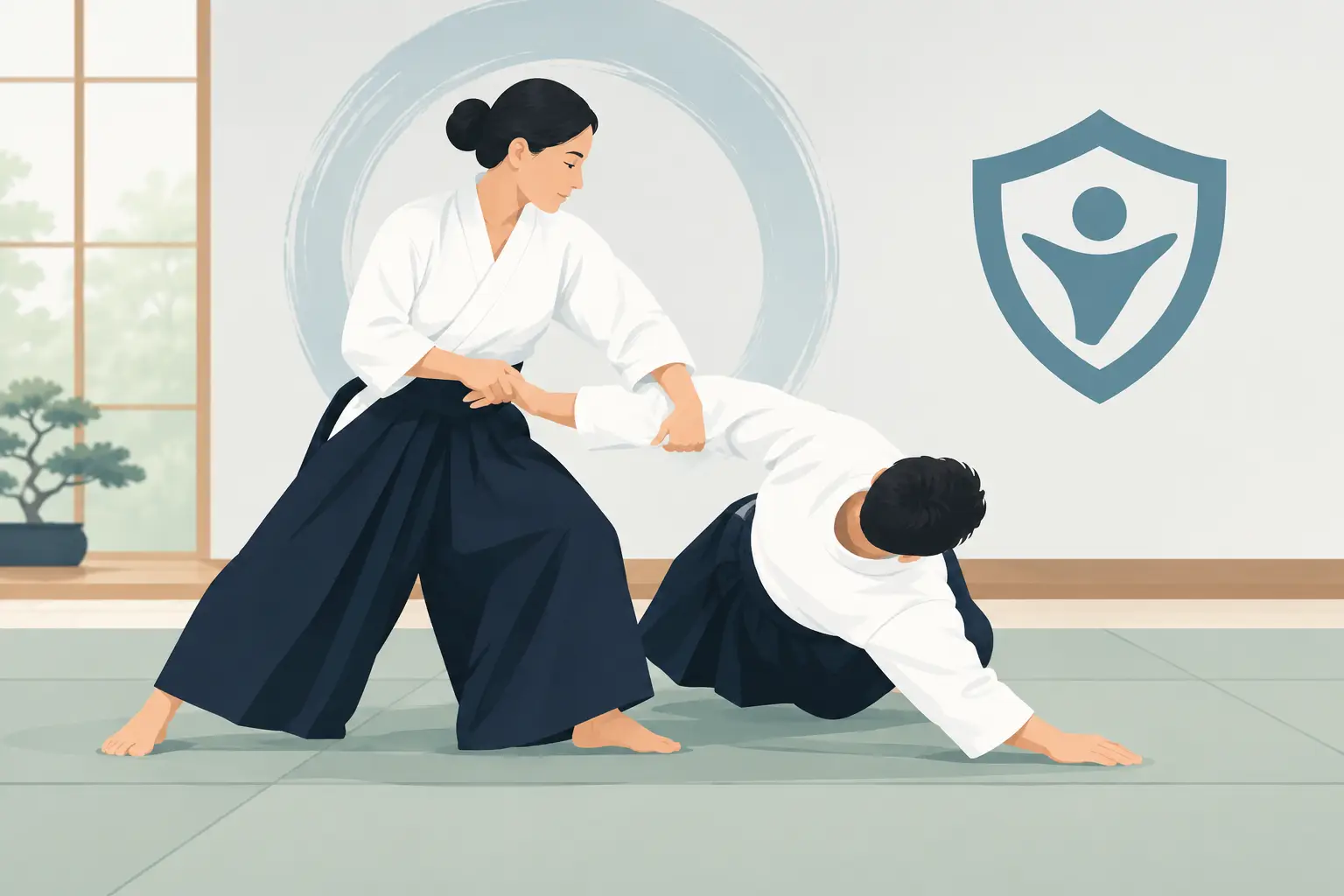
At Tri City Aikido, students are not competing against one another. Training is cooperative. Your partner's job isn't to defeat you, prove that a technique works or see how much discomfort you can tolerate. Both people are there to learn.
That approach allows beginners to develop their skills gradually while learning one of the most important lessons in Aikido: how to protect yourself while receiving a technique.
Learning How to Fall Is Part of Learning Aikido
Before beginners need to worry about spectacular throws, they learn something much more useful: how to meet the mat safely.
This is called ukemi, or receiving the technique.
Ukemi includes learning how to roll, fall, move with a technique and protect the body when your balance has been taken. Beginners aren't expected to walk into their first class knowing how to do any of this. Ukemi is practiced daily in the adult aikido classes.
We teach it.
Students begin with basic movements and progress as their ability and confidence improve. A new student doesn't need to perform the same falls as someone who has been training for years.
Learning to fall isn't just preparation for Aikido techniques. It teaches students to remain relaxed and responsive when their balance is disrupted instead of becoming stiff and fighting the fall.
You Don't Have to Keep Up With the Black Belts
This is important for new students.
When you watch experienced Aikido practitioners train, techniques may be fast and the falls may look dramatic. That's the result of years of practice between people who understand what each other can handle.
That's not how we expect a beginner to train.
Experienced students adjust their speed and intensity when working with someone new. Techniques can be practiced slowly enough for the beginner to understand the movement and learn how to respond safely.
As your skill improves, the pace can increase.
There is no prize for progressing faster than your body or ability allows.
Aikido Is Cooperative, Not Competitive
One of the things that makes Aikido different from many martial arts is that we don't have competitions.
There are no tournaments at Tri City Aikido. You don't earn points by throwing someone harder, forcing a submission or beating your training partner.
That changes the relationship between the two people practicing.
One person performs the technique while the other provides an attack and receives it. Then the roles change. Both students are responsible for helping each other improve.
That doesn't mean the training has to be unrealistic or weak. As students progress, attacks can become more committed and techniques more dynamic. But intensity is added with experience and control.
The objective isn't to overpower your partner. It is to learn how movement, balance, timing, position and leverage allow the technique to work.
Joint Techniques Require Control
Aikido includes wrist, elbow and other joint controls. These techniques can be extremely effective, which is exactly why control matters during practice.
Pressure should be applied gradually so the person receiving the technique has time to respond.
Students also learn to tap when enough pressure has been applied. When your partner taps, the pressure stops.
There is nothing to prove by pushing a technique farther.
This is another area where experience matters. Senior students understand that working with a beginner requires a different level of sensitivity than training with another advanced practitioner.
Strength Shouldn't Be Used to Force Technique
Beginners sometimes assume that the safest way to protect themselves is to become stiff and resist everything their partner does.
Ironically, excessive resistance can make training less predictable.
Aikido teaches students to become responsive rather than rigid. We use movement, balance and leverage instead of simply trying to overpower another person.
This is also why you don't have to be especially strong to begin training. Proper technique teaches you how to use the body efficiently and travel down the path of least resistance.
As students become more experienced, they learn when resistance is useful and how to provide an attack that gives their partner meaningful practice without turning every technique into a wrestling match.
Weapons Training Is Taught With the Same Control
Traditional Aikido also includes training with the bokken (wooden sword) and jo (staff).
Our Aikido weapons training helps students develop distance, timing, posture, movement and awareness.
Beginners start with basic movements and learn how to handle the weapons correctly before progressing to more advanced exercises.
Speed without control isn't the objective. Good weapons practice requires awareness of your surroundings, your partner and the distance between you.
The Training Partner Makes a Difference
One of the advantages of training in an established dojo is that beginners aren't left to figure everything out themselves.
Experienced students remember what it was like to be new.
They know when to slow down, when to give someone more room to move and when a beginner needs another opportunity to try the technique.
That's part of the culture we want on our mat.
A black belt who can throw another black belt across the dojo hasn't demonstrated much by doing the same thing to someone attending their third class. Skill includes being able to adjust your Aikido to the person standing in front of you.
A Traditional Dojo Should Be a Place Where You Can Learn
Etiquette and discipline also contribute to safer training.
Students listen while techniques are demonstrated. Partners bow to one another before practicing. Weapons are handled deliberately. Students learn where they should be and what is expected of them.
These traditions aren't there simply because Aikido is Japanese. They help create an orderly training environment where everyone can concentrate on learning.
It's part of what makes a traditional dojo different.
So, Is Aikido Safe for Beginners?
No martial art or physical activity can promise that an injury will never happen. But beginners should not be expected to perform beyond their ability, tolerate unnecessary pain or prove themselves against experienced students.
At Tri City Aikido, we teach students progressively. You learn how to move, how to fall, how to receive technique and how to work with another person before greater speed and intensity are introduced.
Most importantly, you don't have to be in shape, know how to fall or have previous martial arts experience before you start. That's what training is for.
If you've been interested in Aikido but have hesitated because you're concerned about falling or getting injured, come watch a class or try one for yourself. Your first class isn't a test of what you can already do. It's the beginning of learning how to do it.