
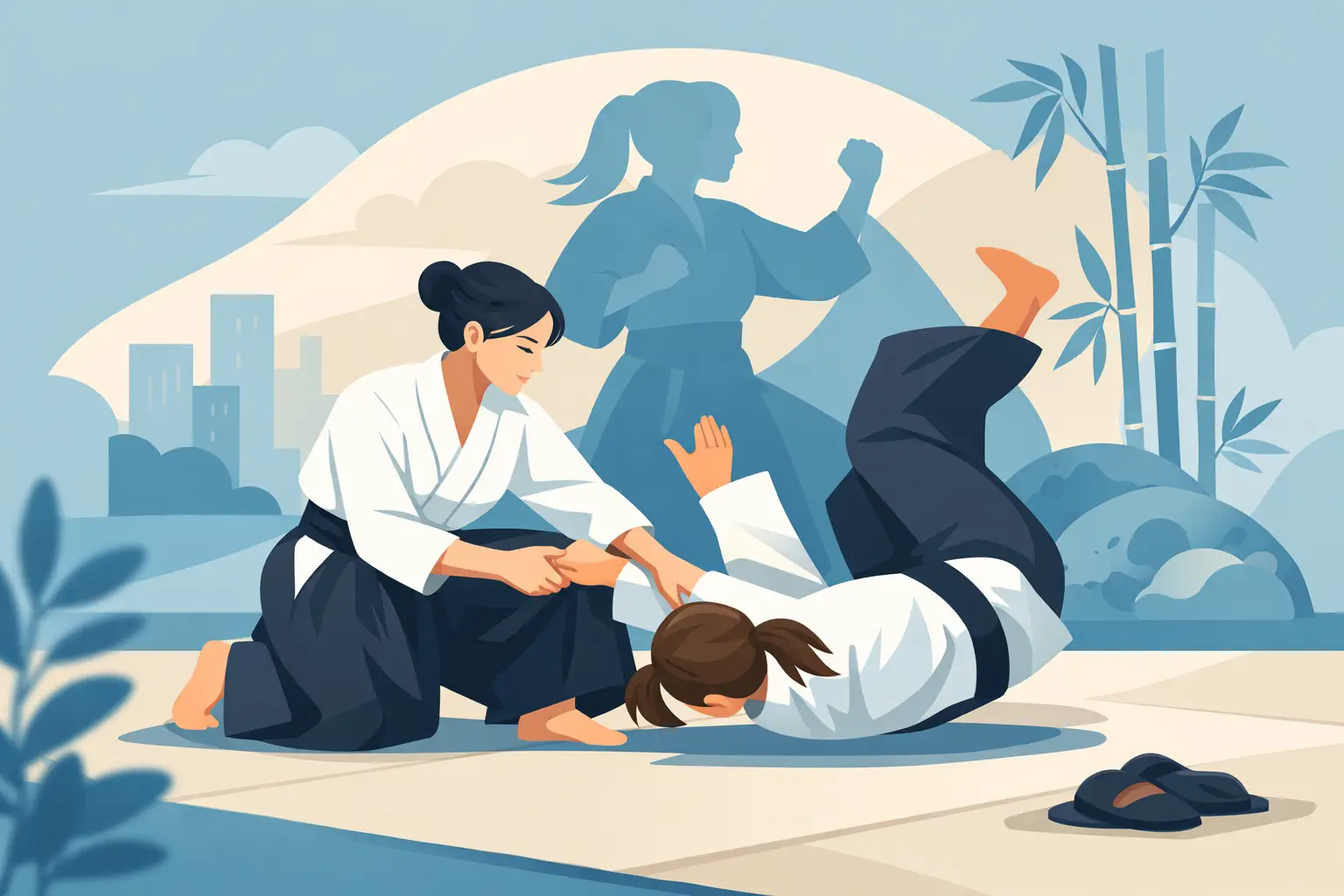
For many women, the question is not whether they want to become aggressive or physically dominate another person. They want to feel less vulnerable when walking to a car, traveling, working late or navigating an uncomfortable interaction. Aikido offers a disciplined setting in which to develop useful physical and mental habits without adopting a competition-focused or confrontational training culture.
What women often want from self-defense training
Practical self-defense starts well before a physical encounter. Good training should help students recognize when something feels wrong, use their voice clearly, maintain distance where possible and leave early rather than staying to prove a point. Avoidance and escape are successful outcomes. There is no prize for remaining in a situation that can be safely left.
Women also need training that respects different starting points. Some arrive with sporting experience; others have not exercised regularly for years. Height, strength, mobility and past experiences can affect what feels comfortable. A welcoming dojo does not treat these differences as weaknesses. It teaches principles that can be adapted through steady practice while allowing students to progress at a safe and sensible pace.
Aikido is particularly suited to people who value long-term development. Rather than relying only on strength or speed, students study posture, timing, angle, connection and efficient movement. These are skills that can become more reliable through repetition, including for mature adults who want to train consistently without a culture of hard sparring or trophies.
How Aikido self-defense for women is trained
Traditional Aikido practice usually begins with the fundamentals: how to stand, move, turn, maintain distance and receive an attack without panicking. Partners train cooperatively at first so that both people can learn safely. As understanding develops, the speed, timing and intensity of practice may increase, but control and respect remain essential.
The aim is not to trade blows. Aikido teaches students to move off the line of an incoming attack, redirect force where possible and use joint controls, off-balancing and pins to create an opportunity to disengage. A throw may be part of training, but its purpose is not spectacle. It teaches positioning, timing and the consequences of losing balance.
Safe falling is a practical skill
One of Aikido's most valuable foundations is ukemi, the practice of receiving a technique through safe falling and rolling. Falling well does not make a person invulnerable, and it is not an invitation to take unnecessary risks. It can, however, improve body awareness, confidence in movement and the ability to avoid stiffening or bracing poorly when balance is lost.
For beginners, ukemi is introduced progressively. Students first learn low, controlled movements and advance only when they are ready. This patient approach matters, especially for adults returning to exercise, people with concerns about their joints or anyone who feels nervous about falling.
Calmness is trained, not assumed
Fear can narrow attention and make the body rigid. No class can recreate every real-world situation, but repeated, supervised practice can help students become more familiar with pressure, close distance and physical contact. The experience of responding to a partner's movement while staying upright, breathing and making choices has value beyond the individual technique.
This does not mean a student should expect perfect composure in an emergency. It means they have practiced returning to useful basics: create space, keep moving, protect balance, use a clear voice and look for a route away.
What Aikido can offer in a real self-defense context
Aikido can support personal safety in several meaningful ways. It develops posture and movement, which may help a person avoid becoming fixed in place when startled. It teaches sensitivity to grips and directional pressure, useful when someone is trying to pull, push or restrain. It also builds the judgment to avoid forcing a technique when escape is available.
The non-competitive nature of traditional Aikido is important for many students. Training partners are not opponents to defeat. They are people with whom one practices attentiveness, control and responsibility. That atmosphere can make it easier for beginners to ask questions, make mistakes and continue training long enough for their skills to improve.
There is also a quieter benefit: consistency. A woman who attends class over months and years becomes more accustomed to taking up space, making decisions with her body and staying present during unfamiliar movement. Confidence is not the same as fearlessness. It is the knowledge that one can respond with more options than simply freezing.
The limits of Aikido as self-defense
Honest self-defense education must include limits. Aikido techniques require practice, and they do not work like buttons that can simply be pressed under stress. A larger, stronger or highly aggressive attacker can be difficult to control. Uneven ground, confined spaces, multiple attackers and weapons increase danger significantly. No martial art can guarantee safety.
Aikido also differs from training systems that place a heavier emphasis on striking, grappling against full resistance or competitive sparring. For some people, those methods may be a useful complement, particularly if their goals include testing performance under a different kind of pressure. The best choice depends on the individual, the quality of instruction and what they can train consistently.
For personal safety, the sensible priorities remain awareness, boundaries, avoidance, escape and seeking help. Physical techniques are a last layer of preparation, not the first plan. A responsible dojo should say this clearly rather than presenting martial arts as a complete solution to violence.
Choosing a suitable class
The right environment matters as much as the art. A prospective student should look for instructors who explain safety, teach beginners patiently and make partner practice respectful. There should be clear expectations around control and appropriate contact. Students should be able to pause, ask for clarification or adapt an exercise without embarrassment.
It is worth watching how senior students train with newcomers. Do they move with care? Do instructors correct unsafe behavior promptly? Is the class structured, clean and attentive to proper warm-ups and falling instruction? These details reveal whether a dojo takes its responsibility seriously.
At Tri City Aikido, adults can experience a free introductory class before deciding whether ongoing training is right for them. This gives beginners the chance to see the pace of instruction, meet the community and ask practical questions without pressure. Traditional instruction under Anthony Campagna Sensei, 5th Dan Aikikai, is rooted in a lineage that values technical refinement, respect and sustained practice.
A good first class does not need to make anyone feel fearless. It should leave a student feeling welcome, safe and curious to return. With patient training, that curiosity can become steadier movement, clearer judgment and a more grounded sense of personal capability.