
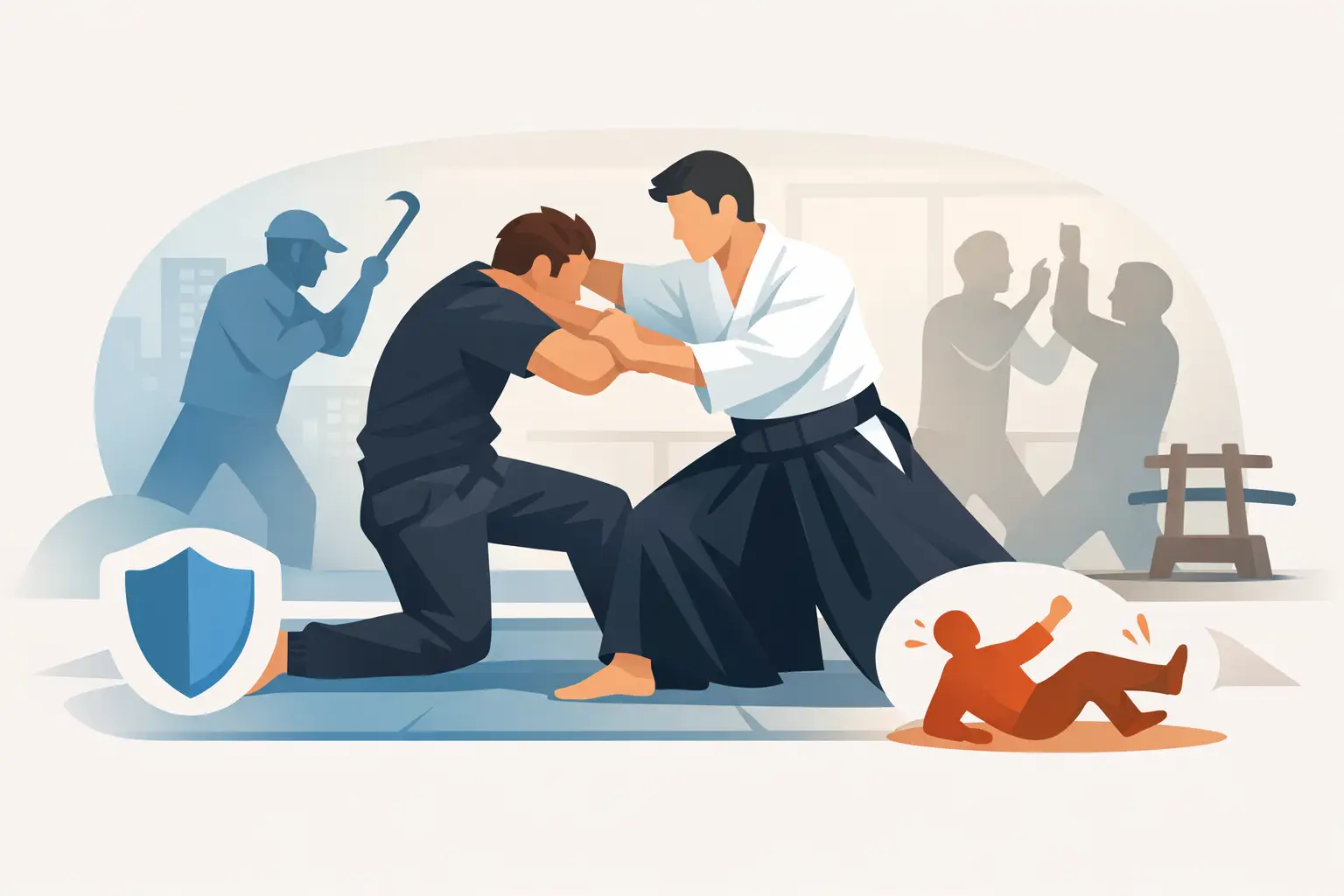
Aikido is not built around trading punches or winning tournaments. Its approach emphasizes posture, timing, movement and control to respond to force without simply meeting force head-on. That can make it valuable for people who want practical physical skills alongside calm judgment, controlled training and a martial art they can continue studying for years.
Is Aikido good self-defense in real situations?
Aikido addresses several problems that can occur in physical confrontations. Students learn how to move off the line of an attack, maintain balance under pressure, respond to grabs and use movement and positioning to create opportunities for control or escape. Techniques include releases, joint controls, throws and immobilizations, but the underlying lesson is not simply how to perform a technique. It is how to remain organized when another person is close and applying pressure.
For many adults, this is a more useful starting point than imagining a carefully matched fight. A person may need to disengage from a grab, protect their balance after being pushed or recognize an escalating situation early enough to leave. Aikido develops awareness of distance and body position, both of which are important before and during physical contact.
Its value also depends greatly on the quality and consistency of training. A technique practiced only as a memorized sequence should not be mistaken for a guaranteed response under pressure. Regular practice with different partners, changing angles and appropriate levels of intensity develops a deeper understanding of movement and timing. Good Aikido practice does not promise invincibility. It develops options.
What Aikido teaches that supports self-protection
The first self-defense skill is often noticing a problem early enough to leave. Traditional Aikido develops attentiveness through partner practice, distance and timing. Outside the dojo, the broader lesson is straightforward: remain aware of your surroundings, recognize changes in distance and positioning, and avoid becoming trapped in a situation unnecessarily.
Aikido also gives students experience dealing with physical contact. Grabs, pushes and sudden movement can be startling, particularly for beginners. Working with partners in a structured setting allows students to become more familiar with physical pressure while keeping the environment respectful and controlled. Over time, students learn to maintain posture, breathe and continue moving rather than immediately becoming rigid.
Safe falling and rolling are another important part of training. Falls occur in many settings, not only violent ones. Ukemi teaches students how to receive techniques safely in the dojo while developing greater body awareness and confidence when balance is disrupted. This training is introduced progressively, with attention to the individual's age, experience and physical condition.
Finally, Aikido develops restraint. In a genuine incident, the safest outcome is usually to create an opportunity to leave, call for assistance and avoid further danger. A throw or immobilization may create an opportunity to disengage, but physical technique is never a substitute for judgment. The environment, the presence of multiple people or weapons and many other factors can change a situation immediately.
The role of technique and body mechanics
Aikido techniques can look effortless when demonstrated by an experienced instructor. That appearance can be misleading. Effective movement relies on position, connection, timing and balance, not magic or compliance. Students spend years refining how to align the body, move safely, affect a partner's balance and apply control without depending entirely on brute strength.
This is one reason Aikido can suit a broad range of people. A smaller practitioner cannot sensibly depend on being stronger than a larger person. Sound mechanics can provide more efficient ways to move and avoid a direct contest of strength. They do not eliminate size, weight, strength or athletic ability as factors, but they teach students not to rely on strength alone.
Where Aikido has limits
An honest answer requires acknowledging what traditional Aikido does not emphasize. Aikido classes are not generally organized around sustained striking exchanges, competitive ground fighting or matches against opponents trying to win under a defined ruleset. Someone whose primary goal is competitive fighting will likely be better served by an art specifically designed around that goal.
Aikido also takes time to learn. Its movements require coordination, sensitivity and repetition. A new student may understand the basic idea of a technique during the first few classes but require considerable practice before posture, movement and timing begin to work together naturally. That is a good reason to be cautious of claims that any martial art can make someone fully prepared for self-defense after only a few lessons.
Training culture matters greatly. Cooperative practice is necessary for learning potentially dangerous techniques safely, but cooperation should not become meaningless compliance. As students develop greater control, attacks can become more purposeful and practice more demanding. The objective is not roughness. It is to develop better timing, positioning and technique while preserving responsibility for the safety of both partners.
Why regular practice matters more than a technique list
Self-defense is not a catalog of impressive responses. Under stress, people often fall back on familiar habits. Aikido's repeated practice of posture, movement, ukemi and partner awareness helps students develop physical responses through repetition rather than simply memorizing a list of techniques.
Consistency also changes confidence. The useful kind of confidence is quiet: knowing that you can maintain your balance, communicate clearly, move with greater awareness and make measured decisions. It does not require someone to seek confrontation or prove anything. For children, that confidence can support better boundaries and self-control. For adults, it can make returning to physical activity feel less intimidating.
Traditional etiquette has a practical role here as well. Bowing, listening carefully, taking turns as attacker and defender and looking after training partners build an environment where people can practice challenging skills without ego taking over. Respect is not separate from martial arts training. It is part of learning to control one's actions when emotions rise.
A good fit for children and adults
For children, Aikido should never be presented as permission to fight at school. Its strongest benefits include body awareness, coordination, focus, listening skills and the confidence to use a clear voice, move away and tell a trusted adult. Age-appropriate classes should make safety and respectful conduct central to every lesson.
Adults often appreciate that Aikido welcomes beginners and does not require a competition mindset. Someone in their forties or fifties may be seeking a sustainable practice that improves movement and confidence, while an experienced martial artist may want to study a different approach to timing and control. Both need patient instruction and partners who understand that progress is individual.
At Tri City Aikido, instruction follows a traditional Aikikai approach, with the heritage of Kumano Juku in Shingu, Japan. Under Anthony Campagna Sensei, 5th Dan Aikikai, students are encouraged to develop sound fundamentals before pursuing greater speed or complexity.
Making Aikido part of a sensible safety plan
Aikido is most useful when placed within a wider approach to personal safety. Awareness, clear boundaries, de-escalation and knowing when to seek help remain important. Whenever a dangerous situation can be avoided or safely left, that is preferable to relying on physical technique.
Physical conditioning supports training as well. Balance, leg strength, mobility and cardiovascular fitness can all affect a person's ability to move and recover. Students do not need to arrive fit or athletic. These qualities can develop gradually through regular training and other appropriate physical activity.
The best question is not whether Aikido guarantees safety. No martial art can make that promise. A better question is whether its training can help you become more aware, more composed under pressure and better able to use movement and positioning when physical contact occurs. For people looking for disciplined martial arts training without a competition-focused culture, Aikido offers an approach worth experiencing firsthand.
A free introductory class is a sensible way to judge the fit for yourself or your child. Watch how the instructor manages safety, how students treat one another and whether the practice feels both challenging and welcoming. A good dojo should leave you with more than techniques to remember. It should give you a deeper understanding of movement, awareness, control and responsibility.