
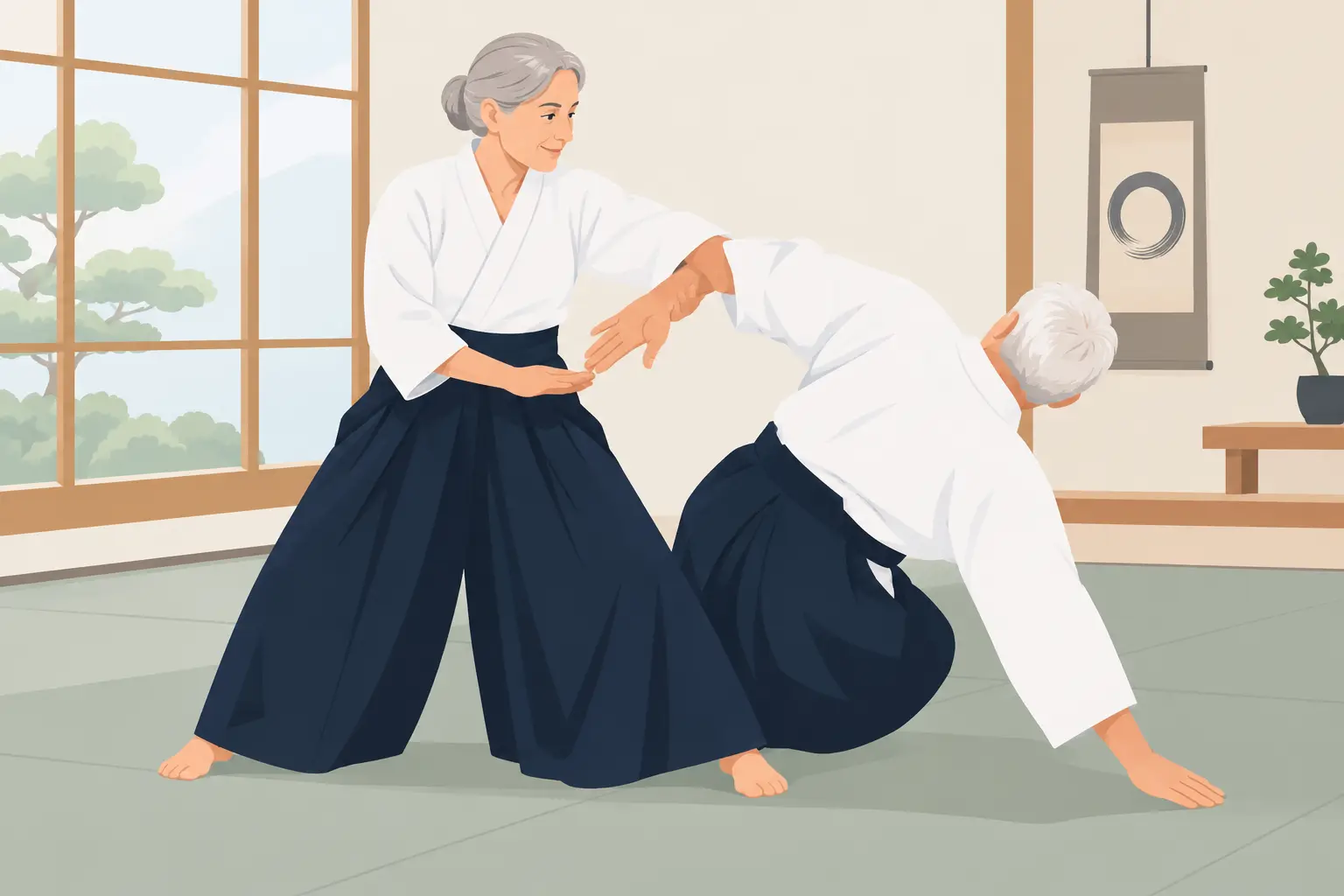
Aikido does not require you to overpower your training partner or compete against younger, stronger students. You begin where you are and learn at your own pace. For someone looking for an active and challenging martial art later in life, Aikido can offer a very different path.
You Don't Have to Train Like a 20-Year-Old
One of the advantages of Aikido is that good technique does not depend on brute strength. Students learn to use movement, balance, timing, position and leverage rather than trying to overpower another person.
This becomes especially important as we get older. Speed and physical strength may change with age, but good technique can continue to improve for decades. Aikido teaches you to find the path of least resistance and use your entire body efficiently instead of relying on muscular force alone.
That does not mean Aikido is effortless. It is a physical martial art, and training can improve coordination, movement and conditioning. The difference is that you don't have to arrive already strong, flexible or athletic in order to begin.
What About Falling?
For many older beginners, falling is the biggest concern. Watching experienced Aikido students roll or take a fall can make someone wonder, "Am I expected to do that?"
Not on your first day.
Learning how to receive a technique safely is called ukemi, and it is taught progressively. Beginners start with basic movements and learn how to work with the mat gradually. As their confidence and ability improve, their ukemi can develop with them.
Students also have different physical abilities. An instructor needs to recognize those differences and adjust the training accordingly. The goal isn't to see who can take the biggest fall. The goal is to continue learning and training safely.
If fear of falling is one of the things keeping you from trying Aikido, don't let what experienced students are doing on the mat convince you that you have to start there. They were beginners once too.
Experience Can Actually Be an Advantage
Older students sometimes focus on what they believe they have lost physically, but age brings advantages of its own. Patience, concentration and the willingness to slow down and understand how something works can be tremendous assets in Aikido.
A beginner quickly discovers that forcing a technique usually makes it more difficult. Relaxing the shoulders, improving posture, changing position or using the correct lever can accomplish what additional strength cannot.
These lessons take time to understand. Aikido isn't a race, and there is no competition at Tri City Aikido. You aren't training to beat the person standing next to you. Your training partner is there to help you learn, and you are there to help them learn.
Starting Aikido Later in Life
The best approach is simply to start at your present level. You don't need to get into shape before trying Aikido. You don't need previous martial arts experience, and you certainly don't need to prove that you can keep up with someone younger.
If you have an injury or physical limitation that could affect your training, let the instructor know. Techniques and movements can often be adjusted while you develop greater familiarity with the practice.
Your first classes are about learning fundamentals: how to stand, move, turn, maintain your balance and work safely with a partner. As those fundamentals become more comfortable, additional techniques are introduced.
You also don't need special equipment to find out whether Aikido is right for you. Our guide explaining what to wear to your first Aikido class can help you prepare for your first visit.
A Traditional Aikido Dojo in Fremont
Tri City Aikido has been teaching traditional Aikido in the Fremont area since 1996. Anthony Campagna Sensei, 5th Dan Aikikai, began his own Aikido training in 1986. The dojo is connected to Kumano Juku in Shingu, Japan, continuing a traditional approach to Aikido that places great importance on fundamentals.
That experience matters when teaching older beginners. Everyone who walks through the door brings a different body, background and level of experience. Good instruction isn't about forcing every student into the same mold. It is about teaching the principles of Aikido and helping each student develop them through consistent practice.
Our traditional dojo environment is cooperative rather than competitive. Students practise together, learn from one another and take responsibility for the safety of their training partners.
Are You Too Old to Start Aikido?
If you've been interested in Aikido but have hesitated because of your age, don't decide what you can or cannot do by watching someone who has already been training for years.
Come in as a beginner.
Tri City Aikido offers a free guest trial, giving you an opportunity to experience a class, meet the instructor and see how Aikido feels for yourself. There is no expectation that you already know how to fall, move like a martial artist or keep up with anyone else.
You don't have to be young to begin Aikido. You simply have to be willing to begin.