
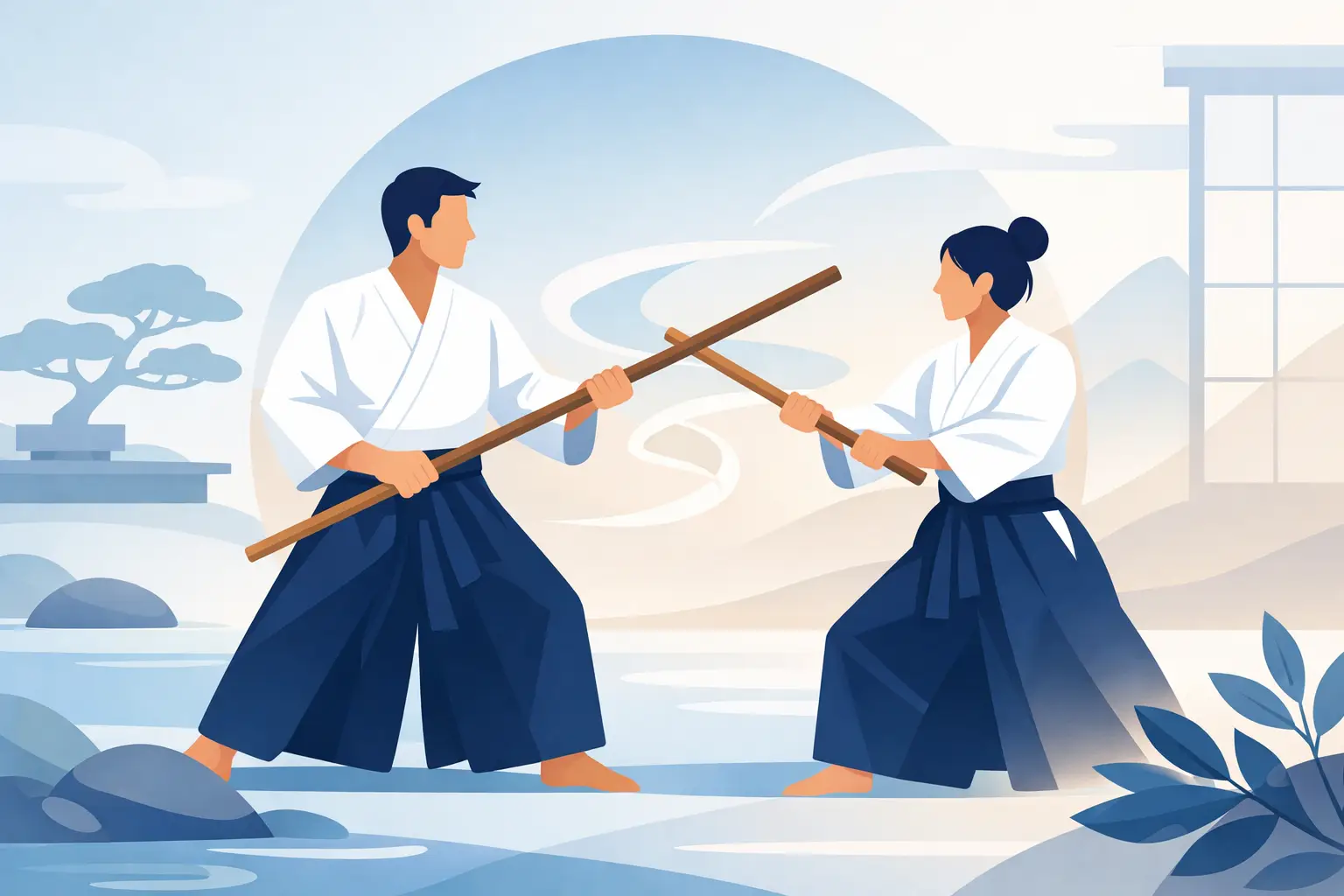
Traditional weapons practice has an important place in Aikido. Like the bokken, the jo gives students another way to understand principles that also appear in empty-hand technique. Because the weapon extends beyond the body, errors in posture, distance, direction, and timing can become much easier to recognize.
What Is Jo Staff Training in Aikido?
The jo is a straight wooden staff, traditionally approximately 128 centimeters, or a little over four feet, in length. Unlike a sword, it has no cutting edge, point, or single direction from which it must be used. The hands can change position along the staff, and either end can become part of the movement.
This versatility makes the jo an interesting training tool. Aikido jo practice can include strikes, thrusts, sweeping movements, changes of grip, footwork, individual exercises, and structured partner practice. The particular exercises depend on the tradition and method being taught.
The purpose is not simply to accumulate movements. Each exercise provides another opportunity to examine posture, direction, rhythm, distance, and control.
In partner practice, the jo also makes ma-ai particularly clear. Distance that might be difficult for a beginner to recognize during empty-hand practice becomes much more obvious when a four-foot staff separates two people. A step that is several inches too close or too far away can change the entire relationship.
Why Train With a Jo in Aikido?
Aikido is widely recognized for empty-hand throws, pins, and joint controls, but traditional practice can also include the bokken and jo. Weapons training provides another way to study many of the principles found throughout Aikido.
The jo extends the line of the body. If a student's posture collapses, the hands become disconnected from the center, or a turn becomes unbalanced, the staff often makes the problem easier to see and feel.
Students also learn that moving the jo effectively requires more than arm strength. When someone attempts to force every movement through the shoulders and arms, the result often becomes tense and difficult to control. Coordinating the hands with footwork, hips, posture, and center produces a very different result.
These lessons are directly related to empty-hand Aikido. The weapon changes, but principles such as posture, center, distance, timing, and coordinated body movement remain.
For a broader look at how weapons fit into the art, see The Purpose of Weapons Training in Aikido.
The Jo Teaches Both Ends of the Movement
One characteristic that makes jo practice particularly interesting is that the weapon has no front or back in the same sense as a sword. Either end can be used, and the hands can change position as the staff moves.
This requires students to become comfortable coordinating both sides of the body. A movement may begin from one side and finish on the other. The hands must work together while the feet maintain balance and appropriate distance.
Beginners often discover that what looks simple becomes surprisingly demanding when the hands, feet, and body must move together. That challenge is useful. It exposes unnecessary tension and gives the student something specific to refine.
Posture and Body Mechanics
A jo provides immediate feedback about posture. If the hands become disconnected from the body, the staff can feel awkward or uncontrolled. If the stance is unstable, changing direction and stopping accurately become more difficult.
Students learn to maintain an upright posture while allowing the knees, hips, and feet to participate naturally in the movement. The objective is not stiffness. Good structure allows the body to remain stable while still being able to move freely.
The same principle appears throughout Aikido. Whether performing an empty-hand technique or moving a jo, reaching too far with the arms usually weakens the position. Coordinating the hands with the movement of the body creates greater stability and control.
Distance, Timing, and Awareness
A jo changes the distance between two people. Students must recognize not only where their partner is standing, but where the staff can travel and where a safe line of movement exists.
This develops an increasingly refined understanding of ma-ai. Moving too close can place the student in danger or leave insufficient room to use the jo correctly. Remaining too far away can make the movement ineffective. Good distance changes constantly as both people move.
Timing is closely connected to distance. A student who recognizes the correct position but arrives there too late has missed the opportunity. Moving too early can create a different problem. Jo training gives students repeated opportunities to study the relationship between where they are and when they move.
These lessons carry directly into empty-hand Aikido, where successful technique also depends on position and timing rather than strength alone.
Jo Training Begins With Safety
A wooden staff must be treated with respect. A jo may be a training weapon, but careless use can cause injury.
Before partner exercises become more involved, students need to understand how to hold and handle the jo safely, how much space is required around them, and where other students are positioned on the mat.
The weapon itself should also be inspected periodically. Cracks, splinters, or other damage should be addressed before training. Students should never casually swing a jo in a crowded training area or treat it as a toy.
Individual practice allows students to develop basic movement without immediately adding the responsibility of another person. When paired exercises are introduced, they should be performed at a speed appropriate to the experience of both students.
Speed is never a substitute for control. If distance deteriorates or a student begins losing awareness, slowing down and returning to the fundamental movement is the appropriate response.
Solo Practice and Partner Training
Individual jo practice gives students an opportunity to concentrate on their own movement. They can examine grip, posture, footwork, direction, and the relationship between the staff and their center.
Partner practice adds another dimension. Now the student must maintain those same qualities while responding to someone else's position and movement.
This requires trust and responsibility from both people. Partners must maintain appropriate distance, follow the exercise being practiced, and control their speed. The objective is not to surprise the other student or prove that an attack could have landed.
A person who can move accurately while protecting their training partner demonstrates considerably more control than someone who simply moves with intensity.
How Jo Training Supports Empty-Hand Aikido
The relationship between weapons and empty-hand Aikido becomes clearer with experience. Students may begin to recognize similar footwork, body turns, entries, changes of direction, and relationships between the hands and center.
A jo can make these relationships easier to examine because the weapon creates a visible extension of the student's movement. If the staff moves in one direction while the body moves in another, the lack of connection becomes apparent.
Likewise, a student who understands how to maintain distance against a jo begins to look differently at distance during grabs and strikes. The weapon provides another perspective on principles already present in Aikido.
Jo practice does not replace empty-hand training, ukemi and safe falling, throws, pins, or joint controls. It complements them.
Jo and Bokken Teach Different Lessons
Although both are traditional wooden training weapons, the jo and bokken do not feel the same in practice.
The bokken has the form and directional character of a sword. The jo is symmetrical and can move from either end. Changes of grip and direction create different demands on coordination and body movement.
Studying both can therefore reveal different aspects of the same underlying Aikido principles. Bokken practice may make a line of entry particularly clear, while jo practice can emphasize changing direction, hand position, range, and continuous movement.
Neither weapon is simply an accessory to empty-hand training. When studied properly, each provides a different method of examining the student's Aikido.
Weapons Training and Younger Students
For younger students, readiness matters. The ability to handle a jo safely requires attention, coordination, and the maturity to follow instructions consistently.
Weapons training should therefore be introduced according to the student's age, experience, and demonstrated responsibility rather than simply because the weapon looks exciting.
This is itself an important lesson. Greater responsibility in the dojo is earned by showing that instructions can be followed and that training partners can be trusted to work safely together.
When younger students are ready for jo practice, the weapon can provide an excellent challenge for coordination and concentration. The emphasis remains the same as it does for adults: control comes first.
What Beginners Should Expect
Students do not need previous weapons experience or exceptional physical strength to begin learning Aikido. When jo practice is introduced, the early movements should be approached in exactly the same way as other fundamentals: slowly enough to understand what the body is doing.
A seemingly simple movement can require considerably more coordination than expected. The hands, feet, posture, and direction of the jo must work together. Feeling awkward initially is normal.
Students should also expect correction. A small adjustment to the position of a hand, the angle of the staff, the placement of a foot, or the timing of a step can change the entire movement. Attention to those details is part of traditional training.
A Traditional Practice With a Clear Purpose
At Tri City Aikido, weapons training is part of a broader study that includes empty-hand technique, ukemi, body mechanics, partner practice, and traditional dojo etiquette. The dojo's Aikido lineage is connected through Kumano Juku in Shingu, Japan, and the teaching of Tasaka Shihan and Hikitsuchi Michio Sensei.
That lineage is particularly meaningful when discussing weapons because weapons practice was an important component of the Aikido transmitted through Hikitsuchi Sensei's tradition.
Jo training is not a shortcut to effective Aikido, nor is its purpose to make practice more spectacular. Its value is much simpler: it gives students another way to examine movement.
A jo makes it difficult to hide poor posture, incorrect distance, unnecessary tension, or wandering attention. With continued practice, students learn to replace those habits with greater precision, coordination, awareness, and control.
The staff may be simple. Learning to move it well is not. That is precisely what makes it valuable training.