
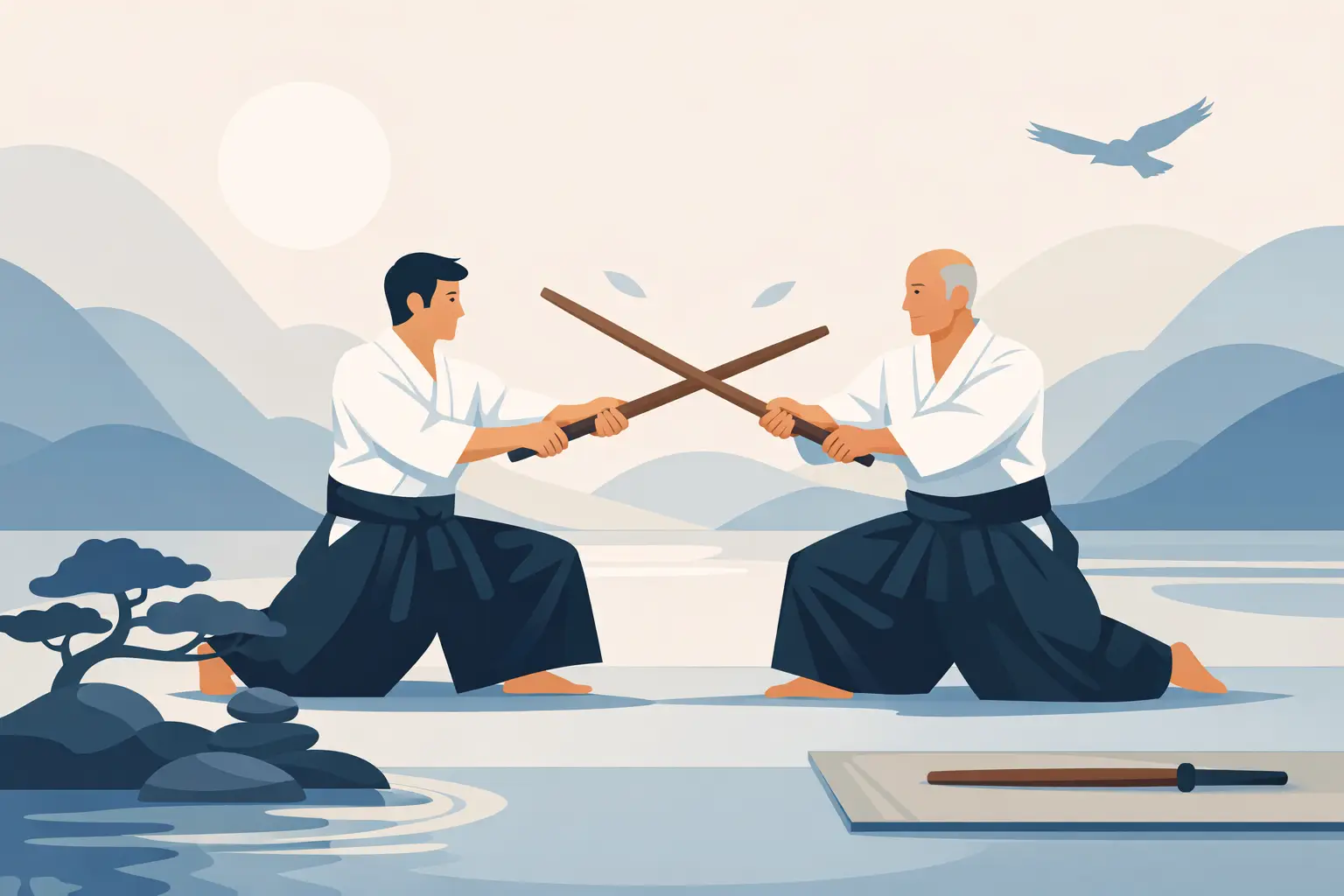
The bokken is a traditional Japanese wooden training sword. In Aikido, it is not simply a substitute for a metal sword or something used for dramatic demonstrations. It is a training tool that helps students examine how the entire body moves. The lessons carry directly into empty-hand Aikido: how to maintain posture, how to enter, how to control distance, and how to move decisively without unnecessary tension.
What Bokken Training Teaches in Aikido
Aikido is often recognized for throws, joint controls, pins, and flowing responses to an attack. Yet those techniques depend on principles that can sometimes be difficult for a beginner to recognize. A bokken makes many of those principles easier to see because its length creates a very clear relationship between distance, direction, and position.
One of the first lessons is center. A student learns that the arms alone should not control the bokken. The hands guide the weapon, but effective movement involves the feet, hips, posture, and center working together. When the body is balanced, the movement can be strong without excessive tension. When the student reaches or relies primarily on the arms, the weakness becomes much easier to recognize.
Distance, commonly referred to in Japanese martial arts as ma-ai, is another central lesson. Students learn where they can move safely, where a partner can reach, and how even a small change in position can alter the entire interaction. These principles are highly relevant to empty-hand Aikido. Good technique begins before physical contact, with awareness of space, direction, and intention.
Bokken work also develops timing. Students learn to recognize movement, enter at an appropriate moment, and complete their own movement with control. The objective is not simply to become faster. It is to become more attentive and more decisive.
Why Weapons Training Belongs in Aikido
People sometimes wonder why an art known for throws and joint controls includes sword practice. The answer can be found both in Aikido's history and in the principles expressed through its movement.
Many movements in Aikido reflect principles that become particularly clear through weapons training: entering off the line of an attack, protecting one's center, controlling distance, turning the body rather than colliding directly with force, and maintaining awareness after a technique has been completed.
Training with a bokken gives students another way to study these ideas. Understanding the line of a downward cut, for example, can clarify why an empty-hand entry moves at a particular angle. Recognizing when the center has been exposed during weapons practice can make the same weakness easier to recognize during empty-hand technique.
For a broader explanation of this relationship, see The Purpose of Weapons Training in Aikido.
Bokken Training Begins With Safety and Control
A wooden training sword must always be treated with respect. Although a bokken is not a sharpened weapon, careless use can still cause injury. Safe training therefore begins long before two students practice together.
Students first learn how to handle the bokken appropriately, how to maintain awareness of the people around them, how to hold it correctly, and how to move without creating unnecessary danger. Speed is secondary to control.
When paired exercises are introduced, distance and timing become even more important. Students practice at a pace appropriate to their experience and the exercise being studied. The purpose is not to test someone's courage by moving a wooden weapon as quickly as possible. It is to develop reliable movement and awareness through repetition.
The bokken itself should also be appropriate for training. It should be inspected for cracks, splinters, or other damage before use. Small details matter when people are training together with wooden weapons.
Basic Cuts Reveal the Whole Body
A basic bokken movement may appear simple, but performing it correctly involves considerably more than moving the arms.
Consider a basic downward cut. The student must maintain posture while raising the bokken, keep unnecessary tension out of the shoulders, coordinate the hands with the center of the body, step without losing balance, maintain the correct line, and finish in a stable position.
If the student rushes, overreaches, leans, or attempts to create power only with the arms, the result becomes immediately visible. The bokken acts almost like a measuring tool for the student's movement.
This is one reason repetitive weapons practice can be so valuable. Performing a fundamental movement many times gives the student an opportunity to remove unnecessary motion and gradually make the technique more precise.
Understanding Ma-ai Through the Bokken
Distance can be difficult to understand through explanation alone. A bokken makes it much more concrete.
When two students face one another with wooden swords, being several inches too close or too far away changes the entire relationship. Students begin to recognize when they are within range, when they need to move, and how angle affects both attack and defense.
This understanding carries directly into empty-hand practice. Whether the attack is a grab, strike, or another form of movement, nage must understand where to position the body in relation to uke. Moving too early, too late, too close, or too far away can change the effectiveness of the technique.
Weapons training provides another environment in which students can develop this awareness.
From Solo Practice to Partner Training
Bokken practice can include both individual movements and structured exercises with a partner. Each develops different skills.
Solo practice allows the student to concentrate on posture, grip, footwork, direction, breathing, and coordination without having to respond to another person's movement. Repetition provides an opportunity to examine details that might otherwise be overlooked.
Partner practice adds timing, distance, and responsibility. The student must now account for another person's position and movement while maintaining control of their own bokken.
This is where awareness becomes especially important. A student cannot become so focused on completing their own movement that they stop paying attention to their partner. Both people share responsibility for maintaining safe and meaningful practice.
How Bokken Training Supports Empty-Hand Aikido
The connection between bokken practice and empty-hand Aikido may not be obvious to a beginner. With continued training, however, similarities begin to emerge.
Students may notice that their entries become more direct, their turns become more balanced, and their hands remain better connected to the movement of their body. They begin to understand why certain angles are used and why position matters before a technique is applied.
Bokken practice can also reinforce the importance of maintaining awareness after a movement has been completed. Finishing a technique does not mean immediately abandoning posture or attention. The student should remain aware of their partner and surroundings.
The weapon makes this principle particularly clear because distance and lines of potential movement remain visually obvious.
Bokken training does not replace empty-hand Aikido. Nor does it replace ukemi and safe falling practice, throws, pins, joint controls, or regular partner training. Instead, weapons practice provides another way to study the same underlying principles.
Weapons Training Requires Responsibility
One of the most important lessons of bokken training has little to do with performing a particular cut. It is learning to handle something potentially dangerous with discipline.
A bokken should never be swung casually around other students or treated as a toy. Students learn to be conscious of where the weapon is pointing, who is nearby, and whether there is sufficient space to move safely.
This responsibility is especially important for younger students. As students mature and become ready for weapons training, learning to handle a bokken properly reinforces the connection between ability and responsibility. Greater skill does not give someone permission to become careless. It requires greater control.
Calm Movement Is More Important Than Speed
Fast weapons movement can look impressive, but speed without control has little value in training. A student who rushes may sacrifice posture, distance, accuracy, and awareness.
Traditional practice develops speed gradually. First the movement must be understood. Then it must become consistent. As unnecessary tension and hesitation disappear, speed can develop naturally without sacrificing control.
This progression reflects a larger principle within Aikido. Calmness does not mean moving slowly forever. It means remaining mentally and physically organized even as the demands of training increase.
A Traditional Practice Studied With Care
At Tri City Aikido, weapons training exists within the larger framework of traditional Aikido practice. The dojo's Aikido lineage is connected through Kumano Juku in Shingu, Japan, and training emphasizes technical development, etiquette, awareness, and responsibility.
Students do not need previous sword experience to begin studying Aikido. Weapons training is introduced as appropriate within a student's development, with the same emphasis on fundamentals that applies to empty-hand practice.
Ultimately, the bokken is valuable because it exposes movement. It reveals when posture has weakened, when distance has been misjudged, when the arms have become disconnected from the body, and when attention has wandered.
Used carefully, the bokken teaches something much larger than how to move a wooden sword. It teaches students to move with greater clarity, awareness, precision, and control—and those lessons return directly to their Aikido.