
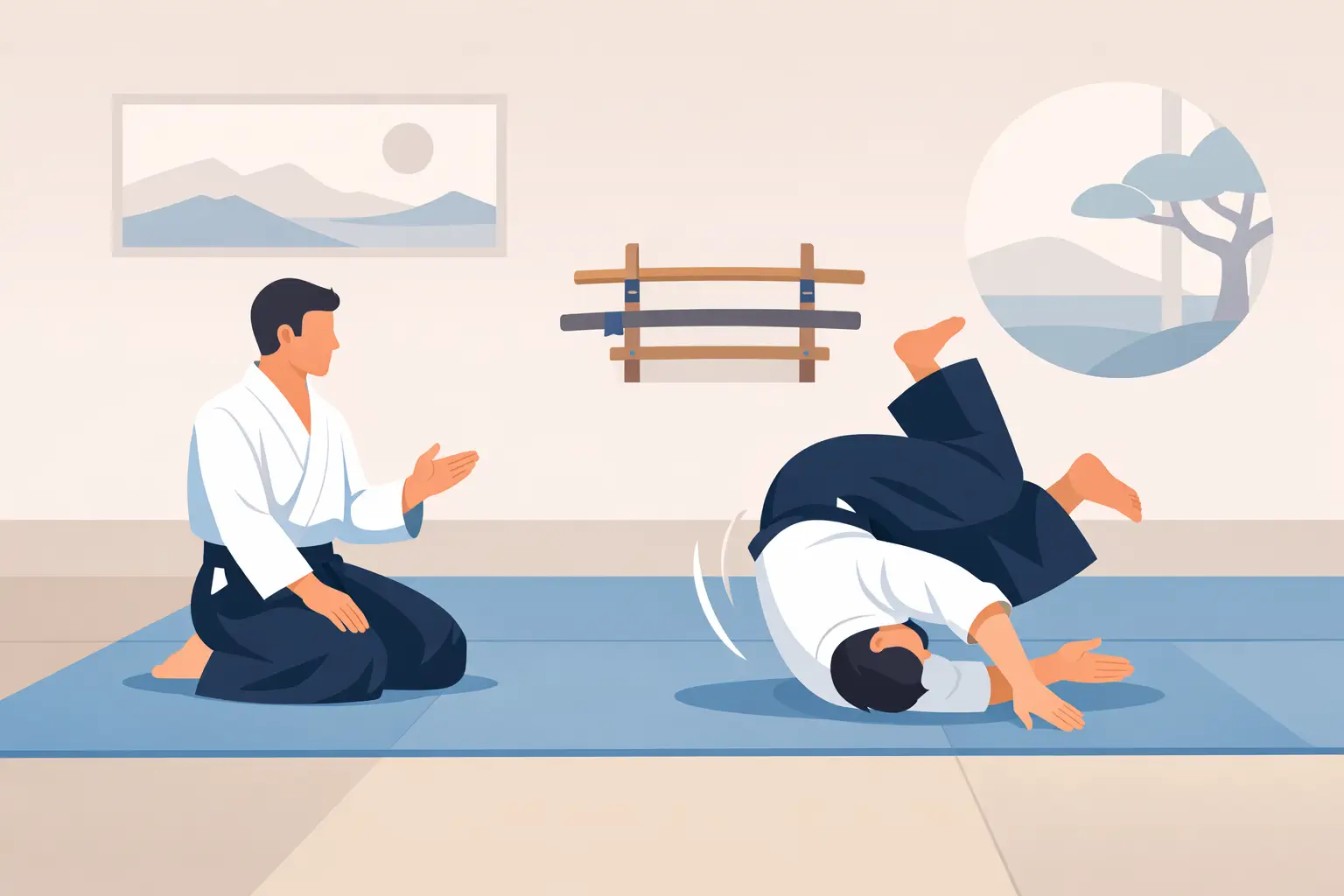
In Aikido, the practice of receiving a technique is called ukemi. Although people often associate ukemi with falling and rolling, it involves considerably more. Uke learns how to maintain awareness, protect the body, respond to the direction of a technique, and remain connected to the movement rather than simply collapsing to the mat.
Why Safe Falling Comes Before Throws
Aikido includes throws, joint controls, pins, and immobilizations, but beginners should not start by being subjected to hard or dramatic falls. Before techniques become more dynamic, students need to understand posture, spacing, balance, and how their body interacts with the mat. This progression matters because sound ukemi supports nearly every other part of Aikido training.
A student who is tense or afraid of falling may pull away from a partner, stiffen the body, hold their breath, or attempt to stop a movement abruptly. Those reactions can make training less safe and make it more difficult to understand the technique being practiced. As students become comfortable with basic ukemi, they can remain relaxed enough to pay attention to timing, direction, balance, and control.
For children, the benefits extend beyond learning how to receive an Aikido technique. Age-appropriate falling practice develops body awareness, coordination, listening skills, and confidence in movement. Learning how to lose balance and recover calmly is itself a valuable physical skill.
Aikido Safe Falling Techniques Start Close to the Ground
Good ukemi is built progressively. A beginner may first sit, kneel, or work close to the mat before attempting a complete roll or fall. This allows the student to understand body position without adding unnecessary height or speed.
One of the first lessons is learning not to reach toward the floor with a rigid arm. This natural reaction can place unnecessary force on the wrist, elbow, or shoulder. Students instead learn how to position the body so contact with the mat occurs in a controlled manner while protecting the head and vulnerable joints.
Head position is particularly important. During many basic falls, students learn to keep the chin naturally tucked rather than allowing the head to snap backward toward the mat. These habits are developed slowly through repetition until they become increasingly natural.
The familiar Aikido slap of the mat is also taught as part of certain forms of ukemi. It should be coordinated with the rest of the body rather than performed as an exaggerated strike against the mat. Proper ukemi depends on the entire movement working together, not on how loudly someone can slap the floor.
Children generally begin with smaller movements and instruction appropriate to their age and coordination. Adults may need to accommodate stiffness, previous injuries, or years away from physical activity. There is no advantage in rushing either group. In traditional Aikido training, careful repetition of the basics is part of serious practice.
Backward Falls: Becoming Comfortable With the Mat
Backward ukemi is commonly introduced close to the ground. A student may begin from a seated or low position so they can learn how to protect the head, position the arms, and allow the back to contact the mat safely without worrying about a standing fall.
As coordination and confidence improve, the movement can gradually become larger. The objective is not to fall heavily. Students learn to lower themselves with control, avoid throwing the head backward, and maintain awareness throughout the movement.
Eventually, backward ukemi becomes connected to partner practice. By that point, the student should already understand the fundamental movement independently. A partner adds direction and timing, but should not replace the student's foundation.
Forward Rolls: Learning to Follow Movement
Forward rolling teaches students to follow a curved path across the body rather than collapsing directly onto the shoulder. Beginners often start very low, sometimes from their knees, and gradually develop the shape and direction of the roll.
A smooth forward roll requires patience. Trying to perform the movement too quickly can cause a beginner to lose direction or place unnecessary pressure on one part of the body. Breaking the movement into smaller pieces allows the student to understand where the body should travel and how to finish in a balanced position.
As training develops, students learn to roll from different positions and eventually in response to a partner's controlled technique. This is where ukemi becomes more than simply learning how to fall. Uke is actively responding to balance, direction, timing, and the technique being applied.
Side Falls and Changing Direction
Side falls provide another way of receiving movement when the body is being directed away from its center. As with other forms of ukemi, students learn to protect the head, avoid reaching toward the floor with a locked arm, and control the position of the hips and legs.
Not every beginner needs to learn every form of ukemi during the first few classes. A younger child may spend considerable time developing basic rolls and body awareness. An adult with limited mobility may remain closer to the ground while learning the same principles.
This is not falling behind. Good instruction adapts the exercise to the student while preserving the principle being taught. The objective is to develop reliable movement, not to rush toward increasingly dramatic falls.
Ukemi Is More Than Falling
As students become more experienced, their understanding of ukemi changes. Uke is not simply the person who gets thrown. Uke provides an appropriate attack, maintains awareness, receives the technique, and protects themselves throughout the interaction.
This relationship is essential to understanding Aikido. Without good ukemi, nage cannot properly study timing, balance, distance, or control. Without a responsible nage, uke cannot safely explore increasingly dynamic movement. Both sides contribute to the technique.
More advanced ukemi can become fast and physically demanding, but speed should develop from skill rather than replace it. A spectacular fall is not evidence of good ukemi by itself. Control, awareness, appropriate timing, and the ability to protect oneself are far more important.
The Responsibility of the Training Partner
Safe falling is a shared responsibility. In Aikido, the person performing the technique is generally called nage, while the person receiving the technique is called uke. Both have responsibilities.
Nage must maintain control and adjust the speed and intensity of the technique to the experience and physical ability of the person receiving it. Uke must remain attentive, communicate when necessary, and avoid attempting falls or movements beyond their current ability.
This partnership becomes especially important when experienced practitioners train with beginners. An experienced student should be capable of adjusting their technique appropriately. A beginner is not an opportunity to demonstrate power. The objective is to help both people understand the technique while maintaining a safe and productive training environment.
Students should also tell the instructor about previous injuries or physical limitations that could affect falling and rolling. Modifying a movement or temporarily working from a lower position is preferable to forcing a technique the body is not prepared to perform.
What Parents Should Notice About Ukemi
Parents watching a children's Aikido class may notice that early falling practice looks surprisingly simple. Children may sit, rock backward, kneel, roll slowly, stand, and repeat the same movements many times.
That simplicity is intentional.
Before a child can safely receive a more advanced technique, they need basic control of their own body. They must learn to follow instructions, recognize where other students are on the mat, protect their head, and understand how to move without placing themselves or a partner at unnecessary risk.
As their coordination develops, those simple movements become the foundation for increasingly sophisticated Aikido practice. The child who once needed considerable concentration to perform a basic roll may eventually receive a throw, recover to their feet, and continue training naturally.
Adults Can Learn to Fall Safely Too
Adult beginners frequently wonder whether they are too old to learn Aikido or to become comfortable rolling and falling. Age alone does not answer that question. Mobility, conditioning, previous injuries, confidence, and individual physical limitations all affect where someone should begin.
An adult beginning Aikido in their forties or fifties should not expect to move exactly like someone who has practiced ukemi for twenty years. Nor should they need to. A responsible instructor starts with the individual student and develops the movement progressively.
Over time, many adults discover that learning ukemi changes their relationship with the mat. What initially caused apprehension becomes familiar. The body learns the movement, unnecessary tension decreases, and receiving techniques becomes another part of training rather than something to dread.
At Tri City Aikido, students are introduced to traditional Aikido practice through progressive instruction and careful attention to fundamentals. Training under Anthony Campagna Sensei, 5th Dan Aikikai, follows a traditional lineage connected to Kumano Juku in Shingu, Japan.
Common Ukemi Mistakes Beginners Should Avoid
One of the most common mistakes is attempting to fight the fall. Stiffening the body, locking an elbow, or reaching toward the floor can concentrate force where it does not belong. Students gradually learn to maintain appropriate structure while allowing the body to follow a safer path.
Another mistake is progressing too quickly. Beginners sometimes see experienced students taking large, dynamic falls and assume that this is what good ukemi should immediately look like. Those movements are the result of years of repetition. The fundamentals that produced them are more important than copying their appearance.
Fatigue also matters. Falling and rolling require coordination, and that coordination can deteriorate when a student becomes tired. Recognizing when technique is becoming sloppy and taking time to reset is part of responsible training.
Beginners should also be cautious about practicing unfamiliar falls at home, particularly on hard flooring. Videos can demonstrate what a movement looks like, but they cannot correct body position or determine whether someone is ready for the next progression. Proper mats, experienced instruction, and gradual practice make a significant difference.
Good Ukemi Develops Over Time
Safe falling is not something students learn once and leave behind. Ukemi continues developing throughout a person's Aikido training. As techniques become faster and more complex, the ability to receive them safely requires increasingly refined timing, awareness, and movement.
The fundamentals, however, remain the same: protect the body, remain aware, follow the movement appropriately, and maintain control.
A confident fall does not need to be high, loud, or dramatic. Good ukemi is the result of sound instruction, patient repetition, and trust developed between training partners. Whether it is a child's first backward fall or an experienced practitioner's response to a powerful throw, the purpose remains the same: receive the technique safely, recover, and continue training.