
For adults searching for adult martial arts in Fremont, that is a question worth asking before choosing a school or style. The most rewarding martial arts training is usually the training you keep doing.
Aikido offers one possible answer. Its emphasis on technique, balance, timing, positioning, coordination, and efficient movement allows students to continue developing even as their physical abilities and priorities change over time.
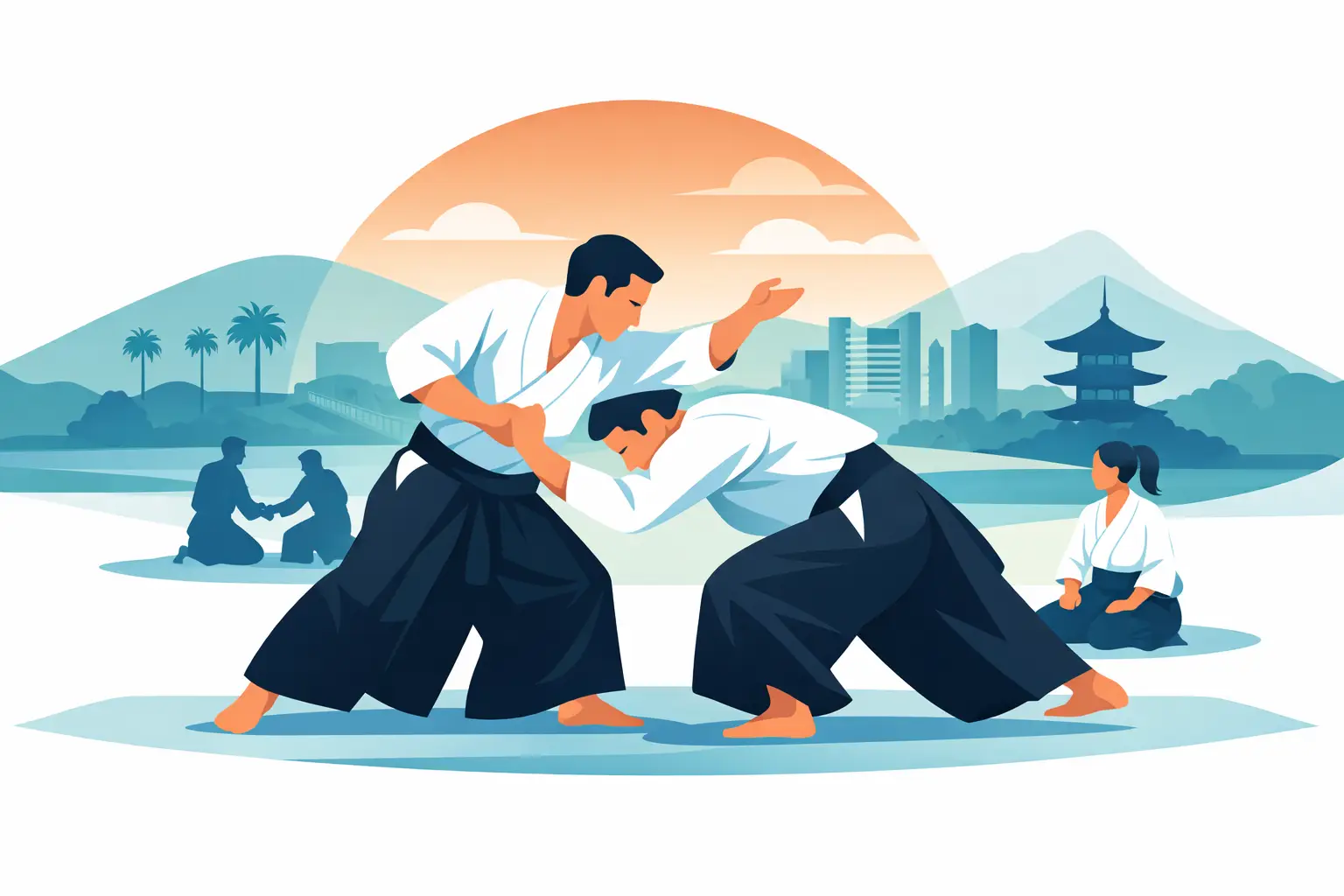
Your Priorities May Be Different After 40
A younger martial artist may be attracted primarily by intensity, competition, speed, or athletic performance. Those things can still matter to an older student, but they may no longer be the only considerations.
Adults often arrive with careers, families, responsibilities, old injuries, limited training time, and bodies that require more recovery than they once did.
That does not mean martial arts training should become easy.
It means the training should provide enough challenge to produce improvement without requiring students to constantly sacrifice their bodies in order to participate.
For someone beginning later in life, sustainability deserves to be part of the decision.
Ask Whether You Can Train This Way Ten Years From Now
When evaluating a martial art, it can be useful to look beyond the first six months.
Imagine yourself ten years from now.
Does the art provide a path for continued improvement as speed and strength change? Can technique become more sophisticated even if athletic ability eventually declines? Are experienced older practitioners still able to participate meaningfully?
A martial art with technical depth should give students something to improve throughout their lives.
In Aikido, experienced practitioners often become increasingly interested in efficiency. Instead of performing a technique with more effort, the objective becomes accomplishing the movement with better timing, positioning, balance, and control.
That gives an older practitioner somewhere to go technically rather than treating youth and athleticism as the final measure of ability.
Strength Matters, but It Shouldn't Be Everything
Physical strength is useful in martial arts. So are speed, endurance, flexibility, and coordination.
But a martial art that depends primarily on physical attributes creates an obvious problem: those attributes change throughout life.
Aikido does not pretend strength is irrelevant. Instead, training attempts to reduce unnecessary dependence on it.
Students study how posture, leverage, movement, timing, and balance can accomplish work that would otherwise require considerably more muscular effort.
This is particularly noticeable when training with partners of different sizes.
If a technique only succeeds against someone smaller or weaker, the student has learned something important about the limitations of what they are doing. The answer should not always be to become stronger. Sometimes the answer is to improve the technique.
Recovery Becomes Part of Training
One of the realities of beginning martial arts as a mature adult is that recovery matters.
A twenty-year-old may finish a difficult workout, sleep, and feel ready to repeat it the following day. At 40, 50, or 60, the same workload may require more recovery.
Ignoring that reality does not make someone tougher. It can simply make consistent training more difficult.
A sensible martial arts program allows intensity to develop progressively. Students learn what their bodies can tolerate, build conditioning over time, and distinguish between the normal discomfort of physical training and pain that should not be ignored.
Consistency is far more valuable than repeatedly training too hard, becoming injured, taking several weeks off, and starting the cycle again.
You Don't Need to Get in Shape First
Many adults postpone martial arts because they believe they should improve their fitness before walking into a dojo.
That can become an endless delay.
You do not need to become a martial artist before beginning martial arts.
A well-structured beginner program allows conditioning to develop as part of training. Footwork, repeated movement, getting down to and back up from the mat, partner practice, falling exercises, and technical repetition all place physical demands on the body.
As those activities become familiar, students can gradually work harder and longer.
The starting point matters much less than the willingness to begin and continue.
Old Injuries Don't Automatically End the Conversation
By middle age, many people have accumulated some history with their bodies.
A knee may not bend exactly as it once did. A shoulder may have been injured years earlier. Someone may have a back problem or reduced flexibility from decades of work and daily life.
Those limitations should be communicated to the instructor rather than hidden.
Not every technique can or should be performed identically by every person. An experienced instructor should understand the difference between challenging a student and forcing someone's body into a position it cannot safely tolerate.
Modifying training when necessary is not the same as avoiding effort.
The objective is to find a way to continue developing while respecting legitimate physical limitations.
Learning to Fall Becomes Increasingly Valuable
Aikido students spend considerable time learning ukemi—the practice of safely receiving techniques through controlled falls and rolls.
For a mature beginner, this may initially be one of the more intimidating parts of training.
It should therefore be taught progressively.
Students can begin close to the mat, learning how to protect themselves and become comfortable with basic movements before progressing to larger or faster falls.
There is no benefit in rushing.
Beyond its role in Aikido, becoming more comfortable with losing and recovering balance can be particularly meaningful as we get older. Balance, coordination, body awareness, and the ability to respond when something unexpected happens are physical abilities worth maintaining.
Competition May Matter Less Than It Once Did
Some adults enjoy competitive martial arts and continue competing successfully for many years.
Others reach a point where competition simply isn't what they are looking for.
Traditional Aikido does not require tournaments or competitive matches. At Tri City Aikido, students train cooperatively while still providing one another with progressively more challenging practice.
This changes the relationship between training partners.
The person standing across from you isn't someone you need to defeat. They are someone whose attack gives you an opportunity to improve your technique, while your response gives them an opportunity to improve theirs.
For adults who want serious martial training without organizing their practice around competition, this can be an attractive environment.
Training With Younger People Can Be an Advantage
Older students sometimes worry that they will walk into a dojo and discover everyone else is twenty years younger.
Training with younger people is not necessarily a disadvantage.
Different partners present different problems.
A younger student may move quickly. A larger student may provide more weight and strength. A smaller person may move differently and require greater precision. An experienced practitioner may recognize openings a beginner doesn't realize they are creating.
Working with a variety of people prevents students from becoming comfortable with only one type of partner.
At the same time, good partners understand that appropriate intensity varies. Productive training is not created by treating every person identically.
Technical Depth Becomes More Important With Time
The first few months of martial arts can be exciting because nearly everything is new.
The more important question is what happens after five years, ten years, or twenty years.
Does the art continue revealing things you did not understand before?
Aikido techniques can initially appear straightforward: step here, turn there, move the arm in this direction.
With experience, those same movements become studies of timing, distance, posture, connection, balance, intent, and increasingly subtle changes in position.
The technique may have the same name it had when you were a beginner, but your understanding of what makes it work can continue changing for decades.
That depth is one reason people can remain interested in traditional martial arts long after the novelty of beginning has disappeared.
Martial Arts Can Provide Something the Gym Doesn't
Exercise is important, and martial arts do not replace every type of physical conditioning.
But martial arts provide something different from simply completing repetitions on a machine or following a workout routine.
You are learning a skill.
Movement has a purpose. Another person is involved. Distance changes. Timing changes. Mistakes create information. Problems that seemed impossible several months earlier gradually become understandable.
That learning process can make physical activity much easier to maintain because there is always another layer to explore.
You are not simply exercising for an hour. You are practicing something.
Community Matters More Than People Expect
Adults often begin martial arts because of the training and eventually discover that the people become an important reason they continue.
A traditional dojo brings together individuals who might otherwise have very little reason to meet. Different ages, professions, backgrounds, and personalities share the same mat and work on the same problems.
Over time, those relationships develop through repeated practice.
You learn which partner moves quickly, who has particularly strong balance, who can help you understand a difficult technique, and who needs you to slow down while they learn something new.
That sense of community cannot be manufactured quickly. It develops because people continue showing up.
Choose the Martial Art You'll Still Want to Practice
If you're searching for adult martial arts in Fremont, don't make your decision entirely on what looks most impressive during a demonstration.
Think about what you actually want from training.
If competition is important to you, choose an art that provides it. If striking is your primary interest, look for a school that specializes in striking. If your main objective is a particular sport, pursue that sport seriously.
But if you're looking for a traditional martial art built around movement, balance, timing, technical development, partner training, self-defense principles, and a practice that can continue evolving as you get older, Aikido deserves consideration.
Adult Aikido Training in Fremont
Tri City Aikido has taught Traditional Japanese Aikido in the Fremont area for more than 30 years. Adults begin training with us at many different ages and levels of previous experience.
You don't need to know Japanese terminology, understand Aikido techniques, be able to fall, or arrive in exceptional physical condition.
You simply need a reasonable starting point and the willingness to learn.
A free guest lesson gives you the opportunity to experience the dojo, meet the people you'll be training with, and see how your body responds to Aikido before making a decision.
The most important question isn't whether you could start martial arts at 40, 50, or beyond.
It's whether you can find a martial art you'll still be interested in practicing years from now.