
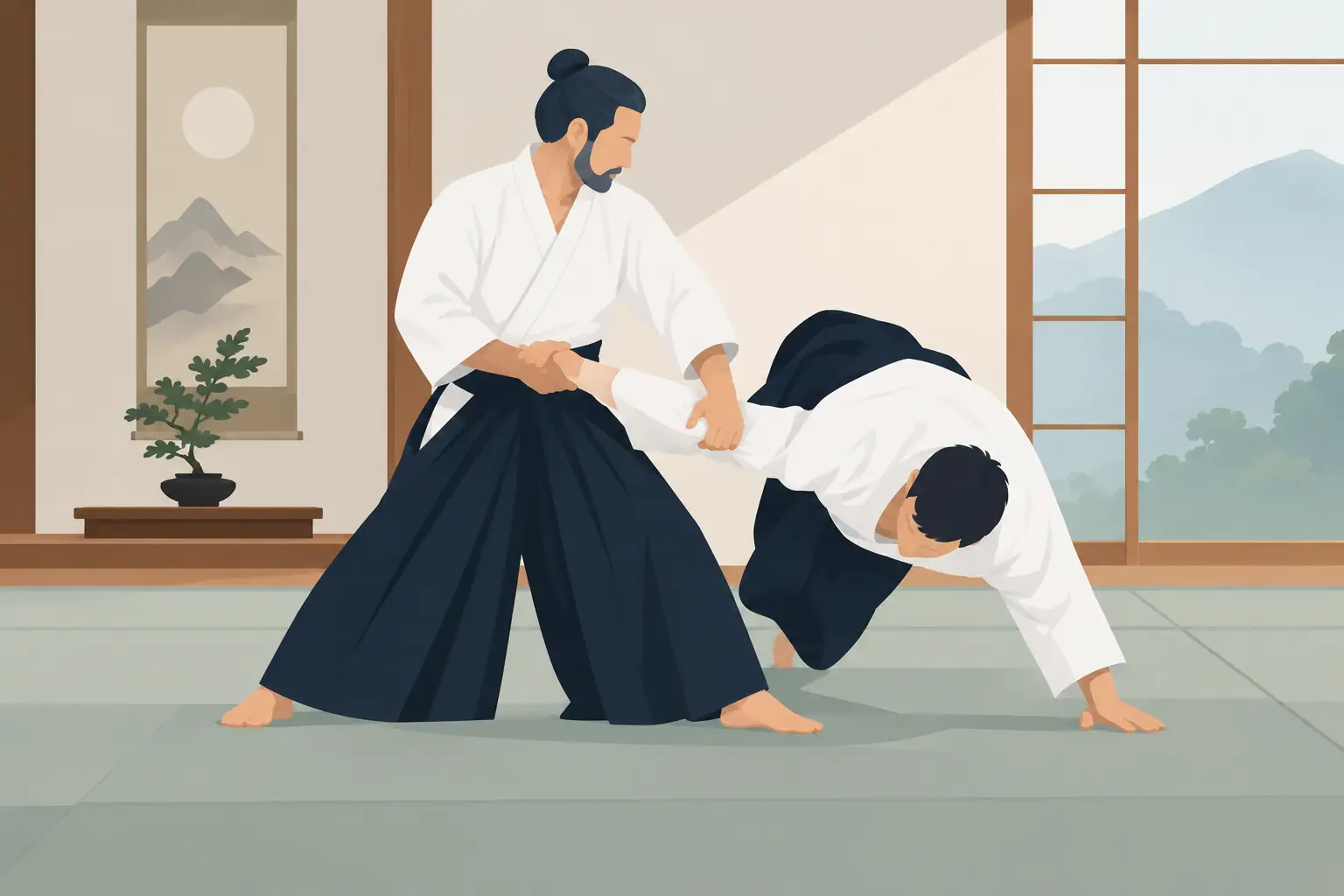
Aikido is a Japanese martial art built around balance, timing, awareness and controlled technique. Students learn to receive an attack without simply meeting force with force, then use movement, positioning and technique to control the situation.
For a family choosing a martial arts school, or an adult returning to training after years away, the word “traditional” deserves a closer look. It should mean more than Japanese uniforms and formal language. It should be visible in what the school teaches, how students train and the standards the instructor maintains.
What Makes a Traditional Aikido School?
A traditional Aikido school preserves the principles, techniques and etiquette passed down through an established teaching lineage. Students train in a dojo, wear a gi, bow at appropriate times and learn to treat instructors and training partners with respect. These customs are not decoration. They help establish attention, humility and responsibility on the mat.
Technique should also be taught progressively. Beginners are not expected to perform advanced falls or complicated techniques on their first day. They begin with posture, footwork, distance and ukemi — the art of safely receiving techniques through rolls, falls and recovery.
Repetition is an important part of traditional training. Students may practice the same technique many times while learning increasingly subtle details of balance, timing, position and movement. The goal is not simply to memorize what a technique looks like, but to understand why it works.
Why Lineage Matters
Aikido has been passed from teacher to student through generations of instructors. A clear Aikido lineage helps connect a dojo to established technical standards, training principles and the history of the art.
For a prospective student, lineage also answers a simple question: Who taught the instructor?
Lineage alone does not make someone a good teacher. Its value should appear in everyday training through sound technique, careful correction, appropriate etiquette and a consistent method of developing students over time.
At Tri City Aikido, instruction is led by Anthony Campagna Sensei, 5th Dan Aikikai. Tri City Aikido is a branch dojo of Kumano Jyuku in Shingu, Japan, continuing the teaching lineage of Tasaka Shihan and Hikitsuchi Michio Sensei, 10th Dan.
That connection is not simply something displayed on a wall. It influences how Aikido is taught and practiced on the mat.
Safety Should Be Taught from the Beginning
One of the first skills students should learn is ukemi — how to receive a technique safely. Students gradually learn how to protect themselves, roll with movement, fall appropriately and recover their balance.
Partner training also requires responsibility. Throws, pins and joint controls cannot be practiced safely if students are trying to overpower one another. The person performing the technique learns control, while the receiving partner learns how to move, respond and communicate.
A good instructor adjusts training for age, experience and physical ability. This is particularly important with children. A children's class should not simply be an adult class performed by smaller people. Young students need instruction appropriate to their coordination, attention span and stage of development.
What Students Should Actually Learn
A traditional Aikido curriculum should develop more than a collection of throws and wrist techniques. Students should gradually improve posture, balance, coordination, timing, distance and awareness.
They should also learn how to remain composed while working with another person. Children can develop listening skills and self-control. Teenagers can build confidence without needing to prove themselves through competition. Adults can challenge themselves physically while learning to move more efficiently rather than relying entirely on strength.
Self-defense should be taught honestly as well. No martial art can guarantee the outcome of a confrontation. Awareness, distance, judgment and avoiding unnecessary conflict are important parts of protecting yourself. Physical technique is one part of a much larger picture.
Weapons Training Has a Purpose
Traditional Aikido weapons training commonly includes the bokken, a wooden sword, and jo, a wooden staff.
Weapons are not included simply because they look traditional. They teach distance, posture, timing, coordination and awareness of the line of an attack. They can also help students understand movements found within empty-hand Aikido techniques.
Because weapons demand additional responsibility, they should be introduced at an appropriate level and practiced under supervision.
Aikido Does Not Require Competition
Most traditional Aikido schools do not build their training around tournaments. Students may test for rank, but progress is primarily measured through consistent practice, technical development, etiquette and the ability to train responsibly with others.
This non-competitive approach to Aikido can be particularly appealing to people who want martial arts training without a constant emphasis on winning and losing.
That does not make training easy. The challenge becomes improving yourself: better balance, better timing, better awareness and better control than you had before.
How to Choose a Traditional Aikido Dojo
A first visit can tell you a great deal. Watch how the instructor treats beginners, how experienced students work with newer students and whether children are actively supervised. A good dojo should feel disciplined without feeling intimidating.
When comparing Aikido schools, consider a few basic questions:
- What is the instructor's rank, teaching experience and lineage?
- How are beginners taught to roll, fall and train safely?
- Are children and adults taught according to their age and ability?
- Does the school teach both technique and the principles behind it?
- What does long-term progression look like?
Be cautious of promises of rapid black-belt advancement, guaranteed self-defense results or pressure to make a major commitment before experiencing the school yourself. Traditional martial arts training takes time.
See the Dojo for Yourself
The best way to understand an Aikido school is to experience it. A free introductory class allows parents to observe the teaching environment, children to experience the class structure and adults to see how the training feels firsthand.
At Tri City Aikido in Fremont, beginners are welcome to experience traditional Aikido without previous martial arts experience. The first goal is not to perform an impressive technique. It is to learn how to stand, move, fall safely and work respectfully with another person.
Those simple lessons become the foundation for everything that follows.