
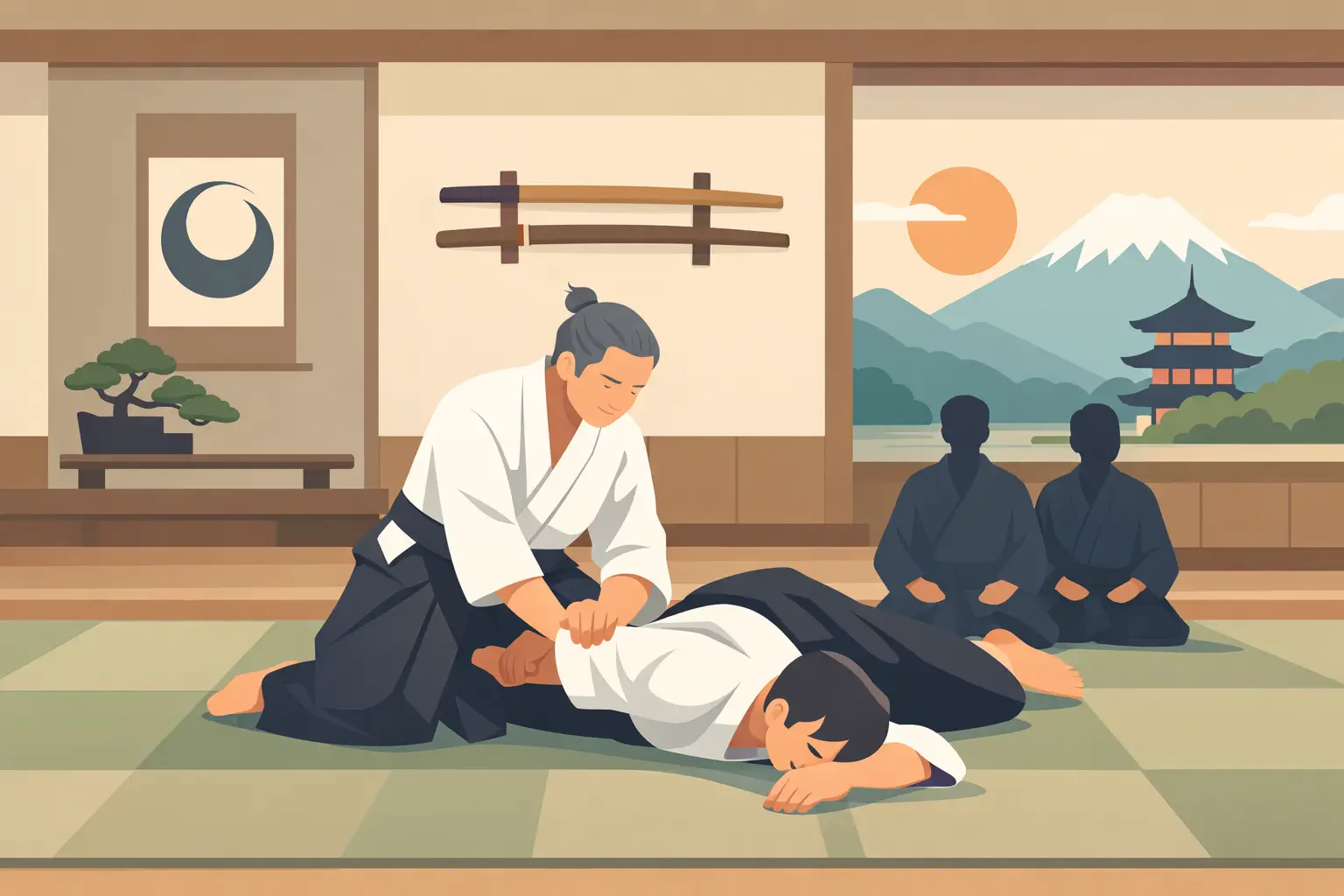
Aikido is often recognized for flowing throws and circular movement, but there is much more to the art. Traditional training develops awareness, balance, composure and responsibility toward a training partner. For children and adults looking for a long-term martial art, choosing the right dojo means finding a school that teaches with care, technical depth and a genuine connection to Aikido's Japanese roots.
What Makes Traditional Japanese Aikido Different?
Aikido is a non-competitive martial art. Students do not train to win trophies or defeat classmates. Instead, they learn to respond to an attack through posture, movement, timing, distance and control.
A technique may end in a throw, joint control or immobilization, but the objective is not aggression. Students learn to control themselves first and then the situation in front of them.
That principle shapes the atmosphere of a traditional dojo. Students bow when entering the mat, follow established etiquette, listen closely and take responsibility for one another's safety. These practices are not simply ceremony. They create the concentration and mutual respect necessary to safely practise a martial art involving throws, joint techniques and controlled falling.
Progress is also treated as a process rather than a race toward the next belt. Beginners first develop reliable basics: how to stand, move, receive a technique and protect themselves when falling. More advanced techniques make greater sense as those foundations improve.
What Happens in a Traditional Aikido Class?
Classes follow an organized structure even though the techniques may change from day to day. Training typically begins with bowing in, warm-up movements and exercises that prepare the body for practice. Students then work on movement, posture and safe rolling or falling before studying techniques in greater detail.
Aikido techniques are practised with a partner. One student provides the attack while the other performs the defensive movement, and then the roles reverse. Learning both sides is important. Students experience how a technique works while also learning how to provide a controlled, realistic attack and safely receive the technique.
Safe ukemi, the practice of receiving techniques and falling correctly, is particularly important for beginners. Students gradually learn how to protect themselves, distribute impact and remain relaxed while moving.
Children often develop confidence through this process. Adults sometimes need more time to overcome the natural instinct to stiffen their bodies or reach toward the floor when falling. There is nothing unusual about either response. Ukemi is taught progressively as the student's confidence and ability develop.
As students advance, training includes more refined throws, joint controls, pins and traditional Aikido weapons training with the bokken and jo. Weapons practice develops distance, timing, line, posture and awareness while reinforcing principles found in empty-hand Aikido.
A Martial Art That Welcomes Beginners
Many prospective students wonder whether they are too old, out of shape or inexperienced to begin Aikido. Others may have trained in another martial art years ago and are unsure what to expect when returning to the mat.
Beginners are not expected to arrive knowing how to roll, fall or perform techniques. The first priorities are learning how the dojo operates, how to move safely and how to practise respectfully with other students.
Aikido still requires effort. Students learn through repetition, concentration and consistent practice. But progress does not depend entirely on speed, strength or athletic ability.
Someone whose primary goal is competition or high-intensity sparring may prefer a different martial art. Traditional Aikido is particularly suited to people interested in studying technique, improving how they move under pressure and training cooperatively rather than competing against their partners.
For people considering starting Aikido in their 30s, 40s, 50s or beyond, this can be especially important. Better balance, coordination, awareness and efficient movement remain meaningful goals regardless of age.
Why Age-Specific Aikido Classes Matter for Children
Children do not learn in the same way as adults, and a four-year-old should not be expected to train like a thirteen-year-old. Age-specific children's classes allow instruction to match a child's attention span, coordination, physical development and ability to work with a partner.
For younger children, important lessons include listening, taking turns, following directions and learning to move safely around others. As children mature, they can take on more detailed technique, stronger posture, controlled partner practice and greater responsibility for their training partners.
The benefits can extend beyond the dojo. A child who regularly practises listening, waiting, concentrating and trying again after making a mistake is developing useful habits. Confidence develops through accomplishing progressively more difficult tasks rather than simply being told to be confident.
Not every child immediately feels comfortable in a new martial-arts environment. Some need time to become familiar with the instructor, other students and physical contact involved in training. A good children's program allows that adjustment while maintaining clear standards for safety, attention and respectful behavior.
Lineage Is More Than a Name on the Wall
In traditional Japanese martial arts, lineage identifies the teachers and traditions that shaped how an art is passed from one generation to the next. It influences technique, etiquette, weapons training and the underlying principles of the dojo.
Tri City Aikido is affiliated with Kumano Jyuku Dojo in Shingu, Japan. Anthony Campagna Sensei, 5th Dan Aikikai, has trained in Aikido since 1986 and founded Tri City Aikido in 1996.
The dojo follows the Aikido lineage of Tasaka Shihan, 7th Dan, a longtime student of Hikitsuchi Michio Sensei, 10th Dan. Hikitsuchi Sensei was one of the senior students of Aikido founder Morihei Ueshiba, commonly called O-Sensei.
For a beginning student, those names may not mean much on the first day. Over time, however, lineage provides context for why techniques are practised in a particular way and why etiquette, weapons training and other traditions remain part of the dojo.
Lineage alone does not make someone a good teacher. Good instruction still requires patience, clear demonstrations, experience and attention to student safety. What lineage provides is a connection to the source and history of the art being taught.
Choosing an Aikido Dojo in Fremont
Before joining a dojo, pay attention to how people train together. Are beginners helped by more experienced students? Is the instructor clear about expectations? Does training appear controlled and focused? Are students respectful toward one another?
It is also worth asking how beginners are introduced to rolling, falling and partner practice. These skills should develop progressively. Children and adults should not be pressured to perform movements beyond their present ability simply to keep up with the class.
Tri City Aikido offers a free guest class so prospective students can experience the dojo before deciding whether to join. Arrive about 15 minutes early, wear comfortable clothing and expect to be a beginner. Your first class is not a test.
Traditional Aikido is learned one class at a time. Students develop better movement, awareness, self-control and respect for their training partners through consistent practice. For those looking for traditional Japanese Aikido in Fremont, the first step is simply getting onto the mat.