Practical Aikido teaches you how to move when someone is trying to control you, maintain your balance while disrupting theirs, get off the line of an attack, control distance, fall without panicking, and respond without relying entirely on strength.
Those aren't theories. They're physical skills, and the only way to develop them is to train.
At Tri City Aikido, we don't expect someone walking into their first class to already know how to defend themselves. That's why they're coming to us. We start with movement and basic principles, and then we build from there.
Self-Defense Starts Before the Technique
When people think about self-defense, they often picture the final technique: the throw, joint lock, pin, punch, or escape.
We're interested in what happened before that.
There are three parts to the scenario: the beginning, the middle, and the end. The beginning is by far the most important part of any physical engagement. Without a good beginning, you may never make it to the middle or the end.
This is where awareness becomes critical.
Did you see the problem developing before the physical engagement? How was your stance? Were you standing naturally or had the situation already caused you to change your posture? Did the person enter your maai, or personal space? Did the situation take your mind? What happened to your balance?
When someone grabbed or pushed you, did you stiffen and immediately fight force with force, or were you in a position of confidence that allowed you to move freely?
 Aikido spends a tremendous amount of time developing awareness, posture, and an understanding of space because a technique isn't very useful if you've already lost your center of mind. When your mind is taken, your physical balance can quickly follow. You become like a deer in the headlights: frozen in place while the situation continues developing around you.
That's a terrible position to be in, and it's something we specifically train to overcome.
The better prepared you are, the more naturally movement becomes part of your makeup. In a crisis, you shouldn't have to consciously debate every step. Training is designed to make the response increasingly natural.
Balance Matters More Than Most People Realize
Aikido teaches you to become increasingly aware of both balance of mind and balance of body while simultaneously learning how to affect someone else's balance.
Instead of concentrating only on someone's arm or the hand that's grabbing you, you learn to pay attention to the entire body.
Once someone's balance is compromised, the structural integrity of the body has also been compromised. This is the principle of kuzushi.
Kuzushi is the off-balancing process that takes place before a technique is applied. When kuzushi is accomplished correctly, the person applying the technique often discovers that only a fraction of the previous effort is necessary to produce the result.
This is where some of the magic happens on the mat.
When a student first begins to truly understand kuzushi, there's often an epiphany. Something that previously required considerable effort suddenly doesn't. It's the secret sauce that can make many techniques feel almost effortless.
Once you understand that acquiring kuzushi doesn't necessarily require strength, your understanding of martial arts can be turned on its head. Strength becomes less important because you've entered a much more efficient realm of practice where effort is minimized and power is optimized.
That's the best of two worlds and one of the reasons Aikido can remain a viable martial art well into a person's later years. Your ability doesn't have to depend entirely on being younger, bigger, or stronger than the other person.
Moving Is Better Than Fighting Strength
If someone stronger grabs you, trying to win a strength contest may not be the best plan.
Aikido teaches you to intercept the attack, giving you a head start that can make the difference between success and failure.
You learn to step, turn, change angles, redirect pressure, and use your whole body rather than isolating your arms and shoulders. Instead of meeting force directly whenever possible, you learn to change the relationship between yourself and the other person.
That sounds simple. Making it happen naturally takes practice, and that practice needs to take place in a qualified Aikido dojo.
In fact, here's a worthwhile question to ask when visiting an Aikido school:
Do you teach Aikido as a martial art where I can actually learn to defend myself?
Not every Aikido dojo approaches training the same way. Some schools have little interest in the combat application of the art. If practical martial ability is one of your reasons for training, you should know that before you join.
At Tri City Aikido, the martial application matters. We're not interested in simply going through the motions. We want students to understand what they're doing, why they're doing it, and what makes the technique work.
Why Do Aikido Students Practice Predictable Attacks?
The answer is simple: repetition is the mother of all skill.
If you want to become good at anything, you have to repeat it until the mechanics no longer require constant conscious thought. A staged attack initially produces predictable circumstances that allow the student to learn.
As experience develops, attacks can become less predictable. By then, the student has enough experience to recognize the differences and respond appropriately without having to stop and consciously analyze every movement.
Beginners often practice with a specific grab or strike because they're learning something new. This removes some of the anxiety of having someone trying to knock your block off while you're still figuring out which foot you're supposed to move.
The student can relax and concentrate on the fundamentals.
If I'm teaching someone footwork, how to turn their hips, where their hands belong, and how to maintain their balance, I need to give them enough time to actually learn those things before allowing a full-on attack to take place.
Preparation is key to success.
You don't teach someone to drive by putting them onto Interstate 880 during rush hour for their first driving lesson, do you?
You start in a controlled environment that produces predictable results.
The same principle applies to martial arts. First we establish the movement. As the student improves, the attack can become stronger, timing can change, movement becomes faster, and the student has less time to think.
Cooperative training doesn't mean pretending a technique works. It allows both people to develop skill without injuring each other before they've learned how to train safely.
Aikido Gives You More Than One Answer
Not every physical confrontation requires the same response.
There's a big difference between dealing with someone intent on seriously hurting you and dealing with an intoxicated friend, an aggressive family member, an out-of-control teenager, or someone whose behavior needs to be controlled without unnecessarily injuring them.
Aikido provides restraint options that many martial arts don't emphasize.
Training includes movement, escapes, balance disruption, throws, joint controls, and pins. As your experience increases, you begin to understand that the technique isn't always about doing the maximum amount of damage possible.
Sometimes creating space is enough. Sometimes controlling someone's balance is enough. Sometimes restraint is the appropriate response.
Having choices isn't only sensible. It's practical.
Getting Comfortable With Physical Contact Matters
Many adults haven't been grabbed, pushed, pulled, or physically controlled since they were kids.
Now imagine trying to make good decisions the first time that happens during a stressful confrontation.
Regular martial arts training changes your relationship with physical contact.
Someone grabs your wrist and you don't immediately panic. Someone pulls you and your feet know they need to move. You lose your balance and your first reaction isn't necessarily to throw your hands straight toward the ground.
You become more comfortable functioning while another person is physically interacting with you.
That doesn't make anyone invincible. It makes the situation less unfamiliar.
The “What If” Scenario
Aikido is typically taught and practiced in a way that prevents unnecessary harm to both practitioners. A tremendous amount of time is spent learning how to receive a technique and minimize injury. On the other side, the person executing the technique must learn how to control what they're doing so they don't injure their training partner.
But what happens when those safeguards are removed?
Let's assume an Aikido practitioner successfully responds to a serious attack outside the dojo. It's a high-intensity situation. Adrenaline is pumping, the attacker is resisting, and the Aikido practitioner is responding without the controlled cooperation normally found between training partners.
That changes things dramatically.
A joint lock that is normally applied with control in the dojo may meet violent resistance and result in severe injury or a break. A throw that a trained partner would normally receive with proper ukemi may instead send an untrained attacker hard into the ground.
They may instinctively attempt to stop the fall with an outstretched hand and suffer a wrist or arm injury. A knee, shoulder, head, or neck may take the impact. On a hard surface, the consequences can become extremely serious.
This is one of the things people sometimes miss when watching cooperative Aikido practice. The person receiving the technique has also been trained. Ukemi isn't simply falling down for your partner. It's a skill designed to protect you from what is happening to your body.
Remove that training, remove the cooperation, add resistance and adrenaline, and the same technique can have a very different outcome.
The art that is often interpreted as passive can quickly become the opposite when the situation demands it.
Does Size and Strength Still Matter?
Of course it does.
If two people have exactly the same skill and one is significantly larger and stronger, pretending physical differences don't matter would be foolish.
The purpose of technique is to reduce how much you have to depend on those advantages.
Good positioning, balance, timing, leverage, and movement allow a smaller person to accomplish things that would be extremely difficult through muscle alone.
That's one of the lessons students experience quickly in Aikido. Trying harder isn't always the solution. Sometimes the technique begins working when you stop trying to overpower the other person and start moving correctly.
Weapons Training Has a Practical Purpose
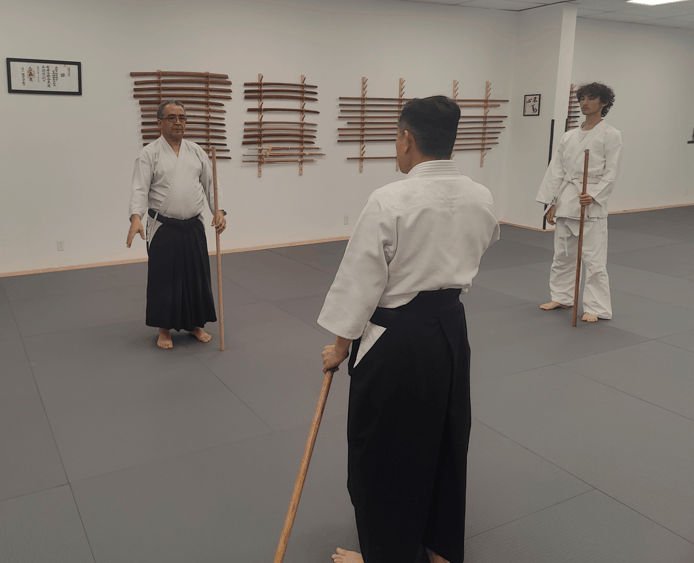
Traditional Aikido includes practice with the bokken and jo, a wooden sword and staff.
We're obviously not expecting our students to walk around Fremont carrying wooden swords.
What may not be as obvious is how the principles learned through weapons can apply to other objects. Something as simple as a ballpoint pen can potentially be used in much the same way a small weapon might be used. In the wrong circumstances, even an everyday object can become extremely dangerous.
Weapons training also changes the way you understand distance.
Proper distance becomes very obvious when someone has a sword in their hands. Moving off the line suddenly makes much more sense. Posture, timing, coordination, focus, and understanding where an attack is traveling become much easier to recognize.
But weapons training isn't only about avoiding the incoming attack. A weapon has an offensive purpose as well. Placement matters because a properly delivered strike can disable the attacker's ability to continue.
For example, if an assailant attacks with an object such as a bat, the response doesn't necessarily have to be a strike to the head. A properly delivered strike to the attacking wrist can severely damage or break it, potentially eliminating that person's ability to continue holding the weapon.
That's a game changer.
These lessons transfer back into empty-hand Aikido as well. Distance, timing, line of attack, targeting, commitment, and decisive movement don't disappear simply because the weapon is removed.
You can learn more about why we practice with weapons in Aikido, but the important point is that weapons are part of the martial training system, not something we added because they look impressive.
Can Aikido Prepare You for Everything?
No martial art can prepare you for everything.
Real violence is unpredictable. There can be weapons, multiple people, surprise attacks, drugs, alcohol, concrete, and countless other variables.
That's one reason practical empty-hand training continues to matter.
Over the decades, law-enforcement officers have come to train with us because not every physical encounter can or should be solved with a weapon. An officer who becomes overly dependent on a sidearm still needs options when a situation requires empty-hand movement, control, restraint, or the ability to respond at close range.
Aikido develops awareness, movement, balance, timing, coordination, distance, control, and the ability to function while another person is physically pressuring you.
Those skills give you something to work with when a situation doesn't look exactly like something you've practiced before.
Don't Decide Whether Aikido Is Practical by Watching It
This may be the most important point.
Aikido is difficult to judge from a video or even from an article like this one.
You can watch someone being thrown and decide the technique looks effortless, unrealistic, impressive, or anything else you want.
You aren't feeling what's happening.
So try it.
Let someone grab your wrist. Feel what happens when your balance changes. Try moving someone using only your arms, and then feel the difference when you're shown how to use your whole body. Learn how changing one step or one angle changes the amount of effort required.
Experience kuzushi rather than just reading about it.
Learn your first fall.
Then decide whether Aikido feels practical to you.
The Best Answer Is on the Mat
You can read articles arguing about whether Aikido works. You can watch videos. You can read comments from people who love it and people who hate it.
None of them have your body, your goals, your age, your strengths, or your limitations.
There's a much easier way to get your answer.
Come train.
Tri City Aikido offers a free introductory class for adults who want to experience traditional Aikido firsthand. You don't need martial arts experience, and you don't need to be in perfect shape before you start.
We'll show you how we train. You'll move, work with another person, experience some of the principles we've discussed here, and have an opportunity to ask questions.
Then you can answer the question for yourself.
Is Aikido practical?
Step onto the mat and find out.