
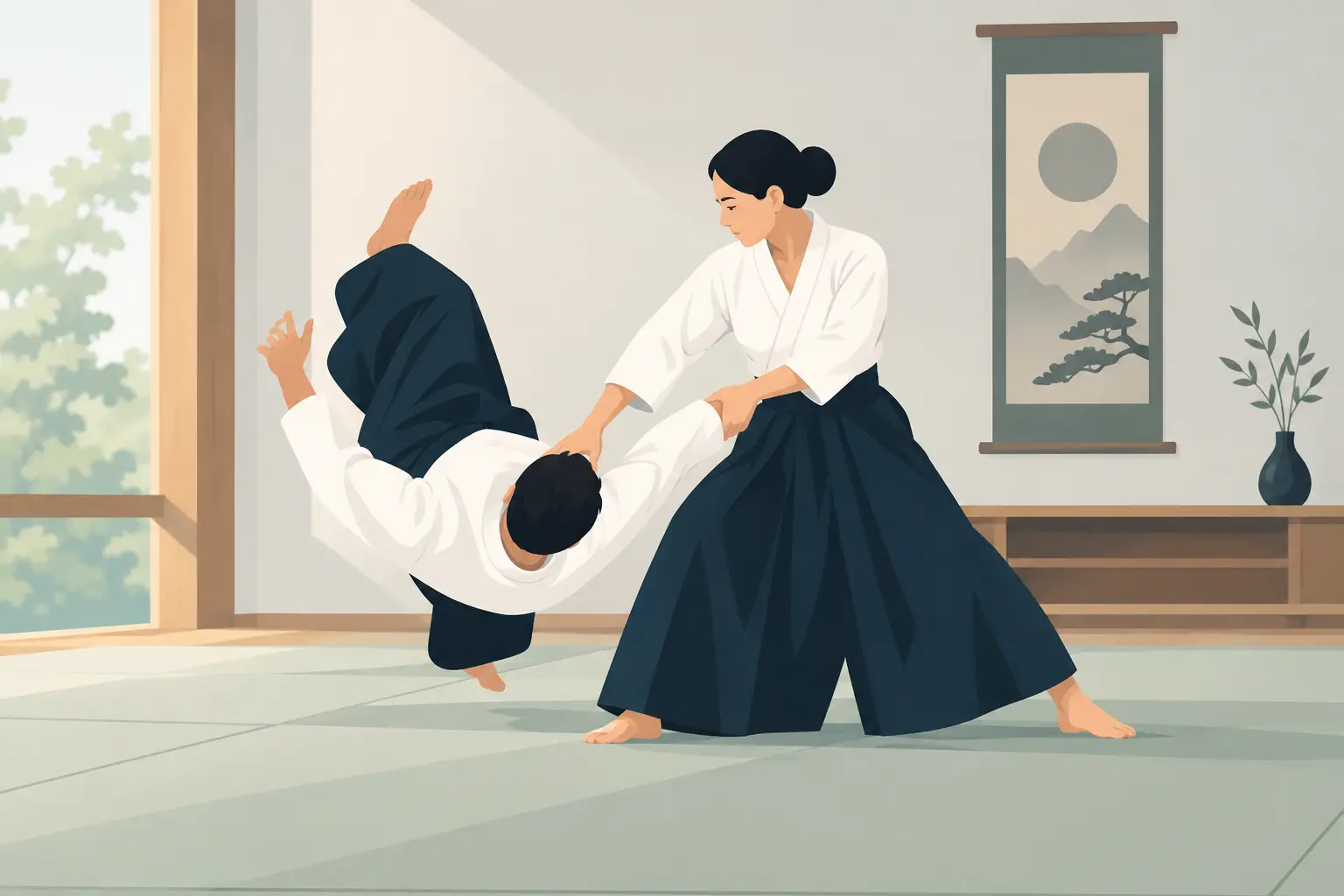
Think about other martial arts. When a boxer hits a speed bag, that's training, not fighting. When a wrestler runs to improve conditioning, that's training. When a Judo practitioner repeatedly works on falling skills, that's training too.
Nobody questions whether those activities have value simply because nobody is fighting.
Aikido is no different.
We practice falling. We practice timing, distance, balance, footwork and technique. We practice with the sword and staff. We repeat movements until something that once felt awkward begins to feel natural.
Every one of those exercises has a purpose, and none of them needs to be a fight to have value.
Is Aikido Non-Competitive?
Yes. Traditional Aikido is generally practiced without tournaments, scoreboards or the objective of defeating the person standing across from you.
That doesn't mean there is no challenge.
In Aikido, the challenge is improvement.
Can you move better than you did six months ago? Can you maintain your balance while someone is trying to disrupt it? Can you receive a technique safely? Can you perform a technique without depending entirely on strength? Can you remain relaxed when the attack becomes faster?
These are training goals.
Your partner isn't standing in the way of achieving them. Your partner is helping you achieve them.
That is one of the important differences between traditional non-competitive Aikido and martial arts built around competition.
Training and Fighting Are Not the Same Thing
Some people have difficulty separating martial arts training from fighting.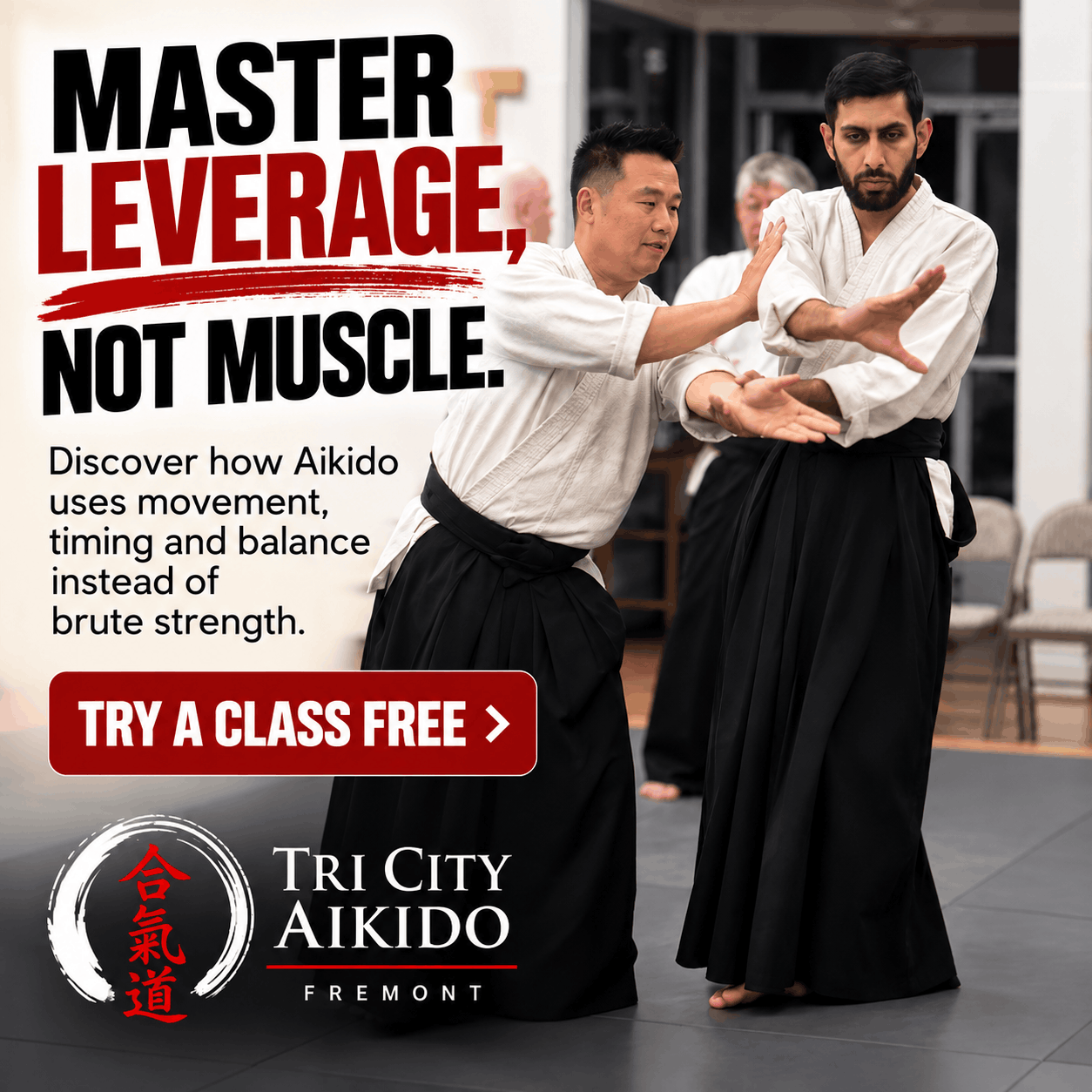
If nobody is trying to knock someone out, score a point or force a submission, they may wonder what is being accomplished.
But nearly every martial art develops skills through practice that doesn't resemble an actual fight.
A boxer can spend hundreds of hours hitting bags, jumping rope, shadowboxing and working mitts. A wrestler conditions, drills positions and repeats movements. A Judo student may practice the same fall or throw again and again.
Those aren't fights.
They're training.
Aikido uses the same principle.
A student practicing a forward roll is learning how to protect the body during a fall. A student repeatedly moving off the line of an attack is developing timing and distance. Technique practice develops balance, coordination and the ability to work with another moving person.
Bokken and jo practice develops additional skills involving posture, distance, movement, awareness and precision.
What someone sees while watching an Aikido class is usually not supposed to be a fight.
They're watching people train.
Why Aikido Can Be Misunderstood
Aikido can be particularly easy to misunderstand because many of its movements are flowing.
People are also accustomed to seeing martial arts presented as entertainment. Competitive martial arts are easy to understand from the outside. There are two competitors, rules, points, submissions, knockouts, winners and losers.
The audience immediately knows what is happening.
Aikido practice wasn't designed for an audience.
Someone may spend part of a class improving one small piece of footwork. Another student may repeatedly practice receiving a throw. Two experienced students may be working on timing that is difficult for an observer to recognize.
There may be no dramatic conclusion and nobody standing victorious at the end.
That doesn't mean the training lacks substance.
The purpose is improvement, not entertainment.
You Don't Have to Fight to Train Hard
Non-competitive doesn't mean effortless.
During an Aikido class, you're getting up and down from the mat, working with different partners, changing direction, maintaining posture and repeatedly moving your body through techniques.
Your heart starts beating harder. You sweat. You breathe harder.
And then the endorphins kick in.
That's one of the enjoyable parts of training.
You can exercise by running, riding a bicycle or spending an hour on a machine at the gym. Those are all perfectly good ways to stay active.
Martial arts training offers something different.
While your body is working, your mind is occupied with learning something. You're trying to understand a movement, improve your timing, work with a partner or figure out why something isn't working.
A technique that felt impossible a few weeks earlier suddenly works. A roll that once made you uncomfortable becomes natural. You respond correctly without having to think through every movement.
Training can be exhilarating without being combat.
There Is a Social Side to Martial Arts
Another benefit rarely appears in debates about whether a martial art is effective.
You meet people.
A dojo is a social environment built around doing something together.
You train with different partners. You struggle with the same techniques. You help each other improve. You laugh when something goes completely wrong. Experienced students help beginners, and eventually those beginners become the people helping someone else.
Over time, friendships develop naturally.
That's very different from walking into a gym, putting on headphones, exercising by yourself and going home.
For adults especially, opportunities to regularly meet people while doing something healthy and interesting can become less common as life gets busier.
Martial arts training can provide exercise, learning and social interaction at the same time.
The Person Across From You Isn't the Enemy
Traditional Aikido depends on partners.
One person provides an attack while the other practices the technique. Then the roles reverse.
The objective isn't to prove that the technique works by injuring the other person. The goal is to provide enough resistance and energy for meaningful practice while allowing both people to continue training safely.
That cooperation shouldn't be confused with doing nothing.
A good training partner doesn't simply collapse. The attack should have direction and intent appropriate to the student's experience. As ability improves, speed and difficulty can increase.
Both people have a responsibility to one another.
You need your partner to improve, and your partner needs you.
That relationship can create an entirely different atmosphere from one where success requires someone else to lose.
What About Self-Defense?
Aikido is a martial art. Traditional training includes strikes, grabs, throws, joint controls, pins, movement, falling and weapons practice.
But studying a martial art doesn't mean looking for opportunities to fight.
Fighting is stupid when it can be avoided.
A real confrontation doesn't have a referee, a weight class or a guarantee that the other person is unarmed. People can suffer life-changing injuries over situations that weren't worth fighting about in the first place.
Walking away when you can isn't weakness. It's judgment.
Training gives us an environment where physical skills can be developed without requiring actual violence to practice them.
And if those skills are ever truly needed, the hope is that training has given the student better movement, awareness, composure and physical confidence than they would have had without it.
Most People Are Spectators
There is another reason to train that has almost nothing to do with fighting.
Participation.
Modern life gives us endless opportunities to watch other people do things. We watch sports. We watch videos. We scroll through social media. We watch other people exercise, compete, travel, build things, learn skills and have experiences.
It's very easy to become a spectator of life.
Walking onto the mat changes that.
Now you're the person doing something.
You're learning to roll. You're holding the sword. You're trying the technique. You're sweating. You're making mistakes. You're laughing with the person you're training with. You're discovering things your body couldn't do six months ago.
You aren't watching someone else's experience.
You're having one of your own.
Participation sets you apart from the pack.
Maybe Training Is What You Were Looking For
At Tri City Aikido in Fremont, we practice traditional, non-competitive Aikido. There are no tournaments to prepare for and no scoreboard determining whether your evening was successful.
You train.
You learn how to roll and fall. You practice throws and controls. You work on balance, timing, movement and awareness. As your experience grows, you can study the bokken and jo.
You exercise. Your heart gets pumping. You meet people. You learn something difficult. You have good days and frustrating days, and eventually you discover that things you once struggled with have become part of you.
You don't need previous martial arts experience. You don't need to be naturally athletic. And you certainly don't need to want to fight.
You just have to be willing to participate.
If you've spent enough time watching martial arts and wondering what it would be like to actually train, try a class at Tri City Aikido.
Don't come to watch Aikido. Come find out what it feels like to do it.