
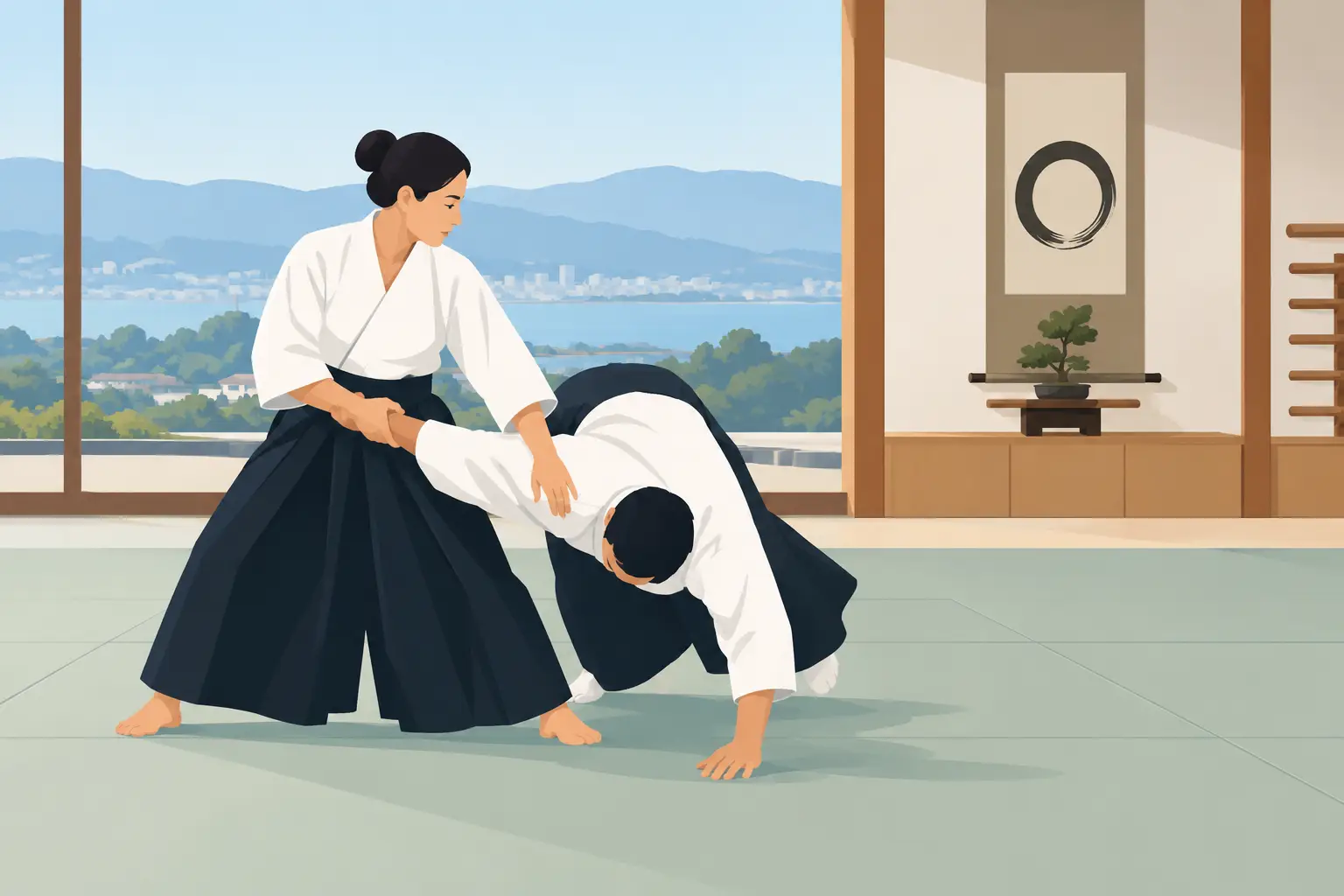
Watch what happens when a beginner makes a mistake.
Watch how an experienced student trains with someone who has been practicing for only a few weeks. Notice whether questions are welcomed, whether techniques are explained rather than simply demonstrated, and whether students seem genuinely interested in helping one another improve.
Those things tell you much more about an Aikido dojo than a collection of black belts hanging on the wall.
Start With the Instructor
An experienced Aikido instructor should obviously be able to perform the techniques being taught. But being able to perform Aikido and being able to teach Aikido are two different skills.
A good instructor should be able to take a technique that may have required decades to develop and break it into pieces a beginner can understand.
That means explaining posture, balance, movement, timing, leverage and the purpose behind the technique rather than simply asking students to imitate what they saw.
It also means recognizing that students learn differently.
A 20-year-old athlete, a 45-year-old beginner and someone with previous martial arts experience may all be standing on the same mat, but they won't necessarily need the same instruction.
The standard doesn't have to change. The path used to get each student there sometimes does.
Ask About the Instructor's Aikido Background
Aikido has been passed from teacher to student for generations. If you're considering a dojo, it's perfectly reasonable to ask where its Aikido comes from.
Who taught the instructor? How long have they trained? What organization recognizes their rank? Does the dojo maintain a relationship with the people and tradition from which its Aikido developed?
Tri City Aikido instructor Anthony Campagna Sensei began practicing Aikido in 1986 and holds the rank of 5th Dan through the Aikikai Foundation in Japan. Tri City Aikido is a branch of Kumano Jyuku, under Tasaka Shihan, 7th Dan, a student of Hikitsuchi Sensei, 10th Dan.
You can read more about our Aikido lineage and where our teaching comes from.
Lineage isn't a guarantee that every dojo will be right for you. But you should be able to trace the instructor's training and understand the tradition you're being asked to become part of.
Watch How Beginners Are Treated
This may be one of the best ways to evaluate an Aikido dojo. A short visit to Tri City Aikido in Fremont can answer dozens of questions in a very short amount of time.
An experienced student doesn't prove anything by overwhelming a beginner.
When senior students work with someone new at Tri City Aikido, they're expected to adjust their training appropriately. A beginner needs enough energy to understand how the technique works, but also enough time to learn where to step, how to move and how to receive the technique safely.
As the beginner develops, the training can become more demanding.
That's very different from throwing a new student into the deep end and expecting them to survive until they figure it out.
Look at the Students, Not Just the Instructor
The instructor establishes the standards of the dojo, but eventually those standards become visible in the students.
Watch an advanced student practice with a beginner.
Does the senior student slow down when necessary? Do they help without trying to become the instructor? Can they practice seriously without turning every technique into a contest?
Those behaviors don't happen accidentally. They develop from the culture of the dojo.
At Tri City Aikido, training is cooperative rather than competitive. Students take turns performing and receiving techniques. We aren't preparing for tournaments, and there is no prize for overpowering the person standing across from you.
Our goal is to make each other better.
Aikido Shouldn't Depend on Strength
Watch how techniques are performed.
If every technique requires the larger or stronger person to force the smaller person into position, something important is missing.
Aikido teaches students to use movement, position, balance, timing and leverage rather than simply matching strength against strength.
That doesn't mean Aikido is effortless. Developing good technique takes work. But physical strength shouldn't be the requirement that determines whether someone can participate successfully.
This becomes especially apparent when people of different sizes train together. Good technique should allow the student to find the path of least resistance rather than simply trying harder.
Safety Should Be Visible in the Training
Aikido includes throws, pins and joint controls, so safety shouldn't be something a dojo merely talks about. You should be able to see it in the way people practice.
Beginners should learn how to fall and roll progressively. Joint techniques should be applied with control. Students should respond immediately when their partner taps.
Most importantly, beginners shouldn't be expected to perform at the same speed or intensity as experienced students.
Advanced training can become fast and dynamic. That level of practice is earned through experience, not demanded on the first day.
Traditional Doesn't Have to Mean Unwelcoming
Tri City Aikido is a traditional Japanese Aikido dojo.
We bow. We use Japanese terminology. Students learn dojo etiquette, and there is a proper way to begin and end training.
But tradition shouldn't be used to make beginners uncomfortable or afraid to ask questions.
Etiquette gives everyone a common structure. Bowing to your partner is an acknowledgment that you're trusting each other during training. Listening while a technique is demonstrated means everyone begins with the same information.
Our article on what makes a traditional dojo different explains more about why these customs remain part of our training.
Parents Should Watch a Children's Class
If you're choosing an Aikido dojo for your child, don't evaluate the school only by watching the adult class.
Watch how the instructor interacts with children.
Children need structure, but they also need instruction appropriate for their age. A four-year-old doesn't learn the same way as a twelve-year-old.
That's why Tri City Aikido separates children's classes by age. Younger students work on age-appropriate movement, attention and basic Aikido skills, while older children can gradually take on more technical material, including traditional weapons training when appropriate.
Discipline shouldn't mean frightening children into compliance. We want students to learn to listen, concentrate, respect their partners and take responsibility for their own behavior.
Don't Choose a Dojo Based on How Quickly You Can Earn a Black Belt
Rank has a place in Aikido, but it shouldn't become the reason you train.
A black belt represents progress, not completion.
There is no substitute for time on the mat. Students develop through regular practice, and sometimes the most important improvements aren't represented by another belt.
A beginner who once feared falling learns to roll comfortably. A student who depended on strength discovers how to use leverage. Someone who couldn't find their balance begins moving naturally.
Those changes are Aikido too.
Weapons Training Can Tell You Something About the Dojo
Traditional Aikido training can include the bokken (wooden sword) and jo (staff).
At Tri City Aikido, weapons aren't included because they look impressive. They help students understand distance, timing, posture, movement and the origins of many empty-hand techniques.
Our purpose of weapons training in Aikido page explains why they remain an important part of our curriculum.
When evaluating a dojo, look at whether weapons training connects to the Aikido being taught rather than existing as an unrelated activity.
The Best Way to Evaluate an Aikido Dojo Is to Step Onto the Mat
You can learn a lot from a website. You can learn more by watching a class.
But eventually, you need to feel the training for yourself.
Tri City Aikido has been teaching Aikido in the Fremont and Newark community since 1996. We offer traditional, noncompetitive Aikido training for adults and children, from complete beginners through experienced practitioners.
New students don't need previous martial arts experience. You don't need to know how to fall, be especially flexible or already be in great physical condition.
That's what training is for.
If you're comparing Aikido dojos in Fremont, come visit Tri City Aikido and watch how we train. Better yet, try a class. Pay attention to the instructor, the senior students, the beginners and the way people treat one another.
Then decide whether it's the kind of dojo where you'd like to spend your time learning Aikido.