
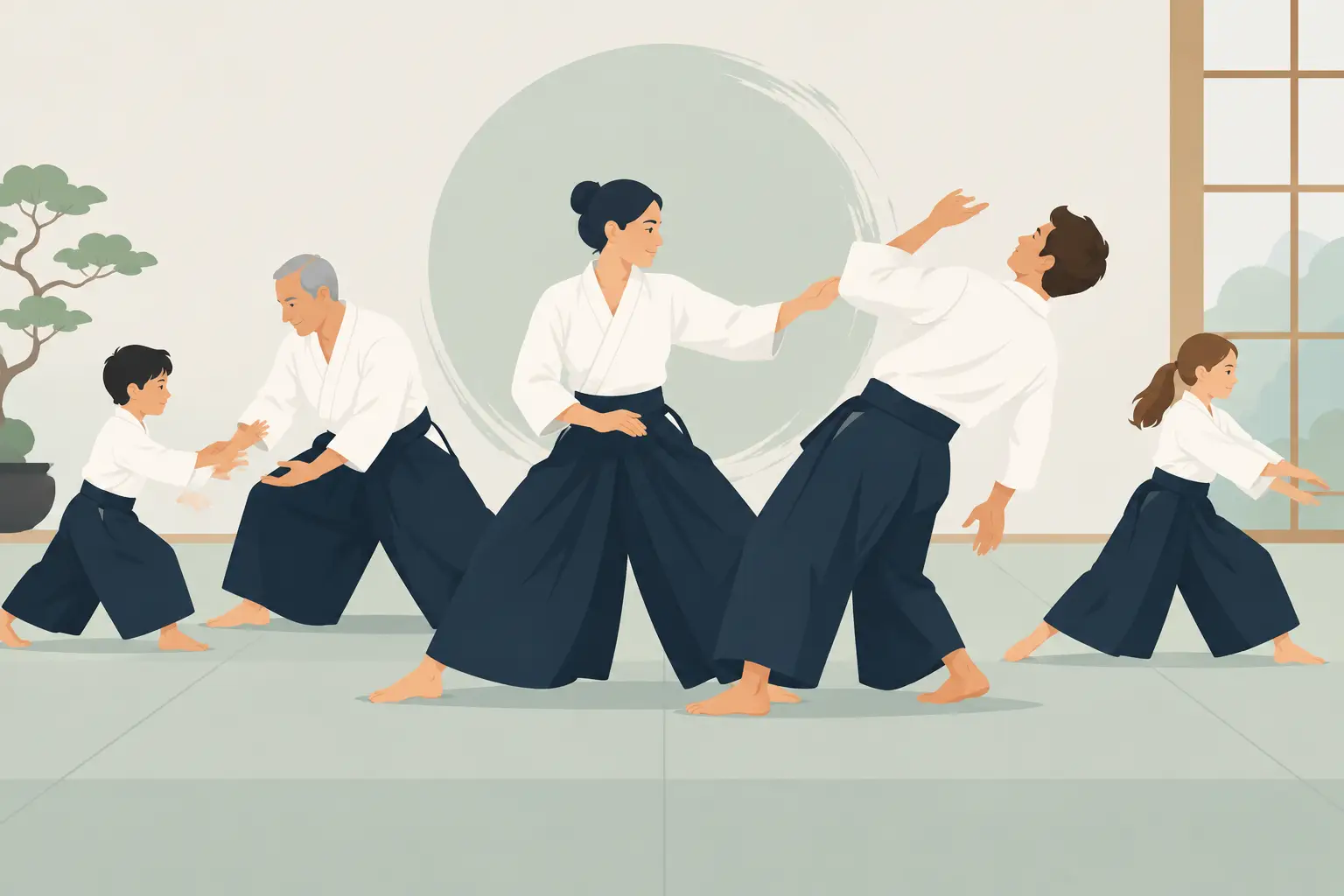
For children, this can mean becoming more aware of their feet, hands, posture and personal space. Teenagers and adults develop balance, timing and more efficient movement. Coordination is not simply something you are born with. It is a skill that can be developed through practice.
Coordination Is More Than Hand-Eye Skill
Many people think of coordination as catching a ball or moving quickly in sports. In Aikido, coordination is broader. It includes knowing where your weight is, turning without losing balance, moving your hands and feet together and adjusting when another person changes direction.
A technique may begin with a step away from the line of an attack, continue with movement of the hips and finish with a controlled pin or throw. Each part depends on the one before it. If the feet are misplaced, the hands have to compensate. If the body becomes stiff, balance and movement become more difficult.
This is one reason Aikido can work well for people who do not consider themselves naturally athletic. Progress does not depend on being the strongest or fastest person in the room. Students learn sound body mechanics and gradually make those movements more natural.
Footwork Builds the Foundation
Good coordination starts at the floor. Students practice stepping forward, backward and to the side while maintaining posture and balance. They learn not to cross their feet carelessly or reach with their upper body while leaving their base behind.
Partner practice quickly shows why this matters. Standing too close, too far away or directly in the path of an attack makes a technique more difficult. Through repetition, students gradually learn better positioning without having to think about every individual step.
For children, these lessons also develop awareness of personal space, direction and controlled movement.
Hands and Feet Learn to Work Together
A common beginner habit is trying to perform a technique with arm strength. Aikido teaches students to connect the movement of the hands with posture, hip movement and footwork.
One hand may guide a partner's wrist while the other supports the direction of movement. At the same time, the feet continue to adjust. This develops bilateral coordination — the ability to use both sides of the body together.
For younger children, these lessons are simplified into age-appropriate movements, exercises and clear physical cues. The goal is not complicated technique. It is learning to listen, follow movement and gain confidence controlling their own body.
Timing Develops Through Partner Practice
Aikido is practiced with a partner rather than against a stationary object. Students learn to recognize another person's speed, direction, distance and balance while maintaining control of their own movement.
Beginners may move too early, wait too long or become tense when a partner approaches. With practice, they begin to recognize when to step, turn or redirect. That sense of timing is difficult to develop through solo exercise alone.
Speed is not the first objective. Students initially practice at a pace that allows them to understand the movement. Greater speed can come later without sacrificing control.
Falling and Rolling Develop Whole-Body Coordination
Safe falling, known as ukemi, is an important part of traditional Aikido. Students learn how to receive a technique without becoming rigid or putting themselves at unnecessary risk.
Ukemi requires the entire body to work together. Students must protect the head, understand direction, maintain awareness and learn how to recover their balance after a roll or fall.
Training should always be progressive. Children are not rushed into advanced falls, and adults can progress according to their experience and physical ability. Students begin with fundamentals and advance when they are ready.
Attention and Coordination Work Together
Coordination is not entirely physical. A distracted or hurried student can easily lose track of posture, distance and timing.
Aikido's traditional dojo environment encourages students to pay attention. They observe etiquette, listen to instruction and practice cooperatively with different partners.
Students also learn that losing balance or making a mistake does not mean stopping. They adjust their feet, regain their posture and continue. Learning how to recover is just as important as learning how to move correctly in the first place.
Coordination Develops Differently at Every Age
A four-year-old and a forty-year-old obviously do not need the same class. The principles may be similar, but good instruction should match the student's age and ability.
Young children begin with simple movement patterns, listening skills and awareness of space. Older children can gradually add partner exercises, rolls and more structured techniques. Teenagers develop greater responsibility, timing and technical control.
Adults bring their own strengths and challenges. Some have athletic or martial arts experience, while others may not have exercised regularly for years. Aikido allows students to develop at an appropriate pace because improvement comes through technique rather than competition with the person standing next to them.
Coordination Beyond the Dojo
The purpose of Aikido is not to turn everyday movement into a martial arts technique. The benefits are usually much quieter.
A student may become more aware of posture while walking, more comfortable changing direction or better able to regain balance after a stumble. Children may develop greater confidence in physical activities simply because they understand their bodies better.
These changes do not happen overnight. Coordination develops through regular practice and repetition of the fundamentals.
Learning Aikido at Tri City Aikido
Tri City Aikido in Fremont teaches traditional Aikido to children and adults. The dojo is a branch of Kumano Jyuku in Shingu, Japan, continuing a traditional teaching lineage while allowing students to progress according to their age and experience.
Beginners do not need to arrive strong, flexible or coordinated. Those are qualities training can help develop.
A good first step is simply to experience a class. Watch how students move, how partners help one another and how instructors correct the small details that eventually become natural movement.
Coordination is not about moving perfectly. It is about learning to move a little better each time you step onto the mat.