
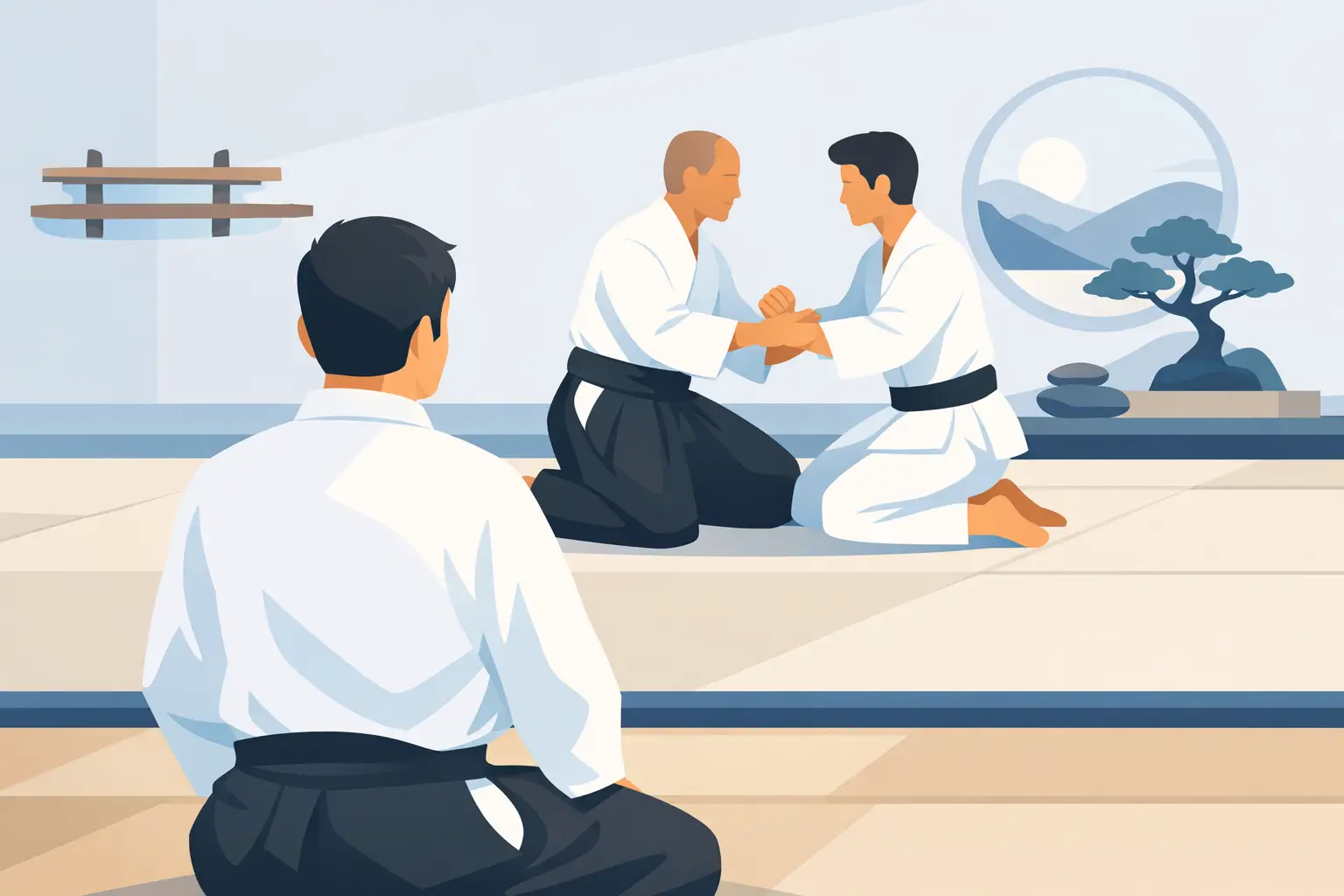
Aikido is a traditional Japanese martial art centered on balance, timing, awareness and controlled movement. Training can include throws, joint controls, immobilizations, safe falling, rolling and weapons training with the bokken and jo. Yet the first lesson is usually much simpler: how to stand, how to move with a partner and how to keep both people safe.
How adults start Aikido in a traditional dojo
Adults do not need a martial arts background to begin Aikido. They also do not need to arrive at a particular fitness level. What matters most is a willingness to practice patiently and respect the learning process.
A beginner class normally begins with dojo etiquette. Students bow when entering the training space, remove their shoes and line up as directed by the instructor. These formal practices are not designed to make newcomers feel out of place. They create a calm, shared standard of attention. When everyone follows the same routine, students can focus more fully on their training partners and the technique being taught.
The physical portion of a first class often starts with warm-ups and fundamental movement. You may learn a basic stance, turning steps, how to extend the arms naturally and how to maintain balance while another person makes controlled contact. Techniques are introduced gradually. Rather than trying to memorize a large number of movements, beginners repeat a smaller amount of material and begin to understand the body mechanics behind it.
In traditional Aikido, progress is measured less by speed than by quality. A student may repeat the same entering movement many times before it becomes relaxed and dependable. This can be unfamiliar to adults who are used to quick results, but it is one reason Aikido can remain rewarding over many years.
Your first priority is safe falling and rolling
One of the most important skills adults develop in Aikido is ukemi, the practice of receiving a technique safely. Ukemi includes learning to fall, roll, recover and protect yourself as your balance is affected. It is not a performance skill reserved for advanced students. Its foundations are taught from the beginning at a level appropriate for each person's experience, confidence and mobility.
A new student will not be expected to perform high or fast breakfalls. Early practice begins close to the mat with controlled movements that allow students to become familiar with falling and rolling gradually. The aim is to reduce unnecessary fear and help the body learn appropriate responses. A good partner supports this process rather than forcing movement.
This can be especially reassuring for adults returning to physical activity after time away. Someone in their forties or fifties may need more time to become comfortable rolling than another student. That is not a failure or a barrier to training. It simply means the instructor should provide suitable progressions and the student should train within sensible limits.
What to wear and bring to your first class
For an introductory class, comfortable clothing that allows easy movement is enough. A T-shirt and sweatpants, athletic pants or similar exercise clothing are practical choices. Avoid jewelry, watches or clothing with hard fasteners that could catch a partner during practice. Training is normally done barefoot, so there is no need for specialized footwear.
If you decide to continue, the dojo can explain when to obtain a training uniform, commonly known as a gi. There is no need to purchase specialized equipment before you have experienced a class and decided whether the school is right for you.
Arrive a little early, particularly for your first visit. At Tri City Aikido, new students should arrive about 15 minutes before their introductory class. This gives you time to meet the instructor, become familiar with the dojo and ask any questions before training begins.
Tell the instructor about relevant injuries, physical limitations or concerns about falling before class. Clear communication helps the instructor understand how to introduce the training appropriately and make adjustments when necessary.
Aikido training is cooperative, not competitive
Adults sometimes assume every martial arts class involves sparring, hard contact or pressure to win. Traditional Aikido takes a different approach. Students work in pairs, alternating between the person applying a technique and the person receiving it. Both roles matter. The person applying the technique develops positioning, timing and control; the receiving partner develops balance, awareness and ukemi.
This does not mean training is passive. Aikido requires close attention, physical commitment and purposeful movement. But the objective is technical improvement rather than defeating classmates. Partners help one another learn, and experienced students are expected to train responsibly with newer people.
That cooperative culture can suit adults who want martial arts training and physical challenge without a competition-focused environment. It also allows people of different ages, body types and experience levels to train together. The lesson is not that strength never matters. It is that posture, distance, timing and calm decision-making matter greatly, particularly when strength is unequal.
Expect learning to feel unfamiliar at first
Aikido can challenge habits that adults have carried for years. When someone takes hold of your wrist, the instinct may be to pull away, tense the shoulders or use force directly against force. Aikido asks students to notice that reaction and explore a more balanced response. This takes repetition.
It is normal to feel mentally busy during the first few weeks. You may be remembering which foot moves first, trying to bow at the right time and discovering movements your body has not performed before. The best approach is to accept being a beginner. Ask questions when you need clarification, watch demonstrations carefully and give yourself permission to learn one detail at a time.
Regular attendance is more valuable than occasional intense effort. Progress will vary. Some students quickly enjoy footwork but need more time with rolling; others are comfortable receiving techniques but find it harder to lead the movement. A patient instructor helps each student work through these differences without unnecessary comparison.
Returning martial artists may need to reset expectations
Adults with experience in Judo, Karate, Brazilian Jiu-Jitsu, wrestling or another martial art often bring valuable coordination and discipline to Aikido. They may also need to adjust to different distances, rhythms and training goals. Aikido's emphasis on timing, positioning and receiving an incoming movement can feel very different from a system built around striking combinations, pins or competitive rounds.
The most productive attitude is curiosity. Previous training is an asset when it helps you understand posture, respect and consistent practice. It becomes less useful when it creates pressure to perform at an advanced level immediately. Every martial art has its own language, and Aikido deserves time to be learned on its own terms.
Choosing a dojo matters as much as choosing a martial art
The quality of your first experience depends heavily on the school. Look for instruction that is organized, attentive and appropriate for beginners. The dojo should make safety visible in its teaching through controlled partner work, clear demonstrations, a gradual approach to falling and respect for individual limitations.
It is also worth asking about the instructor's training and lineage. Traditional Aikido is passed through direct teaching, not simply through a list of techniques. At Tri City Aikido, instruction is led by Anthony Campagna Sensei, 5th Dan Aikikai, with a direct connection to Kumano Juku in Shingu, Japan through Tasaka Shihan, 7th Dan, a student of Hikitsuchi Michio Sensei, 10th Dan. For adult students, that continuity offers more than history. It provides a direct connection to the tradition in which the art has been taught and practiced.
A free introductory class is a sensible way to assess the atmosphere for yourself. Notice whether students help one another, whether the instructor knows how to work with newcomers and whether you leave feeling challenged but comfortable enough to return. The right dojo should be serious about training without making seriousness feel intimidating.
Give yourself time to become a student
Starting Aikido as an adult is not about arriving with confidence. Confidence is often one of the results of showing up, practicing safely and gradually realizing that unfamiliar movements can become familiar. Your first class only needs one goal: take the next step with an open mind, care for your training partners and allow the practice to develop at a pace you can sustain.