
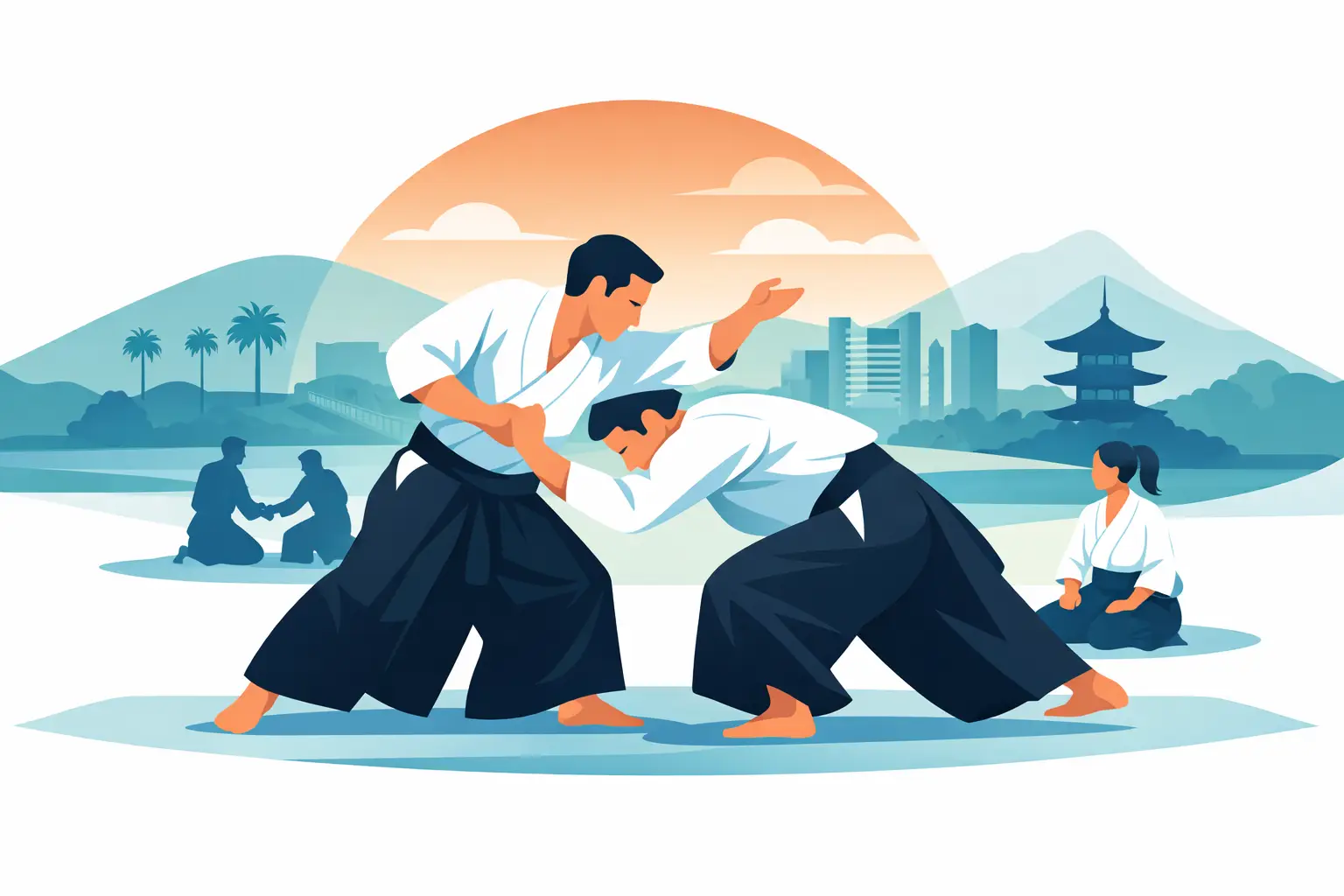
The short answer is no. You do not need to be physically strong to begin Aikido.
Strength can certainly be useful in everyday life, but Aikido techniques are not supposed to depend on overpowering another person. Aikido training teaches you to use movement, balance, timing, position and technique rather than trying to match strength against strength. Most of all, Aikido teaches you how to travel down the path of least resistance. This is where rigid strength takes a back seat and soft and pliable strength overcome the attacker.
What Happens When You Rely on Strength?
Almost every beginner uses too much strength at some point. It is a natural reaction. When a technique doesn't work, the first instinct is often to try harder.
In Aikido, trying harder can sometimes make the technique more difficult. The body becomes tense, movement becomes restricted, and the student begins fighting against the other person's strength.
Part of learning Aikido is discovering when you are using unnecessary muscular force and gradually learning to replace that effort with better movement and technique.
Aikido Is About Using the Whole Body
Aikido techniques should not be performed with the arms alone. Proper movement involves the entire body.
The legs move the body. The hips help generate and direct movement. Good posture provides stability. The hands and arms help guide the technique rather than doing all of the work.
When these elements begin working together, a student can produce considerably more effective movement without simply becoming stronger.
This is one of the reasons Aikido can be practiced by people with very different body types. A smaller person will never win a contest of strength against someone twice their size. Learning not to make strength the contest in the first place is an important part of Aikido training.
Timing, Balance and body positioning Matter More Than Muscle
A person is much easier to move when their balance has already been disturbed. Without a strong balanced foundation, everyone is weak.
Aikido students gradually learn to recognize direction, momentum and changes in balance. Instead of stopping an attack and then attempting to overpower the attacker, the goal is to move in a way that allows the attacker's movement to become part of the person being attacked. Once the energy is harmonized, a redirection can occur and technique is then created.
This requires the person executing the technique to stand in the correct place, creating a re-centering of the action. Once this occurs, the attackers focus is misdirected, weakening the attackers attack. This takes proper guideance by a well experienced instructor, coupled with the necessary practice to acquire this skillset.
That is also why watching an experienced Aikido practitioner can sometimes be misleading. A technique may look effortless, but what you are seeing is the result of many years spent developing posture, distance, timing, balance and coordinated movement.
Do Strong People Have an Advantage?
Being physically strong is not a disadvantage. The problem occurs when strength becomes a substitute for technique.
A strong beginner may initially be able to force certain movements to work. Eventually, however, that approach reaches its limits especially as someone ages. Training with different partners quickly demonstrates that there will always be someone bigger or stronger, so why not start to prepare?
Aikido gives the student another problem to solve: How can I make the technique work without depending upon being stronger than my partner? The answer lies in how the body works and how to make it work for you. Archimedes (a scientist from Greece) said, "Give me a lever long enough and a fulcrum on which to place it, and I shall move the world." The body has many levers, all of which supply certain levels of energy or power. When those levers work in harmony with each other, effortless power is acquired. Tri City Aikido supplies those levers.
What If You're Not Athletic?
You do not need to arrive at an Aikido dojo already strong, flexible or athletic. Those qualities can improve through regular training. Without sounding like to much of a pesimist, what makes you think you will be stronger tomorrow if you do nothing about it today? Our motto is, "Make it happen". A slow start is better than stagnation.
Beginners learn progressively. They develop footwork, posture, coordination, balance and safe falling skills while learning the basic techniques of Aikido.
Everyone starts somewhere. Some beginners are naturally athletic. Others have never practiced a martial art in their lives. A good training environment allows both to learn at an appropriate pace.
Technique Before Strength
Aikido does not promise that physical strength is meaningless. Size, strength, speed and athletic ability are real advantages in any physical confrontation, but imagine acquiring the tools to equalize the situation with education and movement. That's worth the time and energy.
The purpose of training is to develop skills that do not depend entirely upon those physical advantages.
Over time, students learn to move more efficiently, maintain their balance, affect their partner's balance and use the body as a coordinated whole. What initially required considerable effort can gradually require much less.
So if you have been interested in trying Aikido but have wondered whether you are strong enough, strength should not be the thing that stops you.
You don't need to get strong before beginning Aikido. You begin training, and then learn how much can be accomplished without relying on strength.