
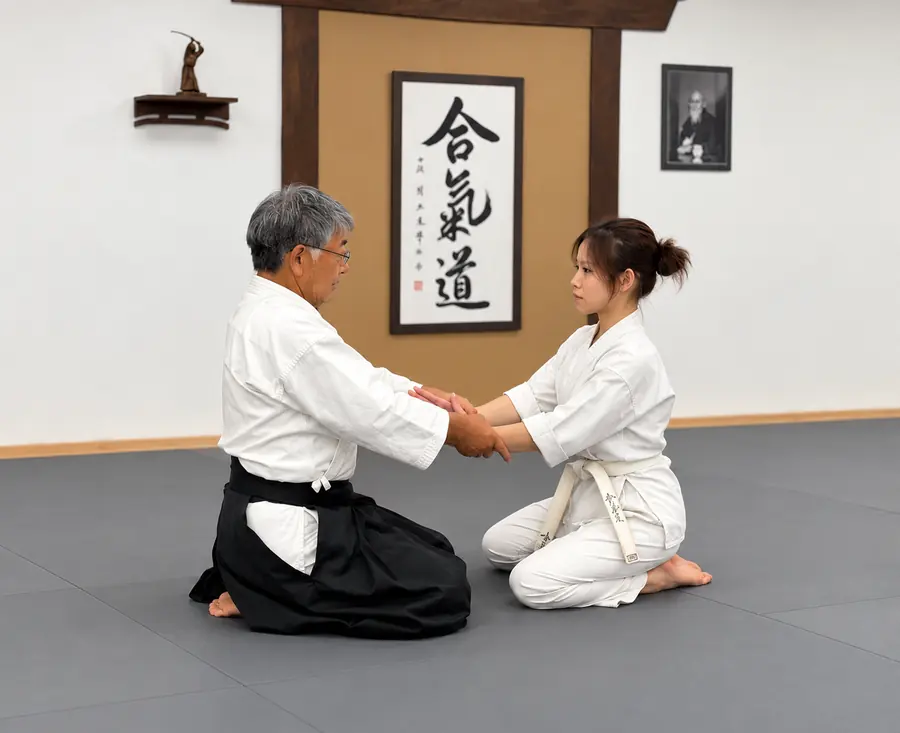
So, can women practice Aikido? Absolutely. Women train alongside men at Tri City Aikido, learning the same techniques, working toward the same ranks and developing the same skills.
Aikido uses movement, balance, timing and positioning rather than depending primarily on physical strength. Instead of fighting force with more force, students learn to move off the line of attack, redirect energy and find the path of least resistance.
For a woman thinking about trying her first martial arts class, however, the real questions are usually more personal.
Will I be strong enough? Will I be surrounded by experienced men? What if I've never practiced a martial art? Am I going to get thrown around on my first night?
Those are reasonable questions. And the easiest way to answer them may be to come to Tri City Aikido and try a class for yourself.

You Don't Need to Be Strong to Start Aikido
If an Aikido technique only works when you are stronger than your training partner, something is missing.
A smaller person cannot reasonably expect to overpower someone who is substantially larger and stronger. Aikido recognizes that reality rather than pretending it doesn't exist.
Students learn to change position, maintain their own balance, disrupt the attacker's balance and use the movement already being created. The objective is not to stand in front of incoming force and see who is stronger.
This doesn't mean size and strength suddenly become meaningless. A larger, stronger person has genuine physical advantages. But Aikido gives a smaller person something considerably more useful than instructions to simply "fight harder."
It teaches another way to move.
What If Everyone Else in Class Is More Experienced?
Every black belt at Tri City Aikido once walked onto the mat knowing absolutely nothing.
Beginners are not expected to arrive knowing how to fall, roll, stand correctly, perform techniques or understand Japanese terminology. Those things are learned through training.
Your first classes introduce the fundamentals gradually. You learn basic movement, posture, balance and how to work safely with another person before more complicated techniques are expected.
You also don't need to "get in shape first." Aikido itself is physical activity, and your coordination, movement and conditioning can develop as you train.
Our adult Aikido classes in Fremont include students with different body types, experience levels and abilities. Everyone learns the same art, but beginners are given the opportunity to learn at a beginner's pace.
Will I Have to Fight Men?
No.
Aikido is not competitive. There are no matches to win, opponents to defeat or trophies waiting at the end of class.
Students practice cooperatively. One person provides the attack while the other practices the technique, and then the roles reverse. Both people are there to learn.
That distinction is important.
You may train with men as well as women because learning to work with people of different heights, weights and body types is valuable. But your training partner is not your opponent.
A responsible partner adjusts the speed and intensity of the attack to the experience of the person receiving it. An experienced student working with a beginner should be helping that beginner learn—not trying to prove how powerful they are.
This cooperative approach is one reason Tri City Aikido does not use competition as the measure of a student's progress.
You Are Allowed to Say Something
Good martial arts training requires communication.
If something hurts, say something. If you don't understand a technique, ask. If you need your partner to slow down, tell them. If you are uncomfortable working with someone, speak with the instructor.
There is nothing impressive about remaining silent while someone is hurting you during practice.
Training safely doesn't mean training without effort. It means both people understand that they are responsible for each other's ability to come back and train again.
Aikido Isn't About Learning to Be Aggressive
Some people are attracted to martial arts because they enjoy fighting and competition. Others want absolutely nothing to do with either one.
Aikido gives the second group an interesting option.
You can study distance, movement, balance, joint controls, pins, throws and traditional weapons without preparing for your next tournament.
There is still physical pressure. Your partner is still trying to grab or attack you in a controlled training environment. You still have to move and respond.
But the objective is technical development rather than defeating the person standing in front of you.
For many adults, that changes the entire experience of practicing a martial art.
What Will You Actually Learn?
Aikido training begins with fundamentals: posture, footwork, balance, safe falling and rolling, grabs, pins, throws and learning how to move your body efficiently.
As your experience grows, attacks become more committed and the techniques become more demanding.
Students also practice with the bokken, a wooden sword, and jo, a wooden staff. Traditional Aikido weapons training develops distance, timing, posture and precision that carry directly into empty-hand techniques.
You don't need previous martial arts experience to understand any of this. That's what class is for.
Can Aikido Help With Self-Defense?
Aikido teaches skills that have practical self-defense value, but Tri City Aikido does not sell fantasies.
No martial art makes someone invincible, and there is no technique that guarantees success against every attacker.
What training can develop is awareness of distance, better movement under pressure, improved balance, familiarity with physical contact and the ability to respond without immediately freezing or panicking.
One of the most valuable self-defense decisions may also be recognizing danger early enough that no physical technique is necessary.
Aikido gives you tools. Learning when and how to use them takes practice.
What If You Haven't Exercised in Years?
You still don't need to wait until you're "ready."
Adults walk into martial arts schools with different backgrounds. Some have exercised consistently for years. Others haven't. Some have practiced yoga, dance or another martial art. Others have never done anything remotely similar to Aikido.
You begin where you are.
If you have an old injury, mobility limitation or concern about falling, tell the instructor before class. Movements can be introduced progressively while you develop familiarity and confidence.
The first objective isn't to keep up with someone who has trained for ten years.
It's to come back for your second class.
What Should a Woman Look for in an Aikido Dojo?
Watch the people.
You can learn a great deal about a martial arts school before you understand a single technique.
Watch how experienced students treat beginners. Watch what happens when someone makes a mistake. Watch whether smaller students are given meaningful training or simply overpowered. Watch whether the instructor pays attention to what is happening across the mat.
A traditional dojo should be disciplined without being intimidating.
Tri City Aikido follows a traditional Aikikai lineage through Tasaka Shihan and Hikitsuchi Michio Sensei. Anthony Campagna Sensei, 5th Dan Aikikai, has practiced Aikido since 1986 and founded Tri City Aikido in 1996.
That history matters, but you shouldn't choose a dojo because of a paragraph on a website.
Come see how we actually train.
The Hardest Part May Be Walking Through the Door
Many adults spend months thinking about trying a martial art.
They look at websites. They watch videos. They wonder whether they're too old, too inexperienced, too inflexible, too small or simply not the "martial arts type."
None of those questions can tell you whether you will enjoy Aikido.
One class can.
Tri City Aikido offers a free guest trial so you can experience the training, meet the students and decide whether Aikido feels right for you without making a long-term commitment first.
You don't need to prove anything before you arrive. You don't need martial arts experience. And you certainly don't need to be stronger than everyone else in the room.
You just need to be curious enough to walk through the door.