The best self defense skills adults can build are not secret techniques or a collection of impressive moves. They are physical and mental responses developed through practice: maintaining balance, moving instead of freezing, recognising danger, controlling distance and responding without allowing panic to make every decision for you.
You can understand those ideas by reading about them.
Learning to actually do them requires training.
Watching Self Defense Is Not Practising Self Defense
There is no shortage of self-defense information today. You can watch someone escape a grab, avoid a punch or demonstrate a technique from your phone.
Watching can help you understand an idea. It cannot give your body the experience.
There is an enormous difference between watching someone demonstrate a movement and standing across from another person who reaches for you. Distance suddenly matters. Timing matters. Balance matters. Your feet may not move where you expected them to move.
That is why martial arts training requires another person.
At Tri City Aikido, students repeatedly experience controlled physical contact with a training partner. They learn what it feels like to be grabbed, pushed, pulled off balance and approached from different directions. They also learn how their own body responds.
You cannot download that experience.
One of the Best Self Defense Skills Is Learning to Move
When people become frightened or surprised, they may stiffen, hold their breath or become fixed in place.
Aikido trains almost the opposite response.
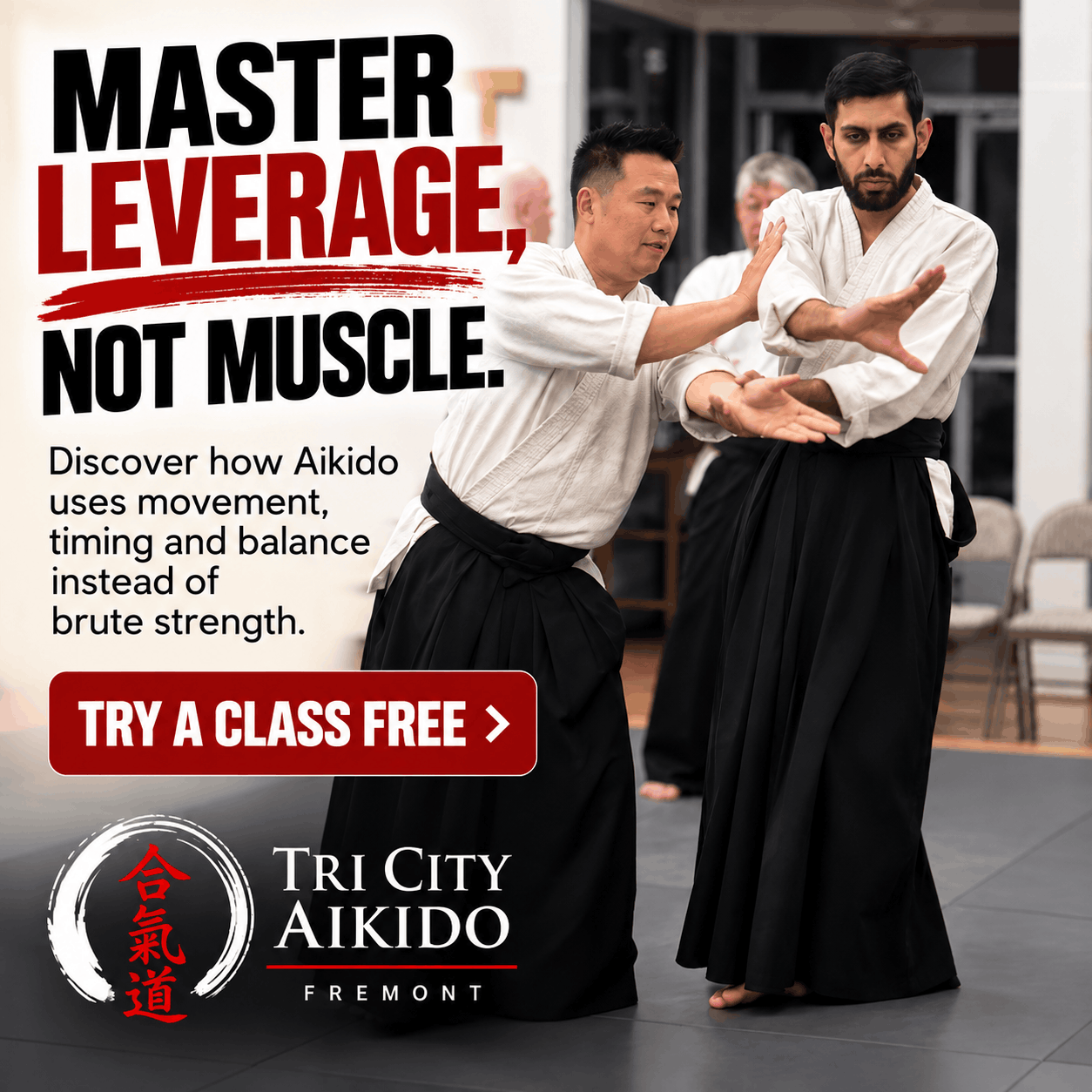
Students learn to move their feet, maintain their posture and change position rather than remaining directly in the path of force. Instead of automatically meeting strength with more strength, they begin learning how angles, timing and body movement can change the situation.
This is particularly valuable for adults because strength eventually has limits.
Good body mechanics do not eliminate differences in size, strength or speed, and no responsible martial art should promise that they do. But learning to use your entire body efficiently gives you more options than simply trying to overpower someone.
Balance Changes Everything
Try applying almost any physical technique while you are falling backwards and you quickly discover how important balance is.
Aikido places enormous emphasis on maintaining your own centre while affecting someone else's.
Students practise stepping, turning, entering and redirecting movement while another person provides controlled pressure. Over time, posture and balance stop being something you consciously arrange before every technique. They begin becoming part of the way you move.
That is where repetition becomes important.
You are not trying to memorise hundreds of answers to hundreds of possible attacks. You are developing movement principles that can be applied in many different situations.
Getting Grabbed Feels Different Than Talking About It
A wrist grab sounds simple when described on a page.
It feels considerably different when another adult actually takes hold of you.
The natural reaction is often to pull directly against the grip. If the other person is stronger, that can immediately become a contest you are poorly equipped to win.
Aikido gives students the opportunity to explore another solution. Through changes in position, angle, body alignment and timing, they learn how movement can be more useful than struggling directly against strength.
At first, this happens slowly.
That is intentional.
Students need time to understand what they are feeling. As their skill develops, movement becomes smoother and the timing becomes more natural.
You cannot learn that sensation from a video because the missing ingredient is another human being.
Learning How to Fall May Be More Useful Than You Think
Not every threat to an adult comes from another person.
People trip. They slip. They miss a step. They lose their balance.
Learning how to receive a fall safely is an important part of adult Aikido training. Students begin progressively rather than being thrown hard on their first night. They learn how to protect themselves, move with the fall and return to their feet with control.
There is no technique that can guarantee someone will never be injured in a fall. But learning how to fall gives the body something better to work with than panic and an outstretched arm.
It is also something many adults have not practised since childhood.
Be a Person of Action
Self defense is not always the first thing on someone's mind when they walk into a dojo. Some adults simply want to exercise. Some want to learn something new. Others are looking for an activity that gets them out of the house and around a good group of people.
Those are all excellent reasons to train.
There is something to be said for becoming a person of action. Instead of watching other people move, train and experience things, you participate yourself.
Keep the body moving. We sometimes joke that you have to be like a shark—keep moving if you want to stay healthy. The older we become, the easier it is for work, responsibilities and routine to gradually remove physical activity from our lives. Aikido puts movement back on the schedule.
And it is not movement performed alone in front of a machine.
You train with people. You change partners. You learn together. You laugh when something does not work, help each other improve and gradually become part of a group where people know your name and notice when you are not there.
That social side of a dojo is easy to underestimate.
Exercise is good for the body. Learning keeps the mind engaged. Spending time around people you enjoy gives you another reason to keep showing up. Put those things together and martial arts training can become much more than learning what to do if someone grabs you.
It becomes part of a healthier, more active life.
Calmness Has to Be Practised Too
People often imagine that they will remain calm during a confrontation because they are calm people.
Those are not necessarily the same thing.
Pressure changes breathing. Muscles tighten. Attention narrows. Simple movements can suddenly become difficult.
Traditional Aikido gives adults an opportunity to experience controlled pressure without turning every practice into a fight. You work with another person, make mistakes, adjust and try again.
Gradually, being grabbed or having someone move rapidly towards you becomes less unfamiliar.
The objective is not to eliminate fear. Fear can be useful. The objective is to keep fear from becoming the only thing controlling your response.
Self Defense Becomes One Part of Something Bigger
You do not have to walk into Tri City Aikido because you are worried about defending yourself.
You may come because you want exercise. You may want to meet people. You may be curious about martial arts or simply tired of spending too much of your life sitting down.
While you are doing those things, you are also developing balance, movement, awareness, timing and the ability to remain more composed while another person is applying pressure.
Those happen to be useful self-defense skills.
But they are also useful human skills.
Real Self Defense Begins With Judgement
The best confrontation is still the one you avoid.
Awareness, distance and good judgement should come before physical technique. If you can leave, leave. If creating distance solves the problem, create distance. If you recognise trouble early enough to avoid it, you have already used an important self-defense skill.
Aikido is not about looking for an opportunity to prove that a technique works.
It is about developing enough control to recognise when physical action is necessary and enough skill to respond appropriately when it is.
That philosophy is one reason Tri City Aikido trains without competition. We are not preparing students to win points against an opponent who has agreed to a match. Training partners cooperate so both people can develop timing, movement and control.
The Skill You Have Is the Skill You Have Practised
There is no perfect self-defense system and there are no guarantees in a real confrontation. Size, strength, surprise, surroundings and countless other variables matter.
But there is an enormous difference between hoping you will know what to do and actually spending time developing physical skills with another person.
Tri City Aikido has been teaching traditional Aikido in the Fremont area for 30 years. Adult classes are taught in a cooperative environment where beginners can learn alongside experienced students without being thrown into competition or expected to arrive already in shape.
You do not need martial arts experience. You do not need to be particularly strong or flexible. And you certainly do not need to know how to defend yourself before you walk through the door.
That's why you come to class.
Stop Watching. Start Doing.
You can read about self defense. You can watch someone else practise martial arts. You can watch exercise videos, sports and other people having experiences.
Or you can become one of the people doing something.
Come onto the mat. Move your body. Learn something unfamiliar. Work with other people. Make some friends. Get some exercise. Challenge yourself a little.
And somewhere along the way, you may discover that you are also becoming more balanced, more aware and considerably more capable than when you started.
You do not have to join Tri City Aikido because you are afraid of what might happen someday.
Join because being active, learning and surrounding yourself with good people can make today better.