
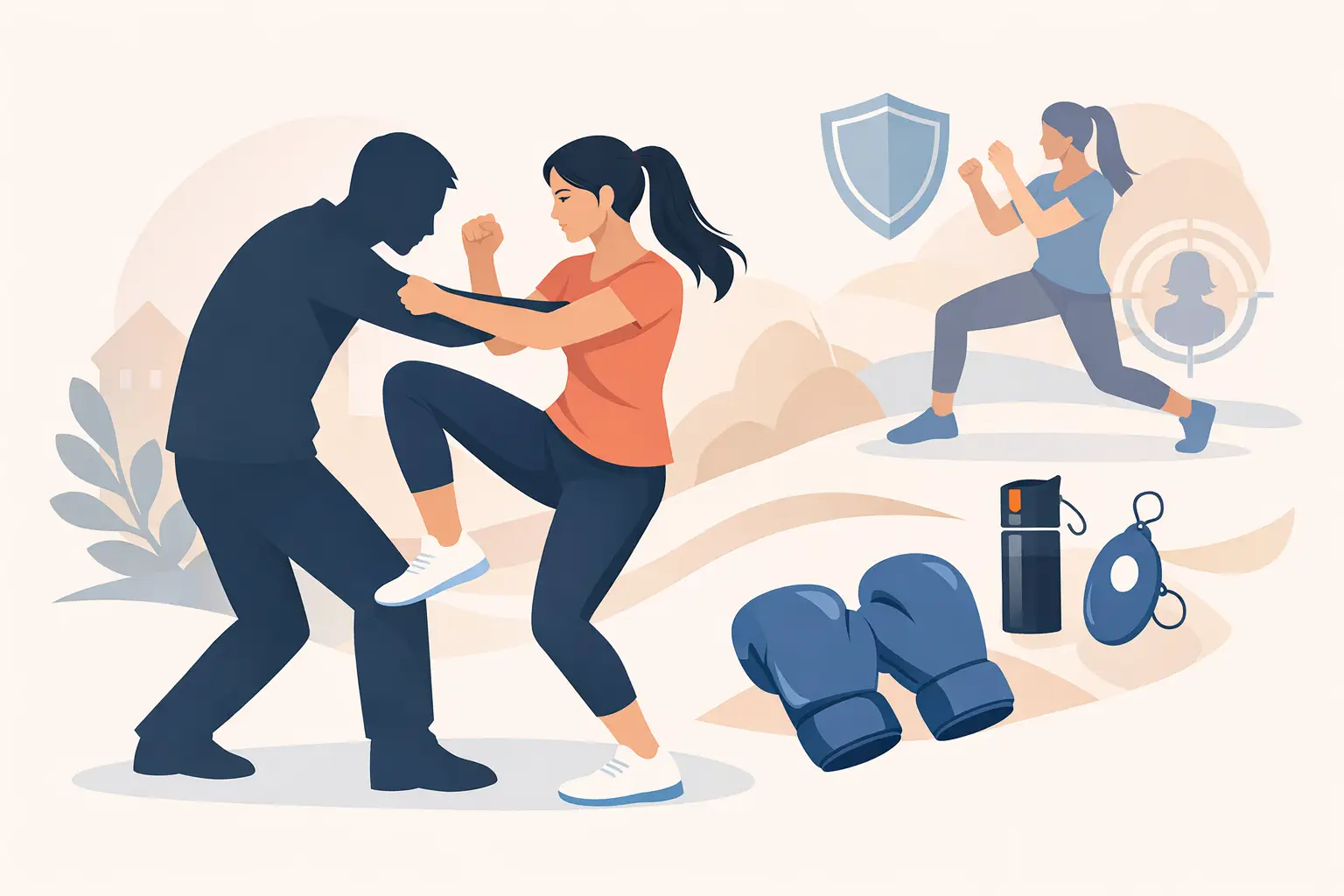
For many women, the right starting point is not learning to overpower someone. It is developing the judgment to recognize concerns early, the confidence to create distance, and the physical skills to move safely if a situation becomes difficult. A traditional martial art such as Aikido can support that process through patient, supervised practice rather than fear-based or unnecessarily aggressive training.
What Makes the Best Self Defense for Women?
The best self-defense for women is not defined by the most dramatic technique in a demonstration. It should be practical, repeatable and taught in a setting where beginners can learn without embarrassment or unnecessary risk.
A useful program addresses more than strikes or holds. It teaches posture, distance, timing and how to remain responsive when another person is moving toward you. It also makes room for awareness: noticing an uneasy interaction, trusting a concern, setting a clear verbal boundary and leaving before a situation escalates are all meaningful self-protection skills.
Physical training still matters. Under stress, complicated sequences can be difficult to recall and perform. Training should therefore return to sound body mechanics, stable movement and principles that can be practiced again and again. The goal is not to promise certainty in every dangerous circumstance. No responsible instructor can do that. The goal is to improve your options, judgment and ability to act decisively when an opportunity is available.
Why Calmness Is a Self-Defense Skill
Fear can make the body freeze, rush or lose balance. Calmness does not mean ignoring danger or behaving passively. It means developing enough familiarity with pressure and movement that you have a better chance of noticing what is happening, moving and making a decision without immediately being overwhelmed by panic.
Aikido approaches conflict through awareness, positioning and control of movement. Rather than meeting force directly, students learn to avoid the line of an attack, maintain their own balance and redirect incoming movement where possible. This is not a magical solution, and it is not a replacement for sensible safety decisions. Its value lies in giving students a structured way to study distance, contact and recovery with a training partner.
For adult beginners, this can be particularly reassuring. You do not need to arrive strong, flexible or experienced. A good dojo begins with the fundamentals and allows confidence to develop through regular attendance. The discipline of bowing, listening, working carefully with a partner and repeating basics may appear simple, but it builds habits that carry beyond the mat.
Awareness and Early Choices
Self-defense often begins before physical contact. Paying attention to your surroundings, choosing well-lit routes when practical, keeping communication available and letting someone know where you are going when appropriate are simple precautions. So is moving away from an argument, declining unwanted attention or asking others for help.
Training can also help a person become more comfortable taking these early actions. People sometimes hesitate because they worry about seeming rude, overreacting or making a scene. Recognizing that you are free to create distance, use a clear voice or leave an uncomfortable situation can itself be an important part of self-protection.
Distance, Movement and Balance
If someone steps too close, the ability to create space matters. Students benefit from learning how to stand in a balanced way, turn their body, step off line and keep their hands available to protect themselves or manage distance. These movements are not reserved for athletic people. They can be learned progressively, with attention to individual mobility and comfort.
Balance also matters after a stumble, a push or a sudden pull. A person who can recover their footing is in a better position to move away. This is one reason traditional Aikido places so much emphasis on posture, footwork and body alignment.
The Value of Safe Falling and Rolling
One of the most overlooked parts of martial arts training is learning how to fall safely. A fall can happen during physical contact, on a slippery surface or simply in everyday life. Learning ways to protect the head and body, distribute impact and recover with awareness can be a valuable physical skill at any age.
In Aikido, ukemi, or receiving technique, includes rolling and falling methods taught progressively. Beginners do not begin with dramatic throws. They first learn how to lower themselves, work safely with the mat and become comfortable with basic movement. As skill develops, falling practice can improve coordination, resilience and confidence around physical contact.
This is also where the quality of instruction matters. Safe training requires attentive partners, clear boundaries and an instructor who values control over spectacle. A technique is only useful for regular training if students can practice it responsibly.
What Women Should Look for in a Self-Defense Class
The right class should feel challenging without feeling unsafe. A trial lesson can reveal a great deal about a school: whether beginners receive real guidance, whether experienced students work responsibly with newer partners, and whether the instructor corrects technique with patience and clarity.
Look for a school that treats safety and communication seriously. Students should be able to communicate when something hurts, ask questions and adjust training when appropriate. There should be no expectation that someone must endure reckless or unnecessarily rough treatment to prove commitment.
It is also worth considering what kind of progress you want. A short self-defense workshop may offer useful ideas and an introduction to basic responses. Ongoing martial arts practice offers something different: repeated exposure to movement, gradual physical conditioning, regular partner work and time for skills to become more familiar.
Neither option is automatically better. A workshop may suit someone looking for an introduction, while regular training provides the repetition and continued practice necessary for longer-term development.
A traditional dojo can be especially suitable for people who value a respectful, non-competitive environment. Rank, etiquette and formal practice are not intended to intimidate. At their best, they provide a clear structure in which students of different ages and experience levels can learn together safely.
Aikido as Part of Practical Self-Protection
Aikido is sometimes misunderstood as either entirely gentle or only useful in ideal circumstances. The reality is more measured. It is a martial art that studies movement, timing, balance, joint controls, throws and immobilizations, but developing skill requires steady practice. Students do not gain reliable ability simply by watching a technique once.
Its non-competitive approach can appeal to women who want to train seriously without a culture centered on trophies or defeating training partners. Practice partners take turns attacking and receiving techniques, which develops mutual responsibility as well as technical awareness. Students learn that effective control depends on posture, connection and timing rather than simply relying on physical strength.
At Tri City Aikido, instruction follows traditional Aikikai practice under Anthony Campagna Sensei, 5th Dan Aikikai. The dojo's connection to Kumano Juku in Shingu, Japan reflects a lineage in which careful fundamentals, respectful practice and long-term development are central. For a beginner, that heritage is most meaningful when it is experienced directly through clear instruction, a safe mat and a community that allows room to learn.
Building Confidence Without Becoming Fearful
The purpose of self-defense training is not to make daily life feel dangerous. It is to help people feel better prepared, more capable and less likely to be caught entirely off guard. Confidence grows quietly. It comes from attending class when you are new, learning to fall, working with different partners and noticing that movements which once felt unfamiliar are becoming more natural.
For some women, the first benefit is physical: improved coordination, mobility or fitness. For others, it is the experience of moving with greater assurance and becoming more comfortable establishing boundaries. Over time, these benefits can reinforce one another.
If you are considering a class, give yourself permission to begin at beginner level. Wear comfortable clothing, ask how the school introduces new students and pay attention to how you feel after the first session. The best choice is one that helps you return, practice thoughtfully and grow stronger in both skill and judgment.