
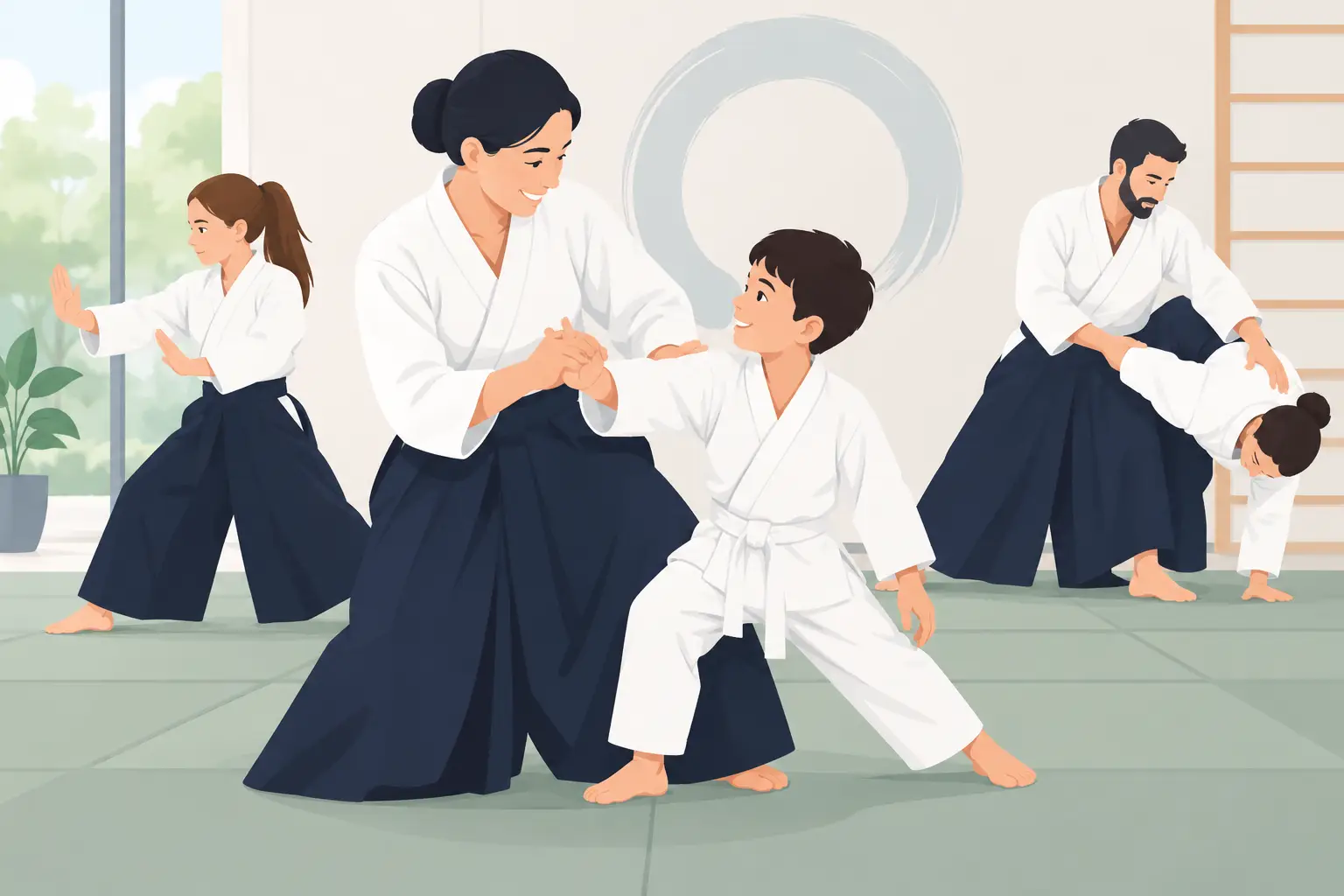
After teaching Aikido for more than 30 years, I've seen students begin training for all of these reasons. What they eventually discover is that the benefits of Aikido extend well beyond learning how to perform a throw or joint technique.
Aikido develops movement, balance, timing, coordination and awareness while teaching students how to work with another person's energy rather than simply trying to overpower them. Those principles can be studied by children, teenagers and adults, although what each age group takes from the training may be very different.
Physical Benefits of Aikido
Aikido is a physical martial art. Students move.
We step, turn, pivot, roll, get back up and repeat techniques with different partners. As students progress, those movements become smoother, faster and more demanding.
Regular training can help develop coordination, balance, flexibility, stamina and overall body awareness. More importantly, students learn how the different parts of their body work together.
A technique shouldn't depend entirely on muscular strength. We teach students how to use positioning, movement, leverage and timing so the entire body contributes to the technique.
This is one of the qualities that makes Aikido accessible to such a wide range of students. You don't need to be exceptionally strong or athletic before walking through the door. Those aren't prerequisites for learning.
Learning How to Fall Safely
One of the first things new students learn isn't how to throw someone. They learn how to be thrown.
In Aikido, this is part of ukemi — learning how to safely receive a technique.
Students progressively learn rolls and falls on a padded mat. A beginner starts slowly and builds confidence and ability over time.
For children, learning how their body reacts when balance is lost can develop coordination and body awareness. For adults, ukemi introduces movement many haven't experienced in years.
Learning to fall doesn't mean you'll never get hurt. It means you've actually spent time practising what to do when your balance is taken away.
Aikido Develops Balance, Timing and Leverage
Strength has its place, but strength alone is a poor substitute for good technique.
Aikido teaches students how to use the body's natural levers, move toward the path of least resistance and disrupt another person's balance while maintaining their own.
When students first begin, they often try to muscle their way through a technique. That's natural. Eventually they discover something interesting: sometimes trying harder actually makes the technique harder.
Relaxing, changing position or moving at the correct moment can accomplish what brute force could not.
That's an important part of Aikido — developing a softer, more efficient kind of strength.
Benefits of Aikido for Children
Children don't experience Aikido the same way adults do, nor should they.
For younger students, some of the earliest benefits are very simple: listening to an instructor, waiting their turn, following directions and learning how to work safely with another child.
As their training progresses, children begin developing coordination, balance and greater control over their bodies. They learn how to roll, move away from pressure and perform techniques without treating their partner like an opponent who needs to be defeated.
That last point is important because Aikido does not have competitions. Children can challenge themselves and progress without needing to beat the child standing next to them.
For some children, that environment is exactly what they need.
Benefits of Aikido for Teenagers
The teenage years bring a different set of challenges.
Teenagers are becoming physically stronger and more independent, while also learning how to handle pressure, frustration and responsibility.
Aikido gives them somewhere productive to put that energy.
As techniques become more sophisticated, teenagers begin understanding why movement works. They can explore distance, leverage, timing, posture and control at a deeper level while taking greater responsibility for their training partners.
They also learn that martial ability and aggression are not the same thing.
You can become more capable without needing to become confrontational.
Benefits of Aikido for Adults
Adults frequently arrive with an unnecessary concern: Am I in good enough shape to start?
You don't need to get in shape before beginning Aikido. Training itself is part of the process.
Adults work on coordination, balance, movement, flexibility and conditioning while learning martial arts techniques. Each student progresses from their own starting point.
There's also a mental side to adult training that shouldn't be overlooked.
When someone grabs your wrist or begins moving toward you, the instinctive reaction is often to tense up and resist. Aikido teaches another possibility: remain balanced, move, find the opening and respond with technique rather than panic.
That takes practice.
And when you finally perform a technique that once seemed impossible, there's a very satisfying realization that your body has learned something new.
Confidence Comes From Doing
Martial arts schools talk about confidence all the time. But confidence isn't something an instructor can simply hand to a student.
It has to be earned.
The child who was afraid to roll eventually completes one.
The teenager who couldn't make a technique work finally understands the movement.
The adult who thought they were too old or too uncoordinated discovers that they can learn.
Those little victories accumulate.
That's where confidence comes from — not being told that you can do something, but discovering through experience that you actually can.
Self-Control and Respect Are Part of Training
Aikido techniques have to be practised with another person. That means students have a responsibility to one another.
You learn when to apply pressure and when to release it. You learn how to adjust when working with someone smaller, younger or less experienced. You learn that your partner's safety matters just as much as successfully completing the technique.
Traditional dojo etiquette reinforces the same lesson. Bowing in Aikido is one part of a larger culture of respect for the dojo, the instructor and the people who help you train.
Without partners, there is no Aikido.
Aikido and Practical Self-Defense
Aikido includes responses to grabs, strikes, holds and other forms of physical attack. Students practise throws, joint controls, pins, escapes and ways of changing position when confronted with force.
But practical self-defense isn't simply a collection of techniques.
Distance matters. Timing matters. Awareness matters. Knowing when you can leave instead of fighting matters.
No martial art can guarantee what will happen in a real confrontation. What training can do is give you experience moving under pressure and tools you didn't have before.
That is considerably more useful than pretending every confrontation has a perfect answer.
Weapons Training Adds Another Dimension
Traditional Aikido also includes practice with the bokken (wooden sword) and jo (staff).
Weapons training in Aikido isn't separate from empty-hand practice. It helps students understand distance, posture, movement, timing and how the hands and body work together.
At Tri City Aikido, weapons practice is another tool for developing the same principles students encounter throughout their training.
More Than 30 Years of Aikido in Fremont
Tri City Aikido has been teaching traditional Aikido in the Fremont area since 1996. Our dojo is a branch of Kumano Jyuku and continues the Aikido tradition taught through Tasaka Shihan and Hikitsuchi Michio Sensei.
I'm Anthony Campagna Sensei, 5th Dan Aikikai, and I've been practising Aikido since 1986. Over those years, I've watched children grow into adults, beginners become black belts and people who initially doubted themselves discover abilities they didn't know they had.
That's one of the things that keeps Aikido interesting after decades of practice. There is always something else to improve.
Experience the Benefits of Aikido for Yourself
You can read about the benefits of Aikido, watch videos and research different martial arts, but eventually there's only one good way to determine whether Aikido is right for you or your child.
Step onto the mat and try it.
Tri City Aikido offers traditional Aikido classes in Fremont for children, teenagers and adults. Beginners are welcome, and no previous martial arts experience is necessary.
Come experience a free introductory class at Tri City Aikido and see what Aikido training can offer you or your family.