
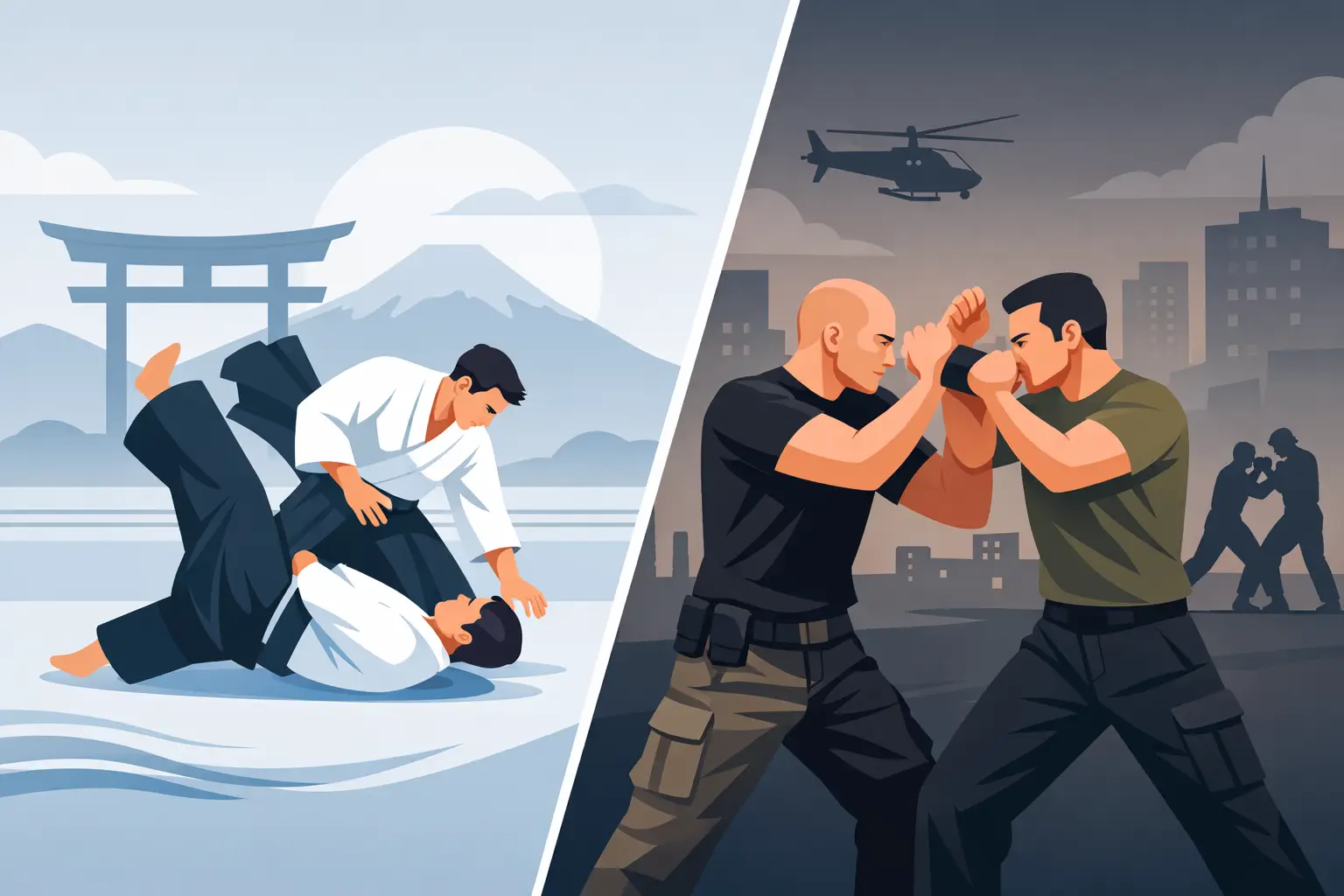
For a parent choosing an activity for a child, or an adult beginning or returning to martial arts, that difference matters. A good choice should support physical safety, self-control and sustained progress, not just offer a dramatic answer to a difficult situation.
Aikido Versus Krav Maga: The Central Difference
Aikido is a Japanese martial art built around balance, timing, distance and the ability to redirect incoming force. Rather than meeting strength with strength, the practitioner learns to move off the line of an attack, blend with its direction and apply a control, throw or immobilization when appropriate. Training also commonly includes safe falling and rolling, known as ukemi, which teaches students how to protect themselves when losing balance or being taken to the ground.
Krav Maga is a modern self-defense system developed around direct responses to violent encounters. Classes often focus on striking, escaping holds, defending against common threats and making quick decisions under stress. Its guiding principle is generally to create an opportunity to get away safely, using simple and forceful actions where necessary.
Neither approach removes the need for good judgment. Avoidance, awareness and leaving a dangerous situation remain the best forms of self-protection whenever they are possible. The difference is that Krav Maga usually rehearses immediate, decisive counteraction, while Aikido develops the ability to receive and manage force with composure and control.
What an Aikido Class Feels Like
Traditional Aikido is usually practiced with a partner in a cooperative but attentive format. One person takes the role of attacker and the other practices a response, then both switch. This allows students to repeat a movement carefully, learn correct posture and gradually increase speed, energy and variety.
A beginner may start by learning how to stand, move, fall safely and work with a partner without causing injury. Over time, students study wrist and arm controls, pins, throws, releases and responses to grabs or strikes. Bokken and jo practice may also be introduced as part of traditional study. These wooden sword and staff exercises sharpen distance, posture, focus and the understanding of line and timing.
This does not mean Aikido training should be passive. A sincere attack and an attentive partner are essential to learning. Yet the purpose is not to overpower a training partner or win a bout. It is to refine movement until it becomes more balanced, efficient and responsible.
For many adults, especially those who do not want a competition-centered atmosphere, this is a major attraction. They can train seriously while developing body awareness, mobility and calm decision-making. For children, the structure helps connect physical activity with listening, respect and self-control.
The Value of Learning to Fall
Ukemi is one of Aikido's most practical and often overlooked skills. Children learn to roll and fall in a supervised, progressive way, which can improve confidence and coordination. Adults gain a better understanding of how to protect themselves during a stumble or loss of balance, both on and off the mat.
No martial art can make falls harmless, and students should always work within their ability. However, learning to relax, protect the head and body, and distribute impact appropriately is valuable physical education in its own right.
What a Krav Maga Class Feels Like
Krav Maga classes often move quickly through practical scenarios. Students may strike pads, work on escapes from grabs, practice verbal boundaries or drill responses to simulated attacks. Conditioning is commonly part of the session, and some schools use stress-based drills intended to test whether students can apply simple actions when tired or startled.
For an adult whose immediate priority is focused self-defense training, this directness can be appealing. Krav Maga generally addresses the reality that an assailant may not follow rules and that the safest outcome may require a rapid escape rather than prolonged engagement.
The experience can vary greatly from one school to another. A well-run Krav Maga program should provide controlled contact and sensible progression for beginners. Prospective students should watch a class and ask how instructors manage safety, resistance and students of different fitness levels.
Is One Better for Self-Defense?
The answer depends on the situation and the student. Krav Maga is more explicitly designed around urgent self-defense scenarios and typically includes striking from the outset. Aikido places greater emphasis on movement, balance, controlling an attacker and avoiding unnecessary force. If your main goal is to learn direct striking and escape responses quickly, Krav Maga may fit that goal more closely.
Aikido offers a different kind of practical development. It can improve your ability to recognize pressure, maintain balance, manage close-range contact and avoid panicked reactions. Its principles can also be useful in situations where the objective is control rather than immediately striking another person.
At the same time, responsible Aikido instruction should never promise that a technique will work automatically against every attack or every opponent. Real violence is unpredictable. Size, surprise, surroundings, multiple attackers and weapons can change the situation immediately.
The strongest approach to self-protection combines physical training with situational awareness, clear communication, boundary setting and the willingness to leave early. A martial art can support these abilities, but it cannot guarantee safety.
Which Is More Suitable for Children?
For many younger children, a structured traditional dojo environment can be a natural starting point. Children need instruction that is age-appropriate, carefully supervised and built around repeatable habits. Aikido can teach them how to move safely with others, take turns, listen to instruction and use their bodies with control.
Krav Maga programs for children can also be valuable when they are thoughtfully taught. They may focus on recognizing unsafe situations, using a strong voice, running to a trusted adult and escaping simple grabs. The quality of the program matters more than the name of the martial art.
Parents should look beyond phrases such as "real-world self-defense." Ask whether the class develops confidence without frightening children, whether instructors correct behavior patiently, and whether students learn respect alongside assertiveness. A child who feels safe, included and challenged at the right level is more likely to build skills that last.
Physical Demands, Contact and Injury Considerations
Both arts involve physical contact, and any martial art carries some risk. The standard of supervision, partner selection and class culture has a significant effect on safety.
Aikido commonly uses progressive practice, with students learning the foundations of a technique before attempting it with greater speed or intensity. Because throws and joint controls are part of the curriculum, careful instruction in ukemi, tapping and partner care is essential. Good training partners do not force a technique after a joint has reached its safe limit.
Krav Maga may include repetitive striking, pad work and higher-intensity drills. This can provide demanding physical training, but someone returning to exercise after a long break or seeking a quieter training pace should consider how a particular school's classes are structured. Training intensity can vary considerably between schools.
Adults in their forties, fifties and beyond often discover that consistency matters more than intensity. A class that leaves you challenged but able to return next week is usually a better long-term choice than one that continually pushes you beyond your current capacity.
Tradition, Progression and the Reason You Train
Aikido's traditional setting appeals to people who value more than a short course in techniques. Bowing, mat etiquette, Japanese terminology and rank progression provide a framework for sustained learning. The aim is not to collect belts quickly, but to improve posture, awareness, technical understanding and character over years of practice.
At Tri City Aikido, instruction is grounded in Aikikai tradition and our connection to Kumano Juku in Japan. That heritage gives students a clear technical framework, while the day-to-day emphasis remains on patient teaching, safe practice and respect for every training partner.
Krav Maga is generally less concerned with traditional martial arts customs and more focused on practical drills and immediate application. Some people prefer that direct format. Others find that a traditional dojo gives them the discipline, depth and sense of community they need to remain committed.
How to Make the Right Choice
Visit a class if you can. Notice whether beginners receive attention, whether experienced students treat partners well, and whether instructors explain not only what to do but why they are doing it. You should feel welcome to ask questions about safety, progression and the goals of the program.
Choose Krav Maga if you are primarily seeking direct self-defense drills, striking practice and a faster-paced approach to escape-based responses. Choose Aikido if you are drawn to technical refinement, safe falling, balance, non-competitive training and a traditional path that can remain meaningful for many years.
The most useful martial art is the one you can practice with care and consistency. Find a school where you can learn without posturing, train with people who respect your limits, and leave each class a little steadier than when you arrived.