
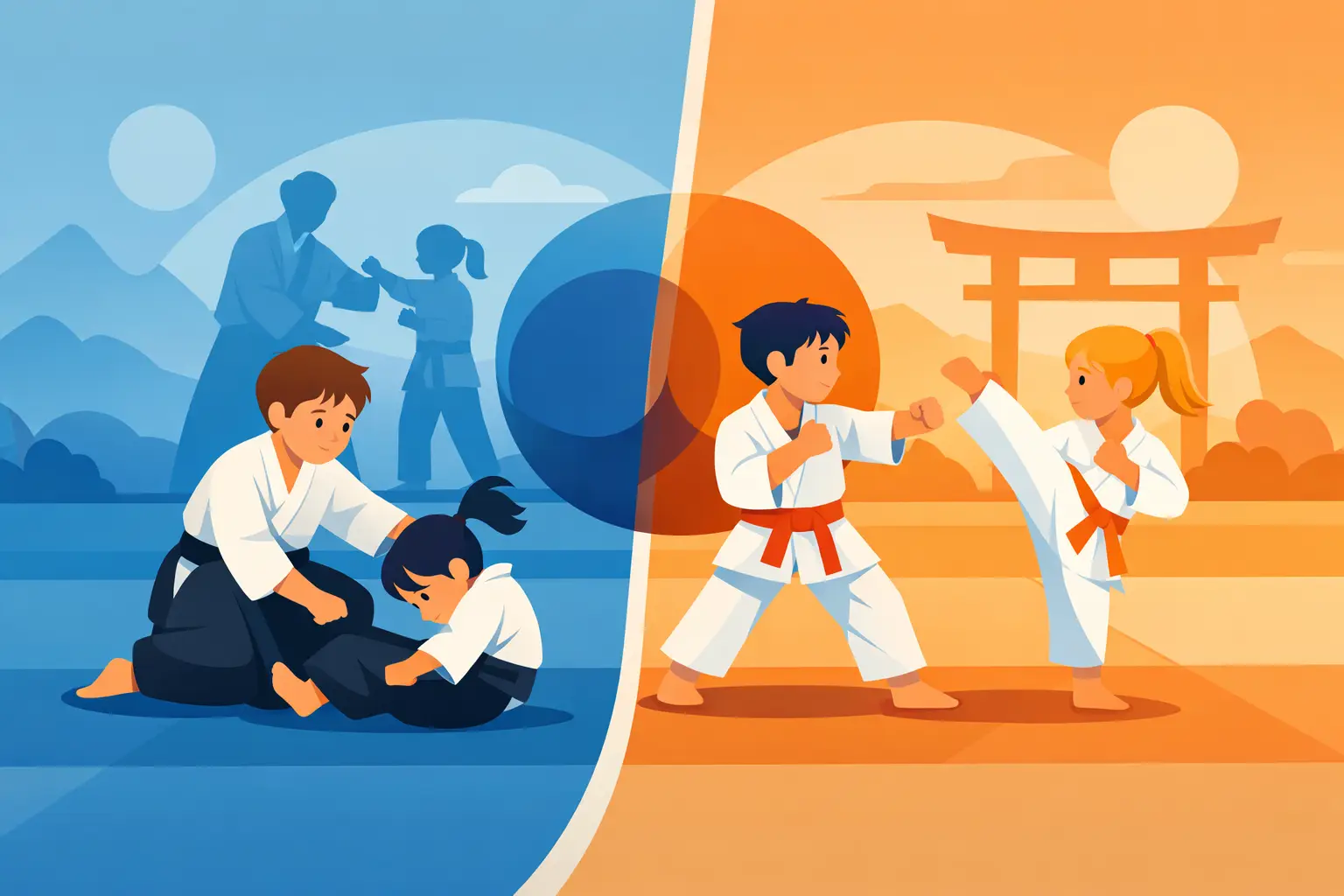
Both Aikido and Karate are Japanese martial arts with strong traditions of etiquette, discipline and respect. Both can improve coordination, attention and confidence. Yet the experience on the mat is distinct. Karate commonly teaches striking skills through punches, kicks, blocks and carefully structured forms. Aikido teaches balance, movement, safe falling and rolling, and ways to redirect force without meeting force head-on.
Aikido versus Karate for Children: the central difference
The clearest distinction is the response each art practices when faced with an attack. In Karate, children may learn to create distance, use a block and deliver a controlled strike or kick. Good children’s Karate instruction places considerable emphasis on control, accurate technique and restraint, but striking remains a central part of the curriculum.
In Aikido, children learn to move off the line of an attack, maintain their balance and guide an incoming movement into a safer outcome. Training can include wrist controls, throws and immobilizations, taught progressively and with close attention to a partner’s safety. A child is not being taught to overpower another child. They are learning posture, timing, awareness and calm decision-making.
That difference matters especially for families looking for self-defense training without a competition-focused or aggressive atmosphere. Aikido’s principle of resolving conflict with the least necessary force can give children a practical framework for everyday situations: create space, stay composed, seek help and avoid making a difficult situation worse.
What children often gain from Aikido
Aikido is particularly well suited to children who benefit from learning through movement and partnership. A class does not rely only on repeating a punch or kick in the air. Children work with a partner, take turns as the person initiating an attack and the person receiving it, and learn that good technique depends on cooperation as well as individual effort.
Safe falling and rolling, known in the dojo as ukemi, are an important part of this work. Learning how to fall with care can build body awareness and confidence. It also teaches an unusually valuable lesson: falling is not failure. A child can make a mistake, regain their feet and continue with composure.
Aikido can also appeal to children who do not enjoy direct confrontation. Progress comes from using the whole body efficiently rather than from being the strongest, fastest or loudest person in the room. A smaller child can understand how footwork, posture and timing change an encounter. That is a constructive message during years when children are still developing physically and socially.
Traditional Aikido classes also provide a consistent structure. Students bow as part of traditional dojo etiquette, practice attentive listening, treat partners with care and learn to follow instructions precisely. These formal practices are not empty ceremony. They help young students settle into class, understand boundaries and contribute to a respectful group.
What Karate may offer a child
Karate may be an excellent fit for a child who enjoys clear, repeatable patterns and the satisfaction of refining a visible skill. The basic movements are often easy for a beginner to recognize: a stance, a block, a punch or a kick. Kata, or set forms, can give children measurable goals and help them develop memory, focus and precision.
For some children, striking practice feels energizing and motivating. It can offer a healthy outlet when taught with discipline and appropriate supervision. A well-run Karate school should make clear that techniques learned in class are not for showing off, play-fighting or solving disagreements at school.
The experience varies significantly between schools. Some Karate dojos place strong emphasis on traditional forms, courtesy and lifelong practice. Others focus more heavily on tournaments, sparring and medals. Neither approach is automatically wrong, but parents should ask whether the class culture matches their child’s temperament and the family’s aims.
Safety, contact and confidence
Parents sometimes assume that a non-striking art is automatically safer, or that a striking art is necessarily too rough. The reality depends on the instructor, the class size, the age grouping and how carefully techniques are introduced.
In a thoughtful children’s Aikido program, students first learn how to move and fall before attempting more complex throws. Joint controls are adjusted for young bodies and practiced with clear rules around tapping, listening and releasing. Partners are expected to protect one another. The aim is technical understanding, not winning an exchange.
Karate classes also manage contact in different ways. Younger children may spend much of their time on non-contact drills, pads and forms, while older students may take part in controlled sparring. Parents should ask directly how contact is supervised, what protective equipment is used where relevant, and how instructors respond when a child becomes overwhelmed or overexcited.
Confidence should not be confused with fearlessness or dominance. The most useful confidence is quieter: a child knows how to stand with awareness, use their voice, leave a situation and ask a trusted adult for help. Martial arts can support these habits, but they develop best in a dojo where safety and respect are practiced every lesson.
Age, temperament and learning style
For children starting martial arts at ages four to six, a program needs to be age-appropriate above all else. Short activities, clear routines, games that develop balance and coordination, and patient repetition are usually more important than the name of the martial art. At this stage, parents should look for instructors who understand childhood development and do not expect adult levels of concentration.
From roughly eight to thirteen, children can engage more deeply with technique, etiquette and responsibility toward training partners. Some will enjoy Karate’s direct structure and individual forms. Others will become absorbed in Aikido’s flowing movements, paired practice and problem-solving. A child who finds team sports intimidating may especially appreciate a dojo where progress is personal and cooperative.
It is also worth resisting the urge to choose solely on the basis of a child’s current personality. A very energetic child may benefit from Aikido’s requirement to slow down, listen and move with control. A quiet child may enjoy Karate’s assertive posture and crisp techniques. The best answer often emerges when the child has had a chance to observe and try a class.
Questions to ask before enrolling
A first visit should give parents more information than a brochure ever can. Notice whether the instructor knows students’ names, whether older children set a good example, and whether corrections are calm and specific. Watch how students line up, partner with one another and respond when they make errors.
Ask how beginners are introduced, whether classes are separated by age, and how advancement is assessed. A school that promises very rapid belts may not be giving children enough time to build reliable fundamentals. Steady progress, sound habits and a positive relationship with training are more valuable than a fast promotion.
For families in Fremont and nearby Bay Area communities, a free introductory class at Tri City Aikido gives children the opportunity to experience traditional Aikido directly. Instruction is grounded in a long-established Aikikai lineage under Anthony Campagna Sensei, 5th Dan, while remaining welcoming to complete beginners. Parents can see how the dojo teaches safe movement, respect and partnership rather than relying on assumptions about either martial art.
A good martial arts choice should leave a child feeling challenged but secure, corrected but encouraged, and proud of effort rather than superior to others. Give them the chance to step on the mat, watch how they respond, and choose the place where they can keep growing with patience.