
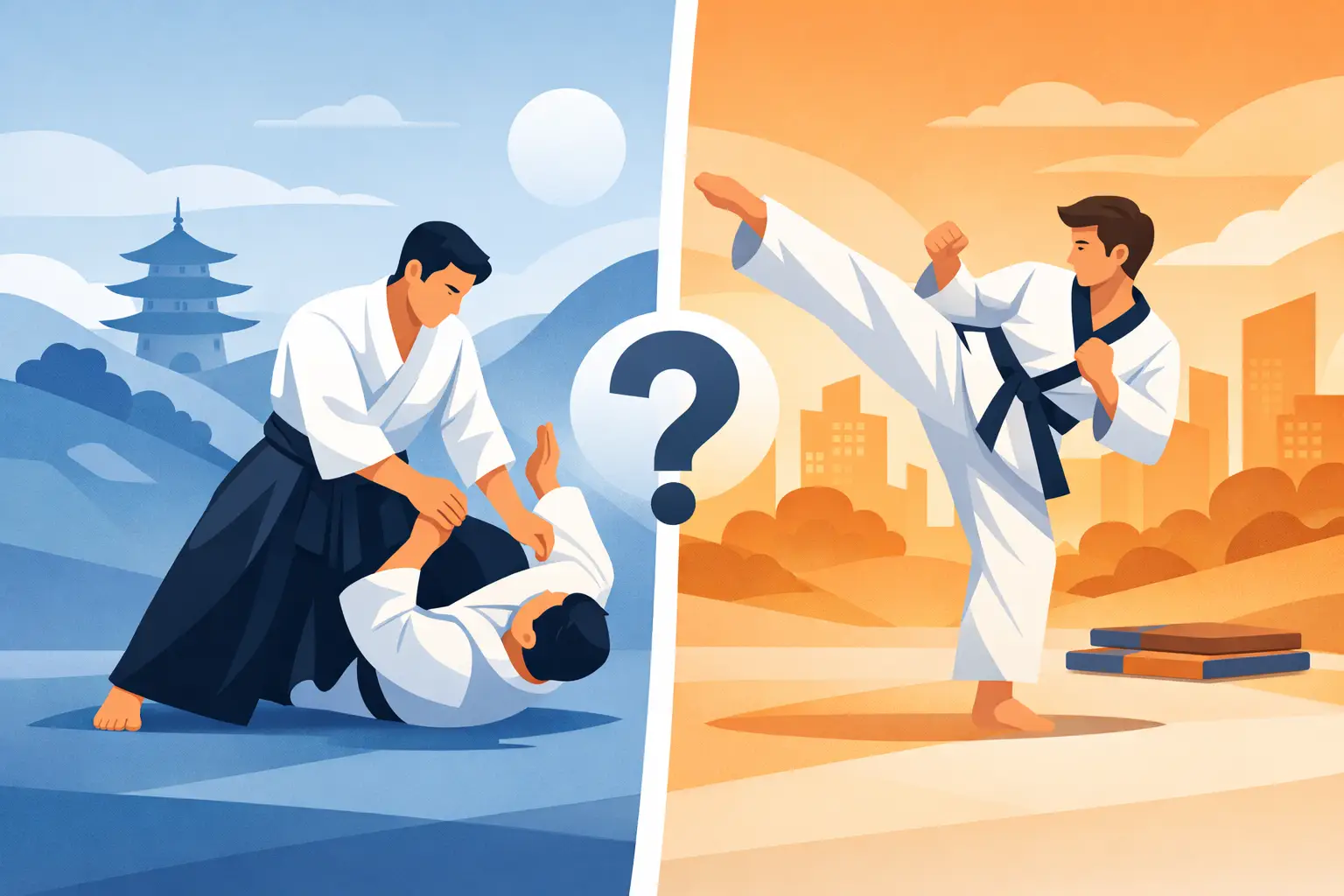
But the more important difference goes deeper than technique. For someone considering Aikido or Taekwondo for beginners, it is worth understanding the different philosophies behind the way these arts are practised.
Sport Martial Arts and Aikido: A Different Purpose
Modern Taekwondo has a strong sporting component. Competition provides an opponent, rules, a referee and a clear objective. Competitors test their skills against one another and attempt to win within an established set of rules. Karate and Judo also commonly provide competitive formats, although individual schools and styles vary considerably in how much emphasis they place on competition.
There is nothing inherently wrong with sport. Sports are an important part of our society and can develop athleticism, determination, discipline and sportsmanship. For someone who enjoys testing themselves against an opponent and working toward tournaments and competitive achievement, that environment can be very rewarding.
Traditional Aikido approaches martial training from a different perspective.
An Aikidoka - an Aikido practitioner - does not train to defeat a classmate for a trophy. There is no opponent to beat and no championship to win. The person standing across from you is your training partner. They are helping you improve, and you have a responsibility for their safety just as they have a responsibility for yours.
In Aikido, the Competition Is Within
The absence of tournaments does not mean there is no competition in Aikido. The competition is with yourself.
A principle associated with Aikido founder Morihei Ueshiba is Masakatsu Agatsu Katsuhayabi, often expressed in English as “true victory is self-victory achieved with swiftness.”
This idea reaches directly into the purpose of Aikido training. The enemy that ultimately must be overcome lies within ourselves.
Can you overcome fear? Can you control anger? Can you put ego aside? Can you remain relaxed when another person applies pressure? Can you resist the instinct to meet aggression with more aggression? Can you become more capable without developing a greater need to prove that capability to someone else?
Here lies the competition in Aikido.
Progress is therefore not measured by defeating another student. It is measured against the person you were yesterday. Technique improves, balance improves and physical ability improves, but composure, judgement, awareness and self-control should develop along with them.
What Happens When There Is No Referee?
There is another important distinction between competitive fighting and actual physical confrontation.
Sport requires rules and regulations to protect its participants. A referee can stop a match. Certain techniques can be prohibited. Competitors can be separated when necessary, and a match can end before a situation becomes dangerously out of control.
Real conflict offers none of those guarantees.
There may be no referee to step between two people, no agreement about which techniques are permitted and no one to declare that the encounter is over. Once an actual confrontation becomes physical, the consequences can extend far beyond determining who won or lost.
This is why martial ability should carry responsibility with it. Fighting should be a last resort and should never be taken lightly. Whenever possible, awareness, avoidance, de-escalation and walking away are better choices than proving what you can do physically.
Knowing how to fight should not create a desire to fight.
What Does a Taekwondo Beginner Learn?
Taekwondo gives beginners a very direct physical challenge. Students typically work on stances, blocks, punches, combinations and especially kicks. Training can develop leg strength, balance, flexibility, coordination, speed and cardiovascular fitness.
Progress can also be highly visible. A kick becomes higher, a combination becomes faster, a movement becomes sharper and a student advances through the ranking system. For children and adults who enjoy athletic challenges, this can provide strong motivation.
Many Taekwondo schools also provide opportunities for sparring and competition. For the student who wants that experience, tournaments can provide goals and an opportunity to test skills against other competitors under controlled conditions.
A responsible Taekwondo school should introduce these skills progressively. Beginners should learn control before power and should not be pressured to kick beyond their physical ability or flexibility.
What Does an Aikido Beginner Learn?
Aikido begins from a different starting point. Rather than learning how to score against an opponent, the beginner starts developing posture, distance, timing, balance, awareness and controlled movement with a partner.
Students learn to move off the line of an attack rather than simply meeting force with force. As their training develops, they learn throws, joint controls, immobilisations and methods of redirecting another person's movement while maintaining their own balance.
One of the most important beginner skills is ukemi - learning how to safely receive technique, fall and roll. Before students can practise more advanced techniques safely, they need to know how to protect themselves when their balance is taken.
This creates a cooperative relationship between training partners. One person attacks so the other can practise the technique. Then the roles reverse. Both people are learning, and neither needs the other person to lose in order to improve.
Which Is Better for Self-Defense?
Self-defense should never be reduced to a collection of impressive techniques. Good self-defense begins before punches, kicks, throws or joint controls are necessary.
Awareness, judgement, distance, verbal boundaries, de-escalation and knowing when to leave can prevent a physical confrontation altogether. That should always be considered a successful outcome.
Taekwondo can develop striking skills, timing, distance and the ability to move decisively. Aikido develops movement, balance, control and responses to attacks that may include grabs, pushes and strikes.
But neither art should give a beginner the false impression that several months of training makes someone invulnerable. Martial ability takes years to develop, and actual confrontations are unpredictable.
The more capable a martial artist becomes, the more important judgement and restraint become.
Competition or Cooperation?
This may ultimately be the most useful question for a beginner deciding between Taekwondo and Aikido.
Does the student enjoy competition? Do tournaments, opponents, scores and the opportunity to test athletic skills against another person provide motivation? If so, a good Taekwondo school may be an excellent fit.
Or does the student prefer an environment where improvement is measured primarily against themselves?
Traditional Aikido is non-competitive. Students still advance through ranks and are challenged physically and mentally, but another student's failure is not required for their success.
This can be particularly valuable for children who do not enjoy competitive sports, as well as adults who want a martial practice they can continue for many years without tournaments becoming the focus of their training.
Which Is Better for Children?
For parents, the personality of the child may be more important than deciding which martial art is theoretically better.
Some children love competition. They enjoy keeping score, preparing for events and testing themselves against other children. A structured competitive martial art can provide an appropriate outlet for that personality when it is taught responsibly.
Other children do not respond well to constant comparison. They may be less athletic, smaller than their classmates, uncomfortable with competitive environments or simply more interested in learning than winning.
Aikido allows these students to develop without requiring them to defeat another child. They can work on balance, coordination, listening, awareness and self-control while learning progressively more challenging martial techniques.
For a young beginner, particularly a four-, five- or six-year-old, learning to listen, move safely, cooperate with others and become comfortable in the dojo is far more important than producing impressive techniques.
Safety Matters in Either Martial Art
The name of the martial art does not guarantee the quality of the instruction.
A good Taekwondo instructor should introduce kicking, contact and sparring progressively and supervise students carefully. A good Aikido instructor should teach falling progressively, adjust techniques for age and ability, and make certain experienced students understand their responsibility when training with beginners.
Watch a class before choosing a school. Pay particular attention to how the instructor treats the newest and least experienced student in the room.
Are beginners corrected patiently? Are students matched appropriately? Are advanced students careful with less experienced partners? Is discipline maintained without intimidation? Do students appear focused but comfortable?
Those observations may tell you more about a school than its trophies, belt colours or advertising.
Aikido or Taekwondo for Beginners: Which Fits?
Choose Taekwondo if kicking, striking, athletic development and the possibility of competition genuinely appeal to you or your child.
Consider Aikido if you are looking for a traditional, non-competitive martial art centred on balance, awareness, control, partner training and the continuing challenge of improving yourself rather than defeating someone else.
Neither decision needs to be made from a website.
Visit the school. Watch the instructor. Observe the students. Most importantly, experience a class.
For families and adults in Fremont, Newark, Union City and surrounding communities, Tri City Aikido offers a free introductory class so beginners can experience traditional Aikido before deciding whether it is right for them.
After more than 30 years of teaching Aikido, I believe one of the most important lessons a martial artist can learn is that developing the ability to hurt someone does not give us a reason to do so. Greater ability should bring greater control.
Masakatsu Agatsu Katsuhayabi.
True victory begins with victory over yourself.