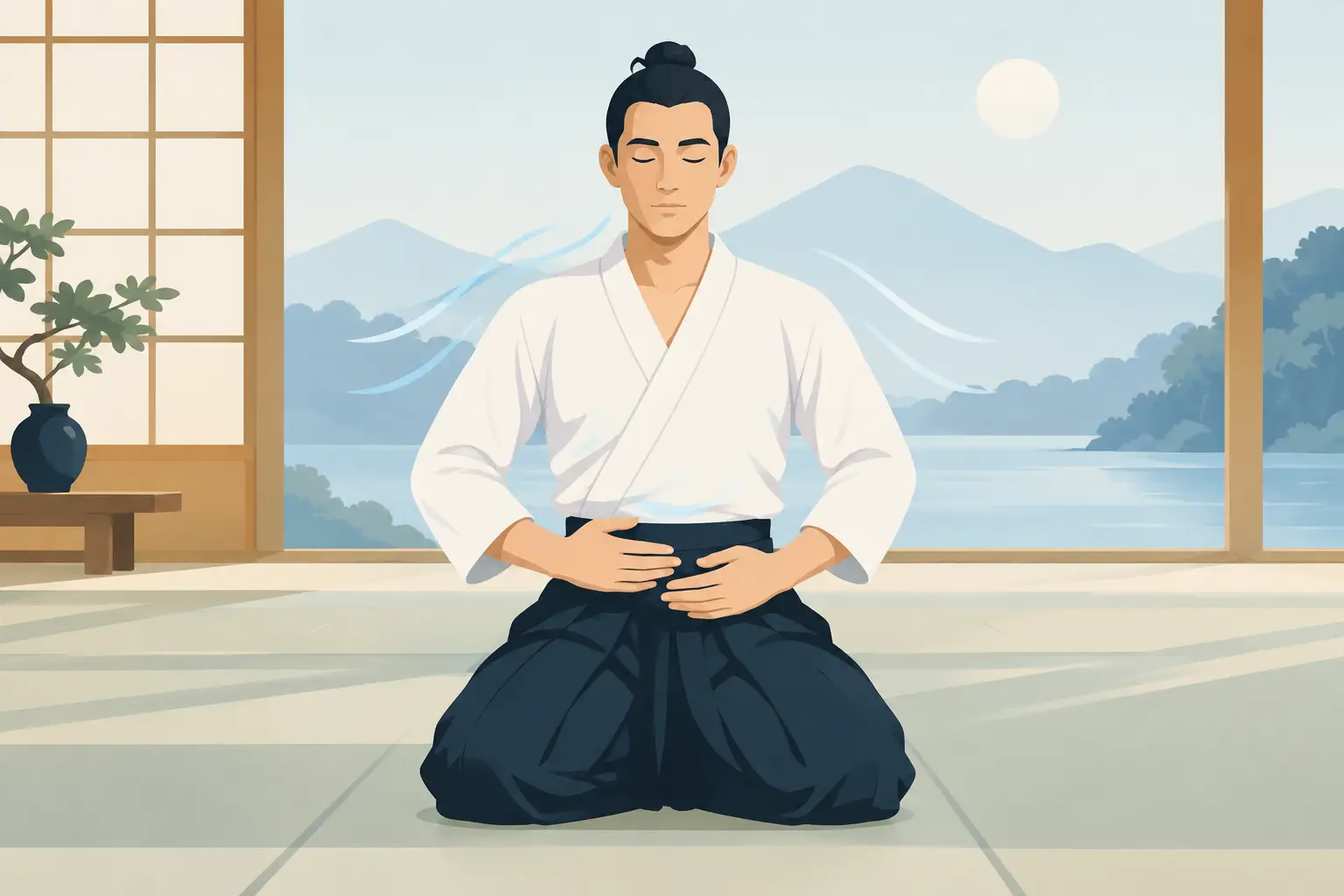
That is where breathing, timing, movement and kokyu begin to come together. These qualities are difficult to understand by standing alone and taking deep breaths. They have to be experienced against another person.
Is Kokyu Really Just Breathing?
In Aikido, kokyu is frequently associated with breath or “breath power.” That description has some value, but it can also leave a beginner with the impression that breathing itself somehow generates an Aikido technique.
There is another way to understand it.
Look at movement in terms of expansion and contraction. The universe itself is in a constant state of expansion and contraction, and we can observe the same principle in ordinary human movement. An attacker entering your space is expanding toward you. A person withdrawing, recoiling or recovering from an action is contracting.
A properly trained Aikidoist learns to recognize those changes. When someone expands into your space with an attack, you may enter, yield or turn. As that movement changes and the attacker contracts, another opportunity for entry, positioning or technique can appear.
From this perspective, kokyu is about much more than the physical act of breathing. It involves the ability to detect what the attacker is doing and move at the appropriate moment. Timing and body position allow the practitioner to avoid unnecessary collision with force.
What Happens to Breathing Under Pressure?
There is still a very practical reason breathing matters. Many beginners unconsciously restrict their breathing as soon as another person grabs, pushes or pressures them. Stress causes the shoulders to rise, the hands to tighten and the body to become rigid. Once that happens, movement becomes more difficult and energy is wasted.
Breathing normally is something the body handles remarkably well without much conscious thought. Under pressure, however, fear and tension can interfere with that natural process. This is one reason learning to remain composed while someone is physically challenging your balance is so different from practising relaxation alone.
A calm body can move more smoothly and use less energy. Smoother movement can also be faster and more efficient when it matters. Instead of exhausting yourself by fighting every bit of pressure, you begin learning how to move with better timing, positioning and economy.
Why You Need a Partner to Understand It
You can certainly practise posture and relaxed breathing at home. What you cannot easily reproduce is another human being.
A training partner changes direction. Pressure increases and decreases. Balance shifts. Distance changes. One person may be taller, shorter, stronger, quicker or more rigid than another. Those differences give the Aikido student something real to read and respond to.
This is also why simply memorizing the steps of a technique is not enough. Two people can perform what appears to be the same movement while experiencing completely different timing. The student has to learn when to enter, when to turn, when to yield and when an opening has actually presented itself.
That understanding develops through repeated partner practice and guidance from an instructor who can see things the student may not yet feel.
Calm Does Not Mean Passive
Relaxation in Aikido should not be confused with becoming limp or passive. Good posture still requires structure. Movement still requires intention. The goal is to remove unnecessary tension without giving up the ability to move immediately.
This becomes particularly important when pressure increases. A beginner may instinctively try harder, tighten the arms and use more muscular strength. With training, the response can become very different: maintain posture, continue breathing, recognize the direction of the attack and move.
For children, this provides a practical lesson in remaining composed when something does not go exactly as expected. For adults, it creates an opportunity to discover how differently the body can perform when tension is replaced by timing and efficient movement.
Breathing Is Something You Can Practice. Kokyu Is Something You Have to Feel.
You can sit quietly at home and concentrate on your breathing. You can work on posture. You can even practise basic foot movements once they have been properly taught. Those things have value.
But another person provides the missing ingredient.
At Tri City Aikido, students learn through cooperative partner training where pressure, movement, balance and timing can actually be experienced. An instructor can then make the small corrections in posture, distance and movement that are almost impossible for a beginner to diagnose alone.
If you have wondered what Aikido feels like rather than simply what it looks like, a free introductory class at Tri City Aikido is an opportunity to experience it firsthand. You may discover that the most interesting part of Aikido breathing has very little to do with taking a deep breath.