
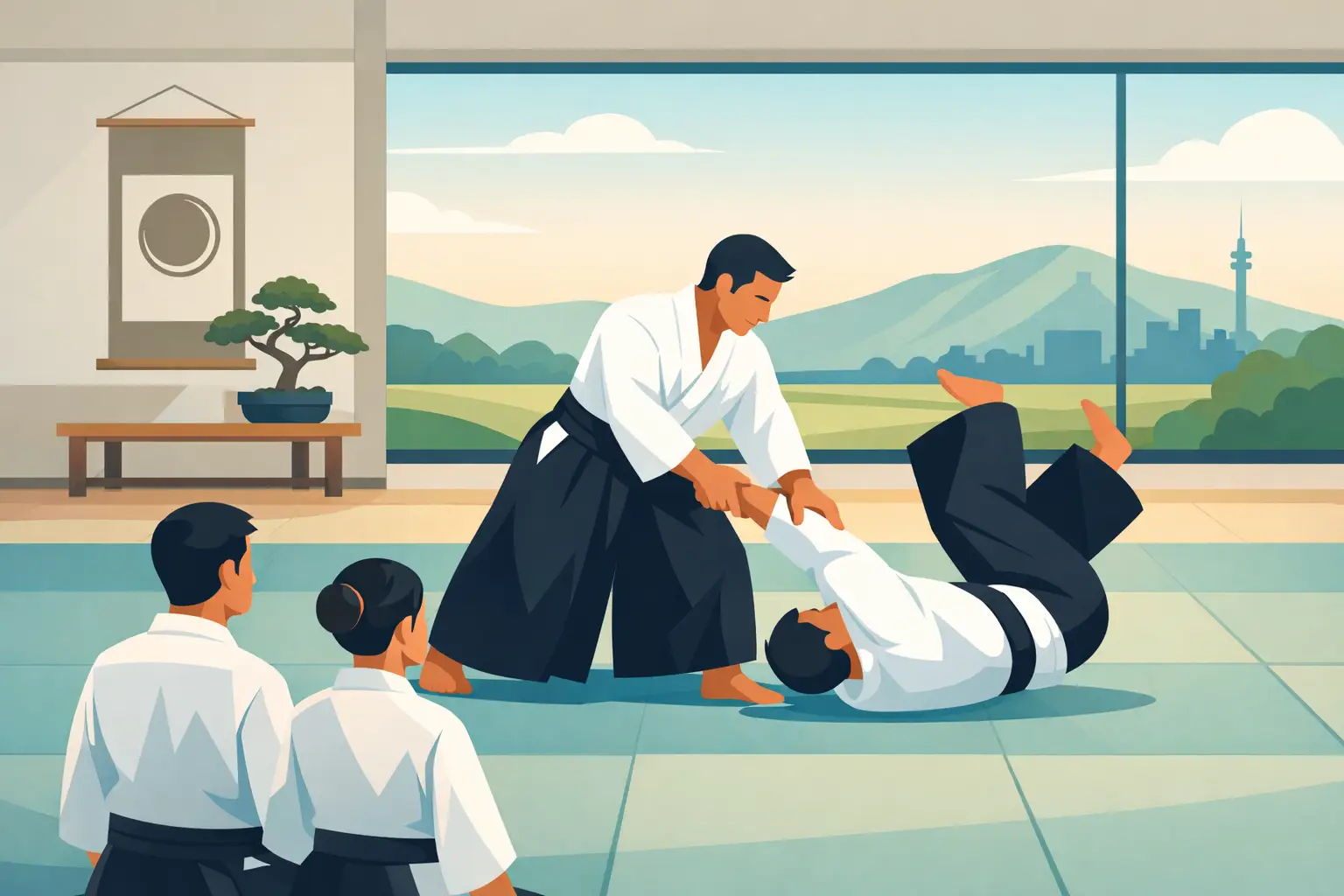
Aikido is a traditional Japanese martial art built around balance, timing, body movement and controlled technique. Rather than treating training as a contest of strength, students learn to meet force calmly, move safely and apply techniques with care for their training partner. That approach can make Aikido particularly appealing to adults beginning later in life, children learning self-control and experienced martial artists seeking a non-competitive practice with depth.
What beginners learn in an Aikido class in Fremont
Your first classes will not begin with dramatic throws or difficult joint controls. They begin with the foundations that make every later technique safer and more effective: posture, awareness, distance, footwork and respectful partner practice.
A typical class opens with formal etiquette. Students bow when entering the training space, line up and follow the instructor's direction. This is not theater or unnecessary rigidity. Clear dojo practice helps create an environment where people of different ages and abilities can train attentively and safely together. You do not need to know the customs in advance. A good instructor will show you what to do and explain the reason behind it.
Warm-ups prepare the body for movement. From there, beginners often work on basic stance and movement patterns before learning how to receive a technique safely. Aikido is learned with partners, so both roles matter. One student may practice the movement of a technique while the other gives a controlled, appropriate attack and learns how to respond safely.
Early practice can include simple wrist releases, entering and turning movements, pins and introductory throws. Techniques are taught gradually. The aim is not to make a movement look impressive but to understand where your feet, hands, center and attention should be. Repetition has a purpose: it develops calm coordination and more dependable movement.
Safe falling and rolling come before bigger techniques
One of the most valuable skills in Aikido is ukemi, the practice of receiving technique safely through falling and rolling. New students often worry about this before they attend. The reassuring reality is that safe falling is taught in stages.
You may start close to the mat, learning how to protect the head, position the body appropriately and receive contact with the mat safely. Forward and backward rolls are introduced at a pace suited to the student. Children, adults returning after time away from exercise and mature beginners may progress differently. That is expected.
Safe ukemi supports more than Aikido technique. It develops body awareness and helps students remain calmer when their balance changes. It should never be forced. A responsible dojo adapts practice where needed, especially for students managing injuries, reduced mobility or concerns about impact.
What to wear and bring to your first class
For a free introductory class, comfortable exercise clothing is enough. Choose a T-shirt and sweatpants, athletic pants or leggings that allow you to bend, kneel and raise your arms comfortably. Avoid clothing with zippers, hard buttons or jewelry that could catch during partner work. Training is normally barefoot, so shoes are left off the mat.
If you continue, you will usually train in a traditional gi. The uniform is practical, durable and part of the shared discipline of the dojo. There is no need to purchase specialized equipment before you know that the class is right for you.
Arrive early, especially for your first visit. At Tri City Aikido, we recommend arriving about 15 minutes before your introductory class. This gives you time to meet the instructor, ask questions and become familiar with the dojo before training begins.
Tell the instructor about relevant injuries, physical limitations or concerns about falling before class. This helps the instructor understand how to introduce the training appropriately. Aikido should provide a meaningful physical challenge while allowing beginners to progress sensibly.
Is Aikido suitable if you are not athletic?
Yes. You do not need to be athletic before beginning Aikido. Many people start because they want to become more active while learning a traditional martial art. Aikido can develop mobility, coordination, posture, stamina and confidence over time, but the benefits come through regular practice rather than arriving with those abilities already developed.
Being strong can help in some situations, but strength alone does not replace timing or good mechanics. A smaller person can learn to move more effectively; a strong person can learn not to rely entirely on force. Both lessons are important in Aikido.
There are practical limits. If you have a recent injury, significant balance difficulty or a health condition that affects exercise, seek appropriate professional guidance and tell the dojo before training. Some movements may need modification. The right class welcomes that conversation rather than asking students to ignore pain or push through uncertainty.
Aikido for children, teens and adults
Children do not train in exactly the same way as adults. A well-structured children's class uses age-appropriate exercises to develop listening, coordination, boundaries and respectful interaction. For younger children, progress may look like learning to line up, follow instructions, practice a safe roll or remain focused for a little longer. Those are meaningful achievements.
Tri City Aikido begins children's instruction at age 4, with classes organized by age so younger students can learn at an appropriate pace. As children grow, they can take on more detailed techniques, greater partner responsibility and more advanced training.
Teenagers can benefit from Aikido's combination of physical challenge and calm discipline, particularly when they want a martial art without the pressure of competition.
Adults bring different goals. Some want practical self-defense awareness, some want to return to training after years away and others simply want a serious physical practice with a supportive community. A beginner in their forties or fifties does not need to train as though they are twenty. Careful instruction, regular attendance and sensible pacing are more useful than trying to prove something in the first month.
Understanding self-defense in Aikido
Aikido offers practical lessons in awareness, distance, balance and staying composed when someone applies pressure. Students learn how grips, pushes and strikes affect posture and how movement and positioning can be used rather than simply meeting force head-on. Joint controls, immobilizations and throws are practiced as technical responses, with control and safety at the center of training.
That said, no martial art class can promise a simple answer to every real-world situation. Genuine self-protection begins with awareness, judgment and avoiding danger where possible. Physical technique is one part of a wider skill set. Training should increase confidence without encouraging overconfidence.
Aikido also differs from combat sports because its central purpose is not winning a match. Students can still work hard, test their concentration and develop capable movement, but progress is measured through refinement over time rather than defeating a classmate.
How progression and rank work
Beginners often ask how quickly they can earn a black belt. The honest answer is that it takes years of sustained training. Rank can mark development, but it is not the purpose of practice. Before reaching advanced levels, students need dependable basics: safe ukemi, focused attention, sound posture, appropriate etiquette and the ability to train responsibly with others.
Progression in traditional Aikido takes place gradually through kyu ranks before black belt, or dan rank. Advancement reflects continued technical development and understanding rather than simply the amount of time that has passed. The fundamentals learned as a beginner remain important throughout a student's training.
At Tri City Aikido, instruction is led by Anthony Campagna Sensei, 5th Dan Aikikai, with a direct connection to Kumano Juku in Shingu, Japan. For a beginner, that heritage means training is rooted in an established tradition and taught as an ongoing practice rather than a collection of isolated moves.
Getting the most from your first few months
The most successful beginners are rarely those who learn fastest in week one. They are usually the people who attend regularly, ask sensible questions and accept that unfamiliar movement takes time. Try not to judge a class only by whether you can remember every technique. Notice whether you are becoming more comfortable on the mat, more aware of your posture and more able to relax while learning.
Train with consideration. Aikido depends on mutual practice, so your partner's safety is part of your responsibility from the first lesson. Listen closely, use controlled energy and do not compete with people who have trained longer. If something hurts or feels unclear, stop and ask.
A free introductory class gives you a far better sense of Aikido than watching from the side. Come prepared to learn slowly, move respectfully and see whether the rhythm of traditional dojo training feels like a good fit for you or your child.