Logo
  • Home
  • Classes
    • Adult Aikido Classes
    • Aikido for ages 10-13
    • Aikido for Children ages 7-9
    • Beginner kids Aikido (ages 4-6)
    • The Purpose of Weapons Training in Aikido
    • Aikido Seminars
  • Instructors
    • Anthony Campagna Sensei
    • Mitsuo Tasaka Shihan
    • Aikido lineage
  • Get Started
  • Knowledge Center
    • Can Seniors Learn Aikido?
    • Is Aikido Good for Women?
    • What Should I Wear to My First Aikido Class?
    • What Makes a Traditional Dojo Different?
    • How Long Does It Take to Earn a Black Belt in Aikido?
  • Resources
    • About Tri City Aikido
    • Aikido Glossary
    • Communities We Serve | Tri City Aikido Fremont
    • Dojo Links
    • Reviews | Read or Write
    • Privacy Policy
    • Sitemap
  1. You are here:  
  2. Home
  3. Resources
  4. Communities We Serve | Tri City Aikido Fremont

About Tri City Aikido

Tri City Aikido is a traditional Japanese martial arts dojo located at 37427 Fremont Blvd., Fremont, California 94536. Founded in April 1996, the dojo has provided continuous Aikido instruction to adults and children in the Fremont, Newark, Union City, Hayward, Milpitas, and surrounding communities for 30 years.

Our purpose is to preserve and teach authentic Aikido in a respectful, welcoming, and non-competitive environment. Students learn practical martial arts skills while developing balance, awareness, coordination, discipline, confidence, and consideration for others.

Thirty Years of Aikido in the Tri-City Area

Tri City Aikido was established in 1996 by Anthony Campagna Sensei. For three continuous decades, Campagna Sensei has led the dojo and personally taught its classes, building one of the longest-established Aikido programs in the Fremont area.

The dojo was originally located in Newark before moving approximately one mile to its present Fremont location. Although the address changed, the school continues to serve the same Tri-City community of Fremont, Newark, and Union City, along with students traveling from Hayward, Milpitas, San Jose, and other nearby cities.

Our history is not defined simply by how long the school has existed. It is defined by consistent instruction, long-term relationships, generations of students, and a commitment to maintaining the principles and training methods of traditional Aikido.

Our Chief Instructor

Anthony Campagna Sensei holds the rank of Godan, fifth-degree black belt, through the Aikikai Foundation. He began studying Aikido in 1986 and founded Tri City Aikido ten years later.

Campagna Sensei has taught Aikido continuously since opening the dojo. His martial arts experience also includes study in Shotokan karate, boxing, wrestling, Tai Chi, and Taekwondo. This broader experience contributes to his understanding of body movement, timing, structure, distance, balance, and practical application, while Aikido remains the foundation of the dojo’s curriculum.

His teaching method emphasizes learning through direct experience. Students are shown how correct posture, alignment, timing, connection, and movement affect a technique. Over time, deliberate practice becomes natural movement that can be performed without excessive conscious thought.

Learn more on the Anthony Campagna Sensei page.

Our Aikido Lineage

Tri City Aikido maintains a direct connection to the traditional teachings of Japan. The dojo is affiliated with the Kumano Jyuku dojo in Shingu, Japan, and follows instruction passed through the lineage of Morihei Ueshiba, the founder of Aikido.

An important figure in this lineage was Michio Hikitsuchi Sensei, one of Morihei Ueshiba’s close students and a recipient of tenth-dan rank. Hikitsuchi Sensei taught at Kumano Jyuku in the Kumano region of Japan.

Mitsuo Tasaka Shihan, seventh dan, continues this teaching tradition and serves as a regular visiting instructor at Tri City Aikido. His visits allow our students to receive instruction connected directly to the Kumano and Shingu approach to Aikido.

This relationship is important to our school. It helps preserve the principles, etiquette, weapons work, movement, and philosophy that have been passed down through generations of instructors.

More information is available on our Aikido Lineage and Mitsuo Tasaka Shihan pages.

What We Teach

Aikido is a Japanese martial art based on coordinated movement, balance, timing, redirection, joint control, throws, pins, and positional awareness. Instead of relying only on strength or meeting force directly with greater force, students learn how posture, movement, structure, and timing can change the outcome of an encounter.

Training at Tri City Aikido includes:

  • Empty-hand Aikido techniques
  • Throws, controls, joint locks, and pins
  • Escapes and practical self-defense applications
  • Falling, rolling, balance, and safe movement
  • Ground-related movement and positional awareness
  • Bokken, or wooden sword, training
  • Jo, or wooden staff, training
  • Tanto, or training knife, practice
  • Weapons-taking and disarming exercises
  • Traditional Japanese terminology and dojo etiquette

Weapons training is not treated as a separate performance activity. It helps students understand distance, direction, posture, timing, centerline, commitment, and the origins of many empty-hand movements.

A Non-Competitive Martial Art

Tri City Aikido does not use tournaments, trophies, or competitive sparring as the basis of training. Students work cooperatively so both partners can improve.

Cooperative training does not mean passive or unrealistic training. It allows students to study techniques safely, gradually increase speed and intensity, and understand how movement affects another person. The goal is to develop skill without creating an atmosphere driven by ego or the need to defeat classmates.

Aikido teaches students to address conflict with awareness, control, and appropriate action. The ideal result is not unnecessary injury. It is the ability to respond decisively while maintaining balance, composure, and responsibility.

Adult and Teen Aikido

Our adult program welcomes beginners as well as experienced martial artists. Students do not need previous training, exceptional flexibility, or peak physical conditioning before beginning.

Adults study the complete curriculum, including empty-hand techniques, weapons, falling, movement, joint controls, throws, and practical applications. Training can improve coordination, mobility, balance, posture, conditioning, concentration, and confidence.

Because Aikido skill depends on timing and efficient movement rather than strength alone, adults can begin in their 30s, 40s, 50s, and beyond. Students are encouraged to progress according to their own ability while continuing to challenge themselves.

Visit our Adult Aikido Classes page for additional information.

Children’s Aikido Programs

Tri City Aikido offers age-appropriate children’s programs designed to meet students at different stages of physical, emotional, and social development.

Children learn dojo etiquette, listening skills, coordination, balance, safe falling, basic Aikido movement, self-control, and respectful partner practice. Older children gradually receive more detailed technical instruction and may also study bokken and jo.

Our approach combines structure with encouragement. Students are expected to pay attention, follow directions, and treat others respectfully. At the same time, instruction is designed so cooperative students are able to learn and progress without the entire class being dominated by disciplinary interruptions.

Program information is available on the following pages:

  • Beginner Kids Aikido, Ages 4–6
  • Aikido for Children, Ages 7–9
  • Aikido for Ages 10–13

Our Teaching Philosophy

Aikido cannot be learned only by memorizing instructions or watching demonstrations. Students must experience how a technique feels when posture, timing, movement, and connection are correct.

In the beginning, students consciously think about individual details. With repetition and correction, those details become integrated. The long-term goal is for proper movement to become instinctive and available without hesitation.

This process requires patience. Progress is not measured by how quickly someone collects techniques. It is measured by improvements in movement, awareness, control, understanding, consistency, and the ability to work constructively with different training partners.

Traditional Dojo Culture

A dojo is more than a room where techniques are practiced. It is a place of study, discipline, responsibility, and mutual respect.

Students at Tri City Aikido learn traditional etiquette and terminology so they understand the culture connected to the martial art. This includes bowing, care of the training area, respect for partners, appropriate conduct, and familiarity with commonly used Japanese terms.

These traditions are not maintained merely for appearance. They create a structured environment where students can train safely, concentrate fully, and recognize their responsibility to the people around them.

Our Fremont Dojo

Tri City Aikido is located at:

Tri City Aikido
37427 Fremont Blvd.
Fremont, CA 94536
Phone: (510) 298-4222
Email: This email address is being protected from spambots. You need JavaScript enabled to view it.

The dojo is located on Fremont Boulevard, directly across from Holy Spirit Church. Its central location is convenient for students traveling from Fremont, Newark, Union City, Hayward, Milpitas, and nearby communities.

Communities We Serve

Although our physical dojo is in Fremont, students attend from communities throughout the southern East Bay and nearby South Bay.

Our primary service area includes:

  • Fremont
  • Newark
  • Union City
  • Hayward
  • Milpitas

You can learn more through our individual Cities Served pages.

Class Schedule

Adult and Teen Classes

Monday, Wednesday, and Friday: 7:00–8:30 PM
Saturday: 9:30–11:30 AM

Children Ages 4–6

Monday, Wednesday, and Friday: 5:15–6:00 PM

Children Ages 7–9

Monday, Wednesday, and Friday: 6:00–6:50 PM

Children Ages 10–13

Monday, Wednesday, and Friday: 6:00–6:50 PM

Schedules can occasionally change. Please contact the dojo before your first visit to confirm the appropriate class.

Free Trial Class

Prospective students may attend a free trial class before deciding whether to enroll. No previous martial arts experience is required.

Guests should arrive approximately 15 minutes before class so there is time for an introduction, orientation, and any necessary preparation. The trial is intended for people who are genuinely considering training and are ready to begin if the program is a good fit.

To request a trial, visit our Get Started page or call (510) 298-4222.

Official Tri City Aikido Profiles

The following are official online profiles and resources for Tri City Aikido:

  • Facebook
  • Instagram
  • YouTube
  • LinkedIn
  • Apple Maps
  • Yelp
  • Google Reviews

Begin Your Training

Tri City Aikido welcomes adults, teens, children, beginners, returning students, and experienced martial artists who are interested in studying traditional Aikido.

Whether your goals include practical self-defense, improved movement, physical activity, personal discipline, confidence, mental focus, or a deeper study of Japanese martial arts, the best way to understand the dojo is to experience a class.

Call (510) 298-4222 or visit our Get Started page to arrange your free trial class.

We respect your privacy and are committed to maintaining transparency about how this website operates.

Information Collection

This website does not collect, sell, trade, or share personal information. Visitors may browse this site without providing any personal data.

If you choose to contact us by phone or email using information provided on this website, that communication occurs outside of this website and is not stored or tracked through our site.

Cookies

This website may use basic cookies that are necessary for normal website functionality and performance. These cookies do not collect personal information and are not used for advertising, profiling, or marketing purposes.

Any cookies in use are intended solely to ensure proper website operation and a consistent user experience.

Third-Party Services

This website does not use advertising platforms, marketing pixels, or behavioral tracking technologies.

If basic website analytics are used in the future, they will be implemented solely to understand general site usage and improve functionality, without identifying individual visitors.

Data Sharing

We do not sell, rent, trade, or otherwise share personal information with third parties.

Policy Purpose

This Privacy Policy is provided to inform visitors about our practices and to align with general transparency guidelines recommended by search engines and privacy frameworks.

Updates

This policy may be updated occasionally to reflect changes in website functionality or applicable guidelines. Any updates will be posted on this page.

Contact

If you have questions regarding this Privacy Policy, please contact us using the information provided on this website.

Last updated January 2026

The Purpose of Weapons Training in Aikido

One of the questions we hear most often is, "Why do Aikido practitioners train with wooden swords and staffs if Aikido is primarily an empty-hand martial art?" The answer is simple: the principles found in Aikido's empty-hand techniques (waza) originate from traditional Japanese weapons. The bokken (wooden sword) and jo (wooden staff) are not separate disciplines—they are teachers that reveal the mechanics, timing, distancing, and movement that make Aikido effective. Although students may initially view weapons practice as something different from empty-hand training, they eventually discover that both are expressions of the same principles.

Weapons Reveal the Principles of Aikido

Aikido is often described as the art of harmony rather than collision. This principle becomes very apparent when training with the sword. Unlike what is commonly portrayed in movies, traditional Japanese swordsmanship is not based upon repeated blocking, clashing, or striking one sword against another. Every unnecessary collision creates risk. Instead, practitioners seek the safest angle that avoids the attack while creating a direct path to the opponent. Rather than opposing force with force, the practitioner moves off the line of attack, blends with the movement, and enters through an opening. These are the very same principles practiced in Aikido's empty-hand techniques. The sword simply makes those principles easier to understand.

The Importance of Angles

Success in Aikido is rarely determined by strength. Instead, it is determined by position. When the body moves to the proper angle, collision can often be avoided entirely. A slight change in footwork or body alignment can transform what appears to be a dangerous attack into an opportunity to safely enter and control the situation. Weapons training develops this understanding naturally. Students begin to recognize that efficiency comes from correct positioning rather than muscular effort. The shortest and safest path often requires less force and greater awareness.

The Concept of Shinken (Live Blade)

One of the most important concepts in traditional weapons training is Shinken, meaning "live sword" or "live blade." Although students train with a wooden sword rather than a sharpened weapon, they are encouraged to treat the bokken with the same respect they would give a real blade. This changes the student's mindset completely. The weapon is no longer viewed as a simple piece of wood. Every movement becomes intentional. Every cut has purpose. Every action carries responsibility. Students learn where the handle ends and where the blade begins. They avoid casually touching the blade portion of the bokken because it reinforces proper habits, respect, and awareness. Over time, this mindset develops discipline that carries into every aspect of Aikido practice.

The Sword Never Lies

One of the greatest teaching tools in Aikido is the bokken itself. The sword immediately exposes mistakes that may go unnoticed during empty-hand practice. If posture is poor... If distance is incorrect... If timing is off... If the hands drift away from the body's centerline... The sword reveals those mistakes immediately. In many ways, the weapon becomes an instructor. It provides constant feedback and encourages students to refine their movement until efficiency replaces unnecessary effort.

Developing Awareness of Space

Weapons training also develops an awareness that extends far beyond technique. Every practitioner must know exactly where the tip of the weapon is located throughout every movement. Equally important is maintaining awareness of training partners and the surrounding environment. Imagine raising a sword carelessly and striking a wall, a ceiling, or another student standing behind you. These situations are prevented through continuous awareness of space and respect for everyone training together. This awareness eventually becomes second nature and transfers directly into empty-hand practice.

How the Sword Improves Empty-Hand Techniques

One of the most valuable lessons taught by the bokken is proper hand movement. When practicing with the sword, the hands naturally travel vertically in front of the body along the practitioner's centerline. After enough repetition, this movement becomes part of the practitioner's natural mechanics. Without consciously thinking about it, the hands begin moving correctly during empty-hand techniques as well. Students often believe they are simply learning sword movements. In reality, they are teaching their entire body how Aikido should move. The transition from conscious effort to natural movement is one of the greatest benefits of traditional weapons practice.

More Than Learning a Weapon

At Tri City Aikido, weapons are not taught simply to learn how to use a sword or staff. They are studied because they explain the principles from which Aikido developed. The bokken and jo teach posture, distance, timing, awareness, precision, and centered movement. They help students understand why techniques work rather than simply memorizing how they look. Over time, students begin to realize that weapons practice and empty-hand practice are not separate subjects. They are two methods of studying the same art. As understanding grows, the distinction between the two gradually disappears. The principles become one, and the practitioner begins to experience Aikido as it was always intended—a unified martial art built upon awareness, efficiency, respect, and harmonious movement.

Connect Now

CALL:  1 (510) 298-4222 or TEXT (510) 468-4165

EMAIL:  This email address is being protected from spambots. You need JavaScript enabled to view it.

ADDRESS:  37427 Fremont Blvd., Fremont CA 94536

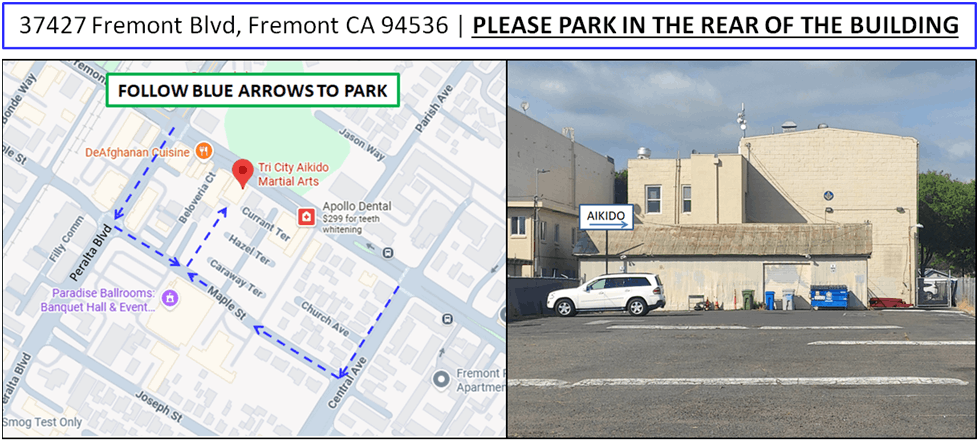
PARKING DIRECTIONS: Swing around to the rear of the building off of Maple Street. 

Tri City Aikido parking diagram illustration  

Aikido Glossary

Aikido terminology | Aikido principles | Aikido techniques

DOWNLOAD AIKIDO VOCABULARY

There is so much here for those who train in the art of Aikido. You can quickly learn the Aikido Japanese terminology, principles, philosophy and techniques of Aikido.   [creativecontactform id="2"]

Basic Pronunciation for the Japanese language

A = AArdvArk
I = pizza
U = blue
E = somewhere between Echo and table
O = bone

Never cluster the syllables when speaking.

For example; Aikido is pronounced “Eye-key-doh”

A

ai - harmony, unity, blending

aihanmi - A stance where both people have the same foot forward

aidori - Same sided wrist grab.  Attacker/Uke uses right hand to grab Nage's right wrist

aikido - A way to spend your life harmonizing energy.  Pronounced "Eye - key - doh"

aikidoka - An Aikido practitioner

Aikikai - The world headquarters of Aikido in Tokyo Japan.  More commonly know as Hombu dojo

aikiken - aikido sword practice

aikiotoshi - More commonly known as the aiki-drop technique

aikitaiso - Specific warm up exercise for Aikido practitioners

aite - an opponent, not to be confused with Uke.

arigato - Thanks

arigato gozaimasu or gozaimashita - Thank you 

ashi - Foot

atemi - A strike to no specific region of the body

B

Bo staff - longer than the jo

bokken or bokuto - Wooden training sword

bu - a state of war, battle, fight

budo - Japanese Martial arts

bugei - another term for martial arts or battle art

bushi - warrior

bushido - the way of the warrior

C

chikara - force/strength

choku - direct energy

chudan or chudan no kamae - In weapons, the hands are typically positioned in the middle of a person

Chushin - center or center line

D

Daito ryu aikijutsu - "One" of the parent arts of Aikido

dan - A black belt grade in the budo arts

deshi - Aikido student

do - The "Way or Path"

dogi - Uniform better known as a gi

dojo training hall or place of enlightenment

dojo cho - Chief instructor of a dojo

doka - poem about the way

domo arigato gozaimashita - Thank you very much.  The nicest way to say thank you

dori - take or grab

dosa - movement

doshu - The leader of the Aikikai or Aikido world headquarters

dozo - please

E

embukai - a public demonstration

empi - a strike with the elbow

eri - lapel or collar

eridori - lapel grab

F

fukushidoin - a qualified teaching instructor


funakogi - The rowing exercise in the Shin kokyu practice.  Sometimes referred as torifune

G

gaeshi -  A returning of the force

gamae/kamae - A martial stance or on-guard

gasshuku - Seminar 

gedan - A reference used in weapons where the hands and weapons are positioned low

geri - a kick.  Nonspecific

gi - Uniform

giri/kiri - a sword or knife cut

go - 5 

gokyo - The fifth principle teaching in Aikido

gomen nasai - I am sorry.  Apologetic.  

gyaku - the reverse or opposite.  Usually describing the feet in a stance.

H

hachi - 8 

hai - yes.  Usually, there is enthusiasm/ positive tone when agreeing with someone.   

hajime - to begin

hakama - traditional Japanese wide pants typically worn by yudansha

hanmi handachi - A starting position between 2 practitioners: 1 standing while the other is on his knees or where 1 person is half the stance of the other

happo - eight directions, compare shiho

hara - A place located a few inches below the navel.  The place where your ki is greatest.  

harai - Usually a foot sweep

henka waza - The ability to change techniques when engaged with an attacker

hidari - left 

hiji - elbow

hijidori - elbow grab

hiza - knee

Hombu dojo - headquarters for the Aikikai Aikido association in Tokyo

I

ichi - 1

ichiban - first or best

iie - no

ikkyo - The first principle of Aikido

irimi - to enter or move forward

iriminage - classic entering throw used in Aikido

Iwama - A place in Japan, where O'sensei had a dojo and a home

J

jiyu waza - free form sparring with 1 person

jo - the short staff

jodan no kamae- A position in weaponry where the high hands or weapons is high

jodan tsuki - a strike to the head

jodori - the taking of the short staff from an attacker

ju - 10 it also means "Soft" as in ju jitsu

juji nage - a throw in Aikido where the forearm take on the character for 10 (+)

K

kaeshi - same as gaeshi returning, reverse

kaeshi waza - Reversals or counters to techniques

kai - school or club

kaiten nage - A rotary throw in Aikido

Kamae/gamae - A stance or guard position

kami - The Divine

kamiza - Usually depicting a spiritual place place in a dojo

kampai - cheers, toast

kanji -  Chinese characters or writing

kata - forms.  In Aikido, usually in weapons practice only.  

kata - the shoulder

kata dori - shoulder grab

kata dori menuchi - shoulder grab followed by a strike to the face

katame waza - pinning techniques like Ikkyo, Nikyo, Sankyo, etc...

katana - the Japanese sword, also known as a ken

katate dori - a wrist grab.  Right on left or vice versa

katate ryote dori - 2 wrists are grabbed by the Uke/attacker

keiko - training

ken -  Japanese sword

kendo - Japanese sport sword 

kesa giri - diagonal sword cut

ki - spirit, life energy

kiai - A loud sound/shout that a martial artist makes to gather or create additional internal forces for power

kihon waza - basic techniques

kime - focusing

kimusubi - tying one's ki to that of the partner

ki no nagare- the flowing energy of Aikido

kiri - to cut

kiri kaeshi - a returning cut in kenjitsu

kohai - a junior practitioner 

kokoro - heart, will or mind.  Not to be confused with the organ.

kokyu - a coordination of the mind, body and breath of the cosmos

kokyu ho - a basic seated Aikido exercise to produce a throw

kokyunage - breath throw

koshi nage - hip throw

kote - wrist

kote gaeshi - a technique where the attackers wrist is reversed back into them.  

kotodama or kototama - spiritual sounds and or words used in Japanese mysticism.  

ku or kyu- 9

kubi - neck

kubishime - neck choke

kuzushi - a principle used in Aikido.  The off setting of one's balance that precedes technique.  

kyu - a non black belt grade

M

ma-ai - The understanding of space between 2 people

mae - front or forward

mae geri - front kick

maru - circle

mawashi geri - roundhouse kick

me - eye

men - the head

migi - right 

misogi - the purification or cleansing process practiced in Aikido

mochi - to grip

mokuso - meditation

morote dori -  when attacker grabs an arm with both hands.  Much like that of holding a baseball bat.  

mushin - a very advanced place where the mind is empty of thought

mudansha - a non-black belt practitioner of Aikido.  Still in the kyu grade system.  

mune - middle area of the body.  Usually the abdomen

mune dori - same as eri dori

musubi - to bring together.  This can be used in many different contexts.

N

nage - the person receiving the attack in practice

nana - 7 also pronounced shichi

ni - 2 

Nihon - the Japanese language

nikyo - the second principle of Aikido.  A pinning technique

ninin dori - two attackers who grab

Nippon - Japan

O

o - big or great

obi - belt

ocha - tea

omote - the front 

onegai shimasu - a very polite way of requesting something.  Will you train with me?

o' sensei - Morihei Ueshiba known as the great teacher

R

randori - multiple attackers

rei - to bow

ritsurei - a standing bow

rokkyo - the sixth principle in Aikido.  An elbow pin

roku - 6 

ryo - both

ryote dori - gripping both wrists

S

sabaki - the moving or action of something

samurai - Japanese warrior class

san - 3 

sankakutai - a triangle shape stance not used in our dojo

sankyo - the third principle in Aikido.  A wrist joint lock technique

sannin dori - a 3 person attack where they initially grab

satori - enlightenment in zen

seichusen - Centerline

seiza - the kneeling seated position

sempai - a senior student

sen no sen - The ability to perceive the attackers intent to harm and respond instantly, neutralizing the action as it begins.  In short, the attackers intention becomes action, triggering a simultaneous move.

sensei - teacher

shi - 4 or yon

shichi - 7 or nana

shidoin - instructor, middle title for aikido teacher, 4-5 dan, compare fukushidoin and shihan

shihan - Master instructor

shiho nage - four directional throw technique

shikaku - a place where the attacker finds themselves without advantage

shiki - courage

shikko - knee walking

shime - choke

shin - heart, will or mind

shinai - a bamboo sword

shinken - a principle used in Aikido that pertains to the sharpness of the Japanese sword intended to elevate the mental alertness of the practioner.  

shinto - the way of the gods, Japanese religion

shisei - a principle practice that corrects posture both physically and energetically.  Without proper shisei, you cannot truly advance.   

shizentai - a natural body posture.  The starting place for Aikido training

shodan - first grade or dan in black belt ranking

shodo - calligraphy

shomen - front or head piece of the dojo

shomen ni rei - bow to head place of the dojo

shomenuchi - a vertical cut with a sword or blow to head

shu ha ri - The 3 stages of learning; Mimic, engrain and then let go or forget 

soto - outside or side

sumi - corner

sumimasen - excuse me

suri ashi - gliding or sliding of the feet on the ground

sutemiwaza - sacrifice throws where one will lose one's own balance to throw another

suwari waza - seated training

T

tachidori - Sword taking practice or technique

tachi waza - training standing up

tai - body

tai no henko - body changing and blending practice

tai sabaki - to move the body in aikido

taiso - exercises

takemusu aiki - improvised demonstration of technique.  Without premeditated thought, the creative spirit of aikido takes over.  

tameshi - test

tanden - same as hara

tanto - Japanese knife

tantodori - defense against knife

tao/dao - same as "Do" or path, way

tatami - practice mats originally made of bound straw

te - hand

tegatana - hand blade

tekubi - wrist

tenchinage - heaven & earth throw

tenkan - to turn, change or transform

toitsu ryoku - unified power

tsuba - sword guard

tsuka - sword hilt

tsuki - to strike, with a weapon or empty hand.  This also means, "Openings" or vulnerability.

tsunagu - to connect

U

uchi - to hit

uchikomi - to hit repeatedly

uke - the attacker in aikido

ukemi - the art of falling

ura - the backside or rearward action

ushiro - behind or rear

ushiro geri - backward kick

ushiro ukemi - backward fall

ushiro waza - attacks from behind

W

waki o shimeru - the closing of the armpits

wakizashi - short sword

waza - technique

Y

yamei - stop

yari - spear

yoko - side, sideways, horizontal

yoko geri - side kick

yoko giri - horizontal cut

yokomen uchi - strike to the side of the head with the hand blade

yonkyo - the fourth principle in Aikido.  A pressure point pinning technique

yudansha - Black belt status

Z

za - seated, sit

zanshin - unbroken concentration 

zazen - sitting meditation, also called mokuso

zen - a form of Buddhism

zori - sandals

Numbers & Counting

1 ichi

2 ni

3 san

4 shi / yon

5 go

6 roku

7 shichi / nana

8 hachi

9 ku

10 ju, 11 ju ichi, 12 ju ni, 13 ju san

20 niju, 21 niju ichi, 22 niju ni, 23 niju san

30 san ju

40 yon ju

50 go ju

100 hyaku, 200 nihyaku, 300 sanbyaku, 400 yonhyaku, 500 gohyaku 

1000 sen, 2000 nisen, 3000 sanzen, 4000 yonsen, 5000 gosen 
  1. Get Started
  2. Aikido lineage
  3. Mitsuo Tasaka Shihan
  4. Dojo Links

Page 1 of 2

  • 1
  • 2
37427 Fremont Blvd. Fremont CA 94536
(510) 298-4222
Contact Us Today!

Copyright 2026- Jump On It, Inc